
Key points
- Nominee companies are middlemen in corporate ownership: They hold shares in name only, masking the identity of the actual owners.
- In Australia, companies with ownership obscured through nominee structures account for 23 million tonnes of fossil fuel CO2 emissions every year — about 18% of the national total.
- Almost all of the Australian nominee companies in GEM’s dataset are branches of the world’s largest banks, including Citibank, HSBC, JPMorgan, Merrill Lynch, BNP Paribas, and UBS.
- They appear as shareholders in at least 25 Australian publicly listed energy firms and are tied to 50+ fossil fuel projects.
- With no rules on nominee companies, fossil fuel backers can profit while staying hidden from public scrutiny.
Nearly 18% of Australia’s fossil fuel emissions are tied to companies whose ownership is hidden through nominee structures, according to a new report from Global Energy Monitor.
Nominee companies are middlemen in corporate ownership: They hold shares in name only, masking the identity of the actual owners. They are paid to be listed as a shareholder of a company, even though they don’t actually own those shares. This makes it incredibly difficult to pinpoint who is the actual shareholder. When companies investing in fossil fuels use nominee companies, it can help obscure their stake in the asset.
Over 22 million tonnes of Australia’s annual CO2 emissions come from fossil fuel assets whose ownership is hidden through just three nominee companies: JPMorgan Nominees Australia Pty Ltd, Citicorp Nominees Pty Ltd, and HSBC Custody Nominees (Australia) Ltd. This is roughly equal to the annual CO2 emissions of one half of all Australian households.
An illustration of how nominee structures obscure ownership is Origin Energy Limited, one of Australia’s largest energy companies and carbon emitters. Over two-thirds of the company’s shares are listed as being owned by three companies: the nominee affiliates of JPMorgan Bank, HSBC Bank, and Citibank. However, these banks are not the actual owners of the shares.
Australian regulations allow nominee companies to be listed instead of the actual shareholders, resulting in obscured ownership. This obscured ownership structure isn’t unique to Origin Energy; nominee companies are listed as shareholders for dozens of publicly traded Australian energy companies.
GEM’s Global Energy Ownership Tracker, a novel dataset of asset-level energy ownership chains, has surveyed the connection of Australian nominee companies to domestic coal plants, coal mines, and oil and gas plants in a first of its kind analysis. (For more information on the methodology used in the analysis, see here.)
What are nominee companies and how do they hide ownership?
Nominee companies hold shares in a company on behalf of another entity. Nominee shareholders are used to fulfill local jurisdictional requirements, expedite administrative responsibilities, and maintain privacy. But in practice, the structure obscures the actual ownership.
Nominee companies are paid by the actual shareholder (also known as the “nominator”) to put their name as the shareholder instead of the actual owner.
Through the use of nominee shareholder services, a nominee company appears as the shareholder of a company on business registries, annual reports, and public sources, despite not actually owning shareholding in the company/asset.
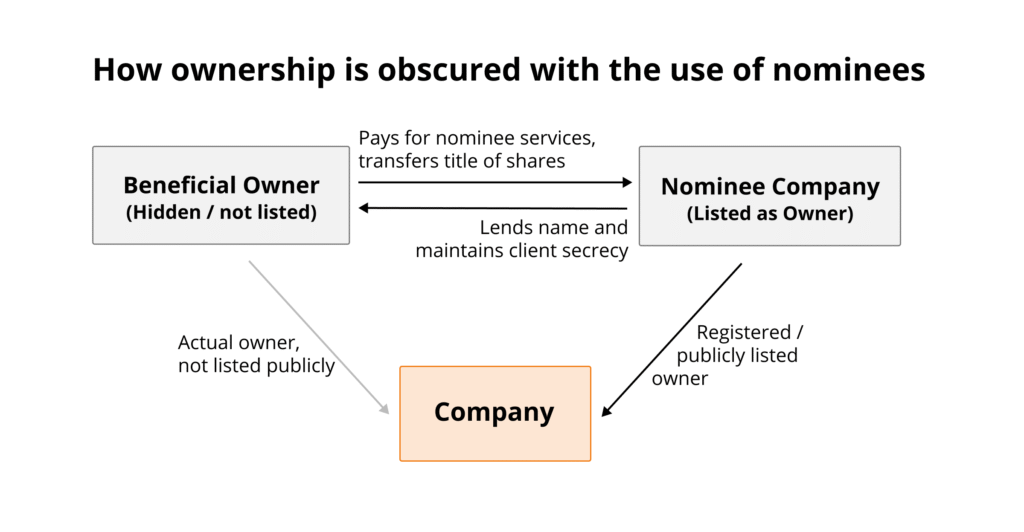
Figure 1: Nominee Shareholder Structure
In some jurisdictions, such as Australia, nominee companies have no legal requirement to disclose on whose behalf they are holding the shares. Under Australian law, nominee shareholders can be paid to be listed as a shareholder in both public and privately held companies, allowing fossil fuels investors to keep their identity hidden.
For shareholding in public companies, nominee shareholders have no legal requirement to disclose their status as nominee shareholders or to disclose the actual shareholder behind the shareholding.
For proprietary companies, nominee shareholders are required to disclose their status as nominee shareholders but are not required to disclose the actual shareholder.
In a 2022 study from the World Bank, Australia had the second-highest concentration of nominee services available, behind only Singapore.
Australian nominee companies in the Global Energy Ownership Tracker (GEOT)
GEM’s Global Energy Ownership Tracker monitors asset-level ownership chains. The dataset covers over 48,000 energy assets across nine sectors in 170 countries, providing information on more than 26,000 companies.
In a first of its kind analysis, GEM found that nearly all of the Australian nominee companies listed in the dataset are branches of the world’s largest banks, including BNP Paribas, Citibank, HSBC, JPMorgan, Merrill Lynch, and UBS.
These nominee companies are listed as shareholders for at least 25 publicly traded energy companies in Australia and are connected to over 50 fossil fuel projects.
A large percentage of shareholding in the biggest Australian energy companies are held through nominee companies. Over a third of AGL Energy’s shareholding, close to 70% of Origin Energy’s shareholding, and two-thirds of Whitehaven Coal are held through nominee companies.
Origin Energy Ltd, an Australian publicly traded energy company connected to three nominee companies, owns seven fossil fuel power plants responsible for close to 17 million tonnes of CO2 emissions/year (See Figure 2).
import {Runtime, Inspector} from "https://cdn.jsdelivr.net/npm/@observablehq/runtime@5/dist/runtime.js";
import define from "https://api.observablehq.com/d/[email protected]?v=4";
new Runtime().module(define, name => {
if (name === "obscuredOwnershipDisplay") return new Inspector(document.querySelector("#observablehq-obscuredOwnershipDisplay-60d1691b"));
});
Figure 2: Origin Energy’s Fossil Fuel Assets
Among Australian nominee companies, three companies appear more regularly as nominee shareholders: HSBC Custody Nominees (Australia) Ltd, JPMorgan Nominees Australia Pty Ltd, and Citicorp Nominees Pty Ltd.
The banks connected to these nominee companies — Citibank, HSBC Bank, and JPMorgan — have all made public climate commitments in the past, but critics have noted they have begun to roll back those pledges.
In 2021, Citibank committed to net-zero emissions in their own operations by 2030 and net-zero emissions in their investments by 2050. Despite this commitment, in 2024 Citibank left the Net Zero Banking Alliance, a coalition of banks working towards net-zero emissions by 2050. In 2024, HSBC Bank reneged on their climate goal of net-zero emissions by 2030, pushing back the target date to 2050. The same year, JPMorgan changed its climate commitments to climate “aspirations” in a letter to shareholders.
These three companies are connected to over 50 fossil fuel projects, including projects with a history of work safety and pollution concerns. Torrens Island power station, a gas plant in Australia, recently failed to comply with work safety regulations, leading to multiple workers becoming “seriously ill” from inhaling large amounts of lead. All three nominee companies are connected to the project.
Citicorp Nominees, JPMorgan Nominees, and HSBC Custody Nominees are also all connected to Loy Yang A power station, a coal plant that is one of the world’s top 50 emitters of toxic sulfur dioxide and Australia’s biggest single carbon polluter.
Additionally, the three nominee companies are connected to Eraring power station, a coal plant that made headlines in 2024 for recording an increase in five major toxic pollutants known to cause cancer and asthma, including a 130% increase in mercury pollution.
The charts below provide a deeper look into the connections of the three nominee companies to Australia’s fossil fuel assets. Figure 3 shows the percentage of Australia’s fossil fuel projects they are linked to, and Table 1 illustrates the amount of annual carbon dioxide emissions they obscure.
Interactive charts are also available in the section below: Figure 4 presents an interactive graph network mapping nominee company connections to Australian energy owners and their assets, while Table 2 provides an explorer tool with project-level details for the energy projects connected to nominee companies.
Nominee companies obscure ownership for one of every five Australian fossil fuel plants and mines
import {Runtime, Inspector} from "https://cdn.jsdelivr.net/npm/@observablehq/runtime@5/dist/runtime.js";
import define from "https://api.observablehq.com/d/[email protected]?v=4";
new Runtime().module(define, name => {
if (name === "waffleHeader") return new Inspector(document.querySelector("#observablehq-waffleHeader-3c36bcbd"));
if (name === "waffleChart") return new Inspector(document.querySelector("#observablehq-waffleChart-3c36bcbd"));
});
Figure 3: Waffle chart showing connection of nominee companies to Australian fossil fuel plants
Table 1: Table of fossil fuel emissions hidden by nominee companies
A handful of nominee companies dominate ownership of some of Australia's biggest energy companies
At least thirteen energy companies, with combined ownership stakes in 51 fossil fuel projects, have their own owners obscured by nominee companies.
Use the search bar below or hover or click on the chart to see more information about each nominee company and energy owner.
import {Runtime, Inspector} from "https://cdn.jsdelivr.net/npm/@observablehq/runtime@5/dist/runtime.js";
import define from "https://api.observablehq.com/d/[email protected]?v=4";
new Runtime().module(define, name => {
if (name === "networkViewer") return new Inspector(document.querySelector("#observablehq-networkViewer-30059ee4"));
});
Figure 4 (Interactive): Network chart of nominee companies, energy companies, and fossil fuel projects
View fossil fuel plants and mines whose ownership is obscured by nominee companies
import {Runtime, Inspector} from "https://cdn.jsdelivr.net/npm/@observablehq/runtime@5/dist/runtime.js";
import define from "https://api.observablehq.com/d/[email protected]?v=4";
new Runtime().module(define, name => {
if (name === "viewof projectViewerFilter") return new Inspector(document.querySelector("#observablehq-viewof-projectViewerFilter-7c458c68"));
if (name === "projectViewerSearchNote") return new Inspector(document.querySelector("#observablehq-projectViewerSearchNote-7c458c68"));
if (name === "projectViewerMatchesSummary") return new Inspector(document.querySelector("#observablehq-projectViewerMatchesSummary-7c458c68"));
if (name === "projectViewerResults") return new Inspector(document.querySelector("#observablehq-projectViewerResults-7c458c68"));
if (name === "pagination") return new Inspector(document.querySelector("#observablehq-pagination-7c458c68"));
if (name === "styleProjectViewer") return new Inspector(document.querySelector("#observablehq-styleProjectViewer-7c458c68"));
return ["formatFilterMatches","filteredProjects","filteredProjects2"].includes(name);
});
Table 2 (Interactive): Project viewer of fossil fuel plants and mines connected to nominee companies
Australian superannuation funds and nominee companies
In 2021, the Australian government introduced a requirement for Australian super funds to disclose their investments.
This disclosure revealed that some of Australia’s retirement pension funds — known as superannuation funds, or “super funds” — use nominee companies.
In May 2025, AustralianSuper, Australia’s largest super fund, disclosed they recently became a shareholder in Whitehaven Coal Ltd (one of the country’s largest coal companies), increasing their shareholding to 5.07%. This investment from AustralianSuper sparked public backlash as the super fund said it would become cleaner by divesting from Whitehaven in 2020, among other initiatives.
The investment in Whitehaven Coal also goes against AustralianSuper’s climate commitment of phasing out carbon emissions in their investment portfolio by 2050.
The disclosure detailed that AustralianSuper’s shareholding is held through a nominee company, JPMorgan Nominees Australia Ltd.
Due to legal requirements1 from the Australian Securities and Investments Commission (ASIC), AustralianSuper is legally required to disclose that a nominee company is the registered holder of the shareholding since the shareholding percentage is over 5%.
But there may be more undisclosed cases where AustralianSuper and other super funds have used nominee companies to invest in Australian energy companies. For example, according to AustralianSuper’s 2024 investments, the super fund invested in Australian energy companies, including AGL Energy Ltd, and 3.4% of their portfolio in Origin Energy Ltd. Other super funds made similar investments, with UniSuper and the Australian Retirement Trust both investing in Origin Energy and AGL Energy Ltd (an Australian energy company owning five operating fossil fuel power plants, responsible for roughly 30 million tonnes of CO2 emissions/year).
Despite these investments being disclosed in downloadable files available on the super fund’s websites, none of these funds are listed as shareholders in the 2024 annual reports from Origin Energy and AGL Energy.
Instead, various nominee companies are listed as shareholders in the company annual reports, with nominee companies constituting over half of the shareholding of Macquarie Group (53.47%) and Origin Energy (69.35%).
Potential ownership regulation changes in Australia
In 2022, the Australian Treasury committed to implement a public beneficial ownership register and released a consultation paper seeking feedback from the public on its potential structure.
Australia currently requires shareholders holding 5% or more in public companies listed on the Australian Securities Exchange to disclose the shares they hold.
The government proposed a register structure that would require regulated entities (Australian proprietary companies and unlisted public companies) to maintain a register of all natural persons owning 20% or more of the entity but did not include any regulations limiting the use of nominee companies.
In late 2024, the Australian government drafted a bill to implement a beneficial ownership disclosure for listed entities. Similar to the consultation paper from 2022, the 2024 draft did not include any language on the regulation of nominee shareholders.
As of August 2025, the bill to implement the first stage of the beneficial ownership register has lapsed and will need to be brought up again in Parliament later this year.
Australia currently has no legislation regulating the use of nominee companies, leaving ownership of fossil fuel interests largely opaque. Greater ownership transparency — for example, through a public beneficial ownership register covering all company types and regulating nominee arrangements — would provide clearer visibility into who holds fossil fuel assets and could help support progress toward Australia’s climate goals.
1There is a legal obligation to report shareholding of 5% or more in an ASX-listed company according to the Australian Securities and Investments Commission. This information is disclosed through Form 603: Notice of initial substantial holder.
About the Global Energy Ownership Tracker
The Global Energy Ownership Tracker (GEOT) provides information on the chain of ownership for various energy projects. The data maps each level of the chain from the direct owner (as in, the lowest-level identified owner in the chain of ownership) up to their highest-level ultimate parents (e.g., corporations, investment firms, and governments).
Ownership links are reported with the percentage of ownership, including owners that have controlling interest as well as those with minority, non-controlling interests (if over a threshold of 5% ownership).
This asset ownership dataset covers nine of GEM’s trackers: coal-fired power plants, oil- and gas-fired plants, coal mines, steel plants, bioenergy, iron ore, gas pipelines, oil and natural gas liquid transmission pipelines, and cement plants.
Media Contact
Gabe Louis
Researcher, Global Energy Ownership Tracker
Email: [email protected]