country/areas included
cement plants tracked
tonnes annual cement capacity
tonnes annual clinker capacity
Overview
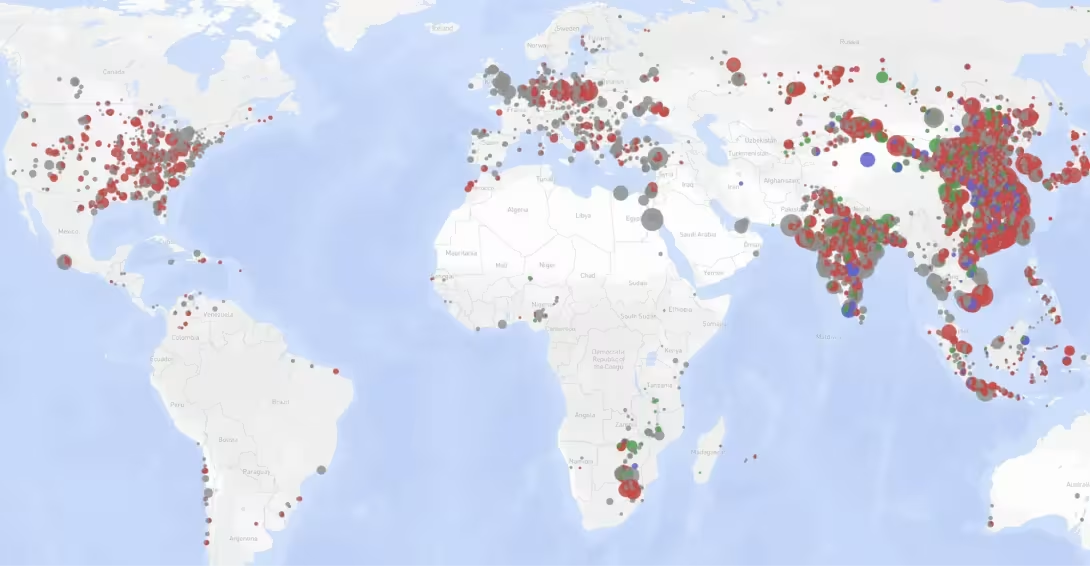
Global Energy Monitor's Global Cement and Concrete Tracker (GCCT) tracks cement and clinker plants around the world, revealing capacity distribution, production methods, and pathways for reducing emissions from clinker production.
The Global Cement and Concrete Tracker (GCCT) provides information on global integrated, grinding, and clinker only plants, including all plants that have been proposed or under construction since 2018 and retired or mothballed since 2021. The GCCT provides asset-level data on location, ownership, operating status, annual clinker and cement capacity, existing and developing kiln numbers, plant-level production, and production methods including relevant green cement technology.
Integrated cement plants consist of multiple units, centered around kilns for clinker production and grinding mills to produce finished cement. Grinding plants consist only of grinding mills, with no clinker producing capacity. Clinker only plants consist only of kilns for clinker production, with no cement grinding capacity. Clinker, the binding element of cement, is typically produced through coal- or oil-fueled combustion due to high heat requirements (1,500°C), which necessitates the use of high-carbon fuels. The GCCT does not capture the historic capacity of all units that have been retired or mothballed within operating plants beyond the dates outlined above. Each plant included in the tracker is linked to a wiki page on GEM.wiki that provides additional details.
China (46%) and India (11%) together account for over half of global operating clinker capacity
India accounts for over 28% of all new cement capacity in development globally
What's inside?
Methodology
Global Energy Monitor’s Global Cement and Concrete Tracker uses a two-level system for organizing information, consisting of both a database and wiki pages with further information. The database tracks individual integrated, grinding, and clinker only production plants and includes information such as plant owner, location, operating status, cement production method, cement and clinker capacity, and emission reduction strategies. A wiki page for each plant is created within GEM.wiki, and contains more detailed, footnoted information such as plant history and environmental and social justice (ESJ) issues.
A preliminary list of cement plants in each country/area was gathered from public and private data sources including Spatial Finance Initiative’s Global Database of Cement Production Assets and LeadIT’s Green Cement Technology Tracker, and data from CemNet, Global Cement, The Global Cement and Concrete Association, and United States Geological Survey, as well as various company and government sources. Data for proposed cement plants was gathered from company announcements, press releases, and government permits, and includes global coverage of cement plants proposed as of May 15, 2026. The data was then vetted against additional sources of information, listed below.
Cement data is updated and maintained through five main sources:
- Corporate reports and data sources from cement plant owner and parent companies
- Government data on individual plants
- Reports by national and regional cement and concrete industry groups
- News and media reports
- Reports from cement technology manufacturers
Where possible, cement plant data is circulated for review to researchers familiar with local conditions and languages.
The majority of research was completed through conventional internet searching and reviews of published datasets, reports, and news articles. AI tools including ChatGPT and DeepSeek were used to support and deepen these research efforts in the following ways:
- Identify and explain cement types.
- Search for information sources not found through conventional means.
- Summarize asset information for GEM wiki pages.
All information presented through the use of AI was vetted by human researchers for accuracy, with a focus on identifying miscommunication of reported information and hallucination of facts. In cases where AI-reported information was used, primary sources are linked. All text generated through AI was edited and drafted by GEM staff.
For each cement plant, a wiki page is created on Global Energy Monitor’s GEM.wiki. Wiki pages provide a repository for plant details including plant, owner, parent company, plant status, capacity, production methods, decarbonization technologies, and location (coordinates and map), as well as additional in-depth information that may include plant background, financing, environmental impacts, public opposition, and aerial photographs. Under standard wiki convention, all information is linked to a published reference, such as a news article, company or government report, or a regulatory permit. In order to ensure data integrity in the open-access wiki environment, Global Energy Monitor researchers review all edits of project wiki pages.
Cement capacity includes the permitted or company-declared amount of finished cement the plant has the capacity to produce in millions of metric tonnes per annum. Clinker capacity includes the permitted or company-declared amount of clinker the plant has the capacity to produce in millions of metric tonnes per annum.
If cement or clinker capacity figures cannot be confirmed, the associated capacity field is listed as “unknown”. Where only daily capacity is reported, annual nameplate capacity is calculated by multiplying the daily figure by 365, representing the maximum theoretical annual output under full operation.
For grinding plants, clinker capacity is always listed as “N/A” as it is known that these plants cannot produce clinker. For plants producing clinker only, cement capacity is always listed as “N/A” as it is known that these plants cannot produce finished cement.
The tracker collects data on the primary cement color and type produced at each plant. Cement color is reported as white, grey, both (white and grey), unknown, or N/A for plants that do not produce cement.
White and grey cement differ mainly in appearance, but achieving that difference requires distinct production methods.
Grey cement is the standard construction cement and is used in the majority of applications.
White cement is used primarily for architectural or aesthetic purposes. To achieve its color, iron and manganese oxides are minimized in the raw material mix, and oil is used as fuel instead of the coal or pet coke typical for grey cement, in order to avoid discoloration. Because of this, and because white cement requires a dedicated production line, it tends to have higher energy requirements, a larger emissions footprint, and a higher cost.
Because different countries and regions use different categorization systems for cement, the reported types are aligned with general categories rather than any single system. The main cement types fall within the following categories:
OPC: The primary cement product is ordinary Portland cement (OPC), containing approximately 95% or more clinker with no or minimal supplementary cementitious materials.
Blended: The primary cement product is blended, in which clinker is partially replaced with one or more supplementary cementitious materials (SCMs), such as fly ash, blast furnace slag, natural or calcined pozzolans, limestone, or calcined clay.
Blast furnace cement: Cement in which ground granulated blast furnace slag (GGBS), a byproduct of iron and steel manufacturing, is blended with clinker as the primary SCM. Unlike other SCMs such as fly ash or pozzolans, which typically replace only 15 to 35% of clinker, slag can make up over 80% of the mix and in some cases act as a standalone binder with little or no clinker. Because of this distinct production route and much lower clinker content, blast furnace slag cement is tracked as a separate category here, while other blended cements are classified under "Blended".
N/A: The plant is a clinker only facility that produces clinker and does not produce finished cement or blast furnace cement on-site.
Unknown: The primary cement type produced can not be clearly determined.
Announced: Projects that have been announced in corporate or governmental planning documents, but have not begun construction.
Construction: Construction of a physical plant facility has begun.
Operating: Plant is operating one or more clinker or cement manufacturing unit(s).
Operating pre-retirement: Plant has announced plans to retire its cement capacity but has not yet ceased operations.
Retired: Plant has ceased operations and no longer has the ability to produce clinker and/or cement.
Mothballed: Plant has been idled such that it cannot be brought into operation immediately, but is not closed. Note that plants undergoing routine maintenance are still considered "operating".
Cancelled: Plant previously planned or under development that has been cancelled. If no progress or announcements for an announced plant are made after 5 years, the plant is considered to be cancelled.
Unknown: The operating status of the plant could not be determined.
Integrated: The plant produces both clinker and finished cement on-site, operating one or more kilns for clinker production and grinding mills for finished cement production. The amount of cement and clinker produced at these plants often do not match due to bottlenecking at various phases in the production line, and therefore these plants may supplement clinker shortcomings or sell off excess clinker produced.
Grinding: The plant produces finished cement by grinding clinker (typically sourced from other plants). Grinding plants do not operate kilns and therefore do not produce clinker on-site. These plants are typically much smaller, cheaper to run, require less energy, and produce much lower emissions than integrated plants.
Clinker Only: The plant produces clinker for shipment to other cement plants and does not manufacture finished cement on-site. These facilities operate kilns but do not have grinding mills for finished cement production. These plants are typically built to supplement clinker capacity for other integrated or grinding plants owned by the same company.
Unknown: The plant type could not be determined.
Wet, dry, and semidry refer to how much water is in the raw material mix fed into the kiln, which affects the energy needed and therefore the carbon footprint of the finished clinker. Integrated and clinker production facilities can use more than one of these types.
Wet: Raw materials are mixed with water to form a slurry that is fed into the kiln. Evaporating this water in the kiln makes the wet process the most energy-intensive method.
Dry: Raw materials are prepared as a dry powder and fed into the kiln, typically through a preheater and precalciner. This is the most energy-efficient and most widely used method in modern plants.
Mixed: The plant operates multiple production lines that use different clinker production methods.
Semidry: Raw materials are prepared as moist pellets or nodules before entering the kiln. Energy use falls between the wet and dry processes.
Implementation of emission reduction technologies including carbon capture and storage or carbon capture, utilization, and storage (CCS/CCUS), alternative fuel for the kiln, and clay calcination is tracked for each plant.
- CCS/CCUS is listed as “Yes”, “No”, or “N/A”;
- Alternative fuel and clay calcination are listed as “Yes”, “No”, “N/A”, or “unknown”.
CCS/CCUS and alternative fuel are associated with clinker production, and are therefore listed as “N/A” for all grinding plants.
Clay calcination operates as an independent production line that does not depend on the presence of a kiln, so grinding plants may still have a clay calcination line and are not automatically marked “N/A” for this field.
Emission reduction technologies are cross-checked against the LeadIT Green Cement Technology Tracker and the 2025 IEA CCUS Projects Database.
To allow easy public access to the results, Global Energy Monitor worked with Earth Genome to develop a map-based and table-based interface. In the case of exact coordinates, locations have been visually determined using Google Maps, Google Earth, Planet Labs, or Wikimapia. For announced projects, exact locations, if available, are from permit applications or other company documentation. If the location of a plant or announcement is not known, GEM identifies the most approximate location.
Frequently Asked Questions
If a plant is still in the announced phase, prior to construction and operation, there may be no sign of activity. In other cases, only approximate location information could be found. Additionally, satellite photos in some geographies are updated infrequently, so recent activity is not shown.
Clinker is the main active ingredient in cement, often called its "glue." It is made by heating limestone and aluminosilicate materials such as clay in a kiln. At around 900°C the limestone calcines, releasing CO₂, and at around 1,450°C it reacts with silica, alumina, and iron to form the calcium silicate minerals that give clinker its binding properties. The clinker comes out as small nodules, which are then ground into a fine powder and mixed with gypsum to make finished cement.
Cement capacity is the amount of finished cement an integrated or grinding plant can produce in a year, based on the design output of its installed cement grinding units.
Clinker capacity is the nameplate amount of clinker that an integrated or clinker only plant can produce in a year, based on the design output of its installed kilns.
Both capacities are measured in millions of metric tonnes per annum. Where only daily capacity is reported, annual capacity is calculated by multiplying the daily figure by 365, representing the maximum theoretical annual output under full operation.
Note that capacity is not the same as production. Capacity is the theoretical maximum output, whereas actual production is typically lower due to factors such as market demand, maintenance downtime, energy availability, and regulatory constraints. Beginning with the 2026 release, the tracker also reports actual plant-level cement production for the previous year, as reported by the owning company, for plants where this figure is publicly disclosed.
Each color represents a different plant operating status:
Yellow: announced
Orange: construction
Green: operating
Olive: operating pre-retirement
Blue: mothballed
Red: cancelled
Dark red: retired
Black: unknown
Each plant location is marked “exact” or “approximate.” In the case of exact coordinates, locations have been visually determined using Google Maps, Google Earth, or Wikimapia (existing projects). For announced projects, exact locations, if available, are from permit applications or other company documentation.
Please see the “Plant status” section left.
Yes, click on “Table view” on the bottom of the map.
Cement capacity is the amount of finished cement an integrated or grinding plant can produce in a year, based on the design output of its installed cement grinding units.
Clinker capacity is the nameplate amount of clinker that an integrated or clinker only plant can produce in a year, based on the design output of its installed kilns.
Both capacities are measured in millions of metric tonnes per annum. Where only daily capacity is reported, annual capacity is calculated by multiplying the daily figure by 365, representing the maximum theoretical annual output under full operation.
Note that capacity is not the same as production. Capacity is the theoretical maximum output, whereas actual production is typically lower due to factors such as market demand, maintenance downtime, energy availability, and regulatory constraints. Beginning with the 2026 release, the tracker also reports actual plant-level cement production for the previous year, as reported by the owning company, for plants where this figure is publicly disclosed.
Please see the “Plant type” section left.
The Global Cement and Concrete Tracker aims to include all operating cement plants in each country or area, regardless of size.
The standard naming convention of the Global Cement and Concrete Tracker is “[Company] [Municipality] Cement Plant”(for example, "XYZ London Cement Plant" for a plant in London owned by company XYZ). Some plants are given unique names by their owners or based on local naming conventions that do not fit this standard format. Where such alternate names exist, they are recorded in the "Other plant names" field.
Please see the “Cement color” section left.
Please see the “Cement type" section left.
Please see the “Production type” section left.
The GCCT has integrated its owner and parent data with GEM’s Global Energy Ownership Tracker. Please visit that project’s homepage for more information.
The GCCT reports the first owner/operator of the plant in the “Owner” column and the ultimate parent companies along with their percent stake in the plant in the “Parent” column. If there is a parent with no stake percentage listed, the exact percentage data has not been confirmed.
Please fill out an error report here.
The tracker was designed and produced by Global Energy Monitor. To the extent possible, the information in the tracker has been verified by researchers familiar with particular countries. The following people participated in plant-by-plant research: Yujia Han (Global Energy Monitor) , Caitlin Swalec (Global Energy Monitor), Joe Hittinger (Global Energy Monitor), Larkin Cleland (Global Energy Monitor), Henna Khadeeja (Global Energy Monitor), Jessie Zhi (Global Energy Monitor), Norah Elmagraby (Global Energy Monitor), Zhanaiym Kozybay (Global Energy Monitor), Ziwei Zhang (Global Energy Monitor), Rolando Almada (Global Energy Monitor), Charmaine Daisay (Global Energy Monitor), and Fanwei Liu (Global Energy Monitor), Charlene Hou (formerly Global Energy Monitor), and Joshua Clement (formerly Global Energy Monitor).
The project is managed by Yujia Han, within GEM’s Heavy Industry Program, managed by Caitlin Swalec, with support from Ryan Driskell Tate.
Please refer to the Download Data section for citation guidance.
Contact
For questions about the Global Cement and Concrete Tracker, contact Yujia Han: