country/areas included
hydropower projects tracked
gigawatts operating capacity
gigawatts prospective capacity
Overview
The Global Hydropower Tracker provides comprehensive data on one of the world’s most established sources for low-carbon power and grid-scale energy storage.
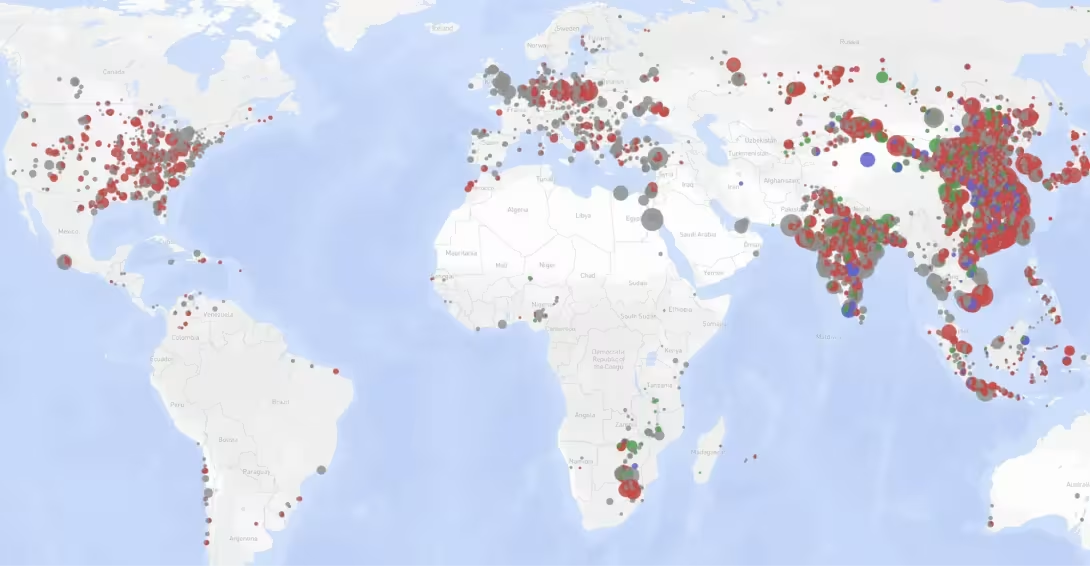
As of 2026, the Global Hydropower Tracker (GHT) covers over 7,000 operating, under construction, and prospective facilities worldwide, totaling 2,600 gigawatts (GW) of capacity. It catalogs both conventional hydropower and pumped storage, spanning facilities that have been in operation for more than a century as well as projects not expected online for several decades. The GHT captures status changes as projects move from initial announcement to construction, operation, or retirement, providing a continuously updated picture of the sector.
Pumped storage hydropower (PSH) remains the most widespread form of grid-scale energy storage globally, and the GHT tracks ~200 GW of operating PSH and ~700 GW of prospective PSH. This dataset offers insights into country‑specific and regional dynamics to balance rising shares of renewables with corresponding storage buildouts, highlighting where PSH is central to meeting system flexibility needs. By mapping this infrastructure, the GHT helps users pinpoint where grids depend on hydropower today and where new investments could reshape planning and operations over the coming decades.
As governments and civil society groups pursue climate targets and seek to accelerate the clean energy transition, hydropower sits at the intersection of reliability and low‑carbon generation, versus growing concerns about water availability, ecosystem impacts, and community rights. The GHT offers transparent, citation-driven geospatial and ownership data for business leaders, policymakers, researchers, and market participants to track project pipelines and evaluate how hydropower interacts with emerging portfolios of wind, solar, and other storage technologies.
Four countries — China, Brazil, the U.S., and Canada — have half of global operational hydropower capacity.
Pumped storage hydropower accounts for nearly 60% of all hydro capacity under construction worldwide.
Methodology
Global Energy Monitor’s Global Hydropower Tracker uses a two-level system for organizing information, consisting of both a database and wiki pages with further information. The database tracks hydropower plants and includes information such as project owner, operator, status, number of turbines, technology type, and location. A wiki page for each project is created within the Global Energy Monitor wiki. The database and wiki pages are updated annually.
Announced: Proposed projects that have been described in corporate or government plans but have not yet taken concrete steps such as applying for permits.
Pre-construction: Projects that are actively moving forward in seeking governmental approvals, land rights, or financing.
Construction: Site preparation and equipment installation are underway.
Operating: The project has been formally commissioned; commercial operation has begun.
Shelved: Suspension of progress has been announced. The status is marked as “shelved – inferred 2 y” if no progress has been observed for at least two years.
Cancelled: A cancellation announcement has been made. The status is marked as “cancelled – inferred 4 y” if no progress has been observed for at least four years.
Mothballed: The project is disused, but not dismantled.
Retired: The project has been decommissioned.
The Global Nuclear Power Tracker data set draws on various public data sources, including:
- Industry data on individual nuclear power units
- Government websites tracking project permits and applications
- Reports by power companies (both state-owned and private)
- News and media reports
- Local non-governmental organizations tracking nuclear projects or permits
A list of major data sources can be found here.
Global Energy Monitor researchers perform data validation by comparing GEM’s dataset against proprietary and public data such as S&P Global’s World Electric Power Plant Database (WEPP) and the World Resource Institute’s Global Power Plant Database, as well as various company and government sources.
For each nuclear power project, a wiki page is created on Global Energy Monitor’s wiki. Under standard wiki convention, all information is linked to a publicly-accessible published reference, such as a news article, company or government report, or a regulatory permit. In order to ensure data integrity in the open-access wiki environment, Global Energy Monitor researchers review all edits of project wiki pages.
To allow easy public access to the results, Global Energy Monitor worked with Earth Genome to develop a map-based and table-based interface. In the case of exact coordinates, locations have been visually determined using Google Maps, Google Earth, Wikimapia, or OpenStreetMap. Exact locations for proposed projects, if available, are obtained from sources such as permit applications, other government documentation, or company reports. If the location of a project or proposal is not known, Global Energy Monitor identifies the most accurate location possible based on available information.
April 2025
Global Energy Monitor releases the third version (second update) of the Global Hydropower Tracker.
- This update covers all regions of the globe, and uses the United Nations’ Statistics Division definitions of region and subregion. All prospective facilities, as well as any for which there was an indication of changed status, were researched for updates.
- This update now includes all operating and prospective projects with more than a 45 MW capacity, lowering the capacity threshold for project inclusion from 75 MW to 45 MW.
- The column name “Country” has been changed to “Country/Area”. The Country/Area column presents energy data within various economic contexts, and the geographical unit does not strictly follow political boundaries.
- GEM ID formats have changed from an L8+5 digit number to L1+11 digit number for location IDs and a G8+5 digit number to a G1+11 digit number. Previous GEM ID numbers have been preserved. For example, a previous GEM ID of L603791 is now L100000603791.
- Shelved and cancelled statuses have been broken down into two subcategories depending on if there was an announcement of delay or cancellation, or if the status is inferred by lack of observed progress.
April 2024
Global Energy Monitor releases the first update to the Global Hydropower Tracker.
- All global regions were included within the scope of research for this data release. All prospective facilities, as well as any for which there was an indication of changed status, were researched for updates.
- Any facilities previously listed with the “inactive” status category were expanded to specify the status as either cancelled, mothballed, or retired. This change was made to increase clarity for dataset users, as well as to harmonize the Global Hydropower Tracker with other power generation trackers at Global Energy Monitor.
- The names for principal administrative divisions of China have been updated to correspond with ISO 3166-2 standards. Specifically, the changes were: “Guangxi Zhuang Autonomous Region” to “Guangxi”, “Inner Mongolia Autonomous Region” to “Inner Mongolia”, “Ningxia Hui Autonomous Region” to “Ningxia”, “Tibet Autonomous Region” to “Tibet”, and “Xinjiang Uygur Autonomous Region” to “Xinjiang”.
May 2023
Global Energy Monitor releases the first version of the Global Hydropower Tracker.
- All global regions have been researched for this data release.
- The Global Hydropower Tracker, consistent with recent changes across all of Global Energy Monitor’s trackers, uses the following naming conventions: Regions and subregions are defined according to United Nations definitions. The country name “Türkiye” is used in place of “Turkey.”
Conventional Storage: Projects which typically or entirely generate electricity from water stored in a reservoir.
Pumped Storage: Projects which generate electricity using water which is cycled between a lower and an upper reservoir by a pumping system.
Run-Of-River: Projects which typically or entirely generate electricity from flowing water with little to no storage capacity.
Unknown: Technology type not specified.
Conventional and Pumped Storage: Projects which have both conventional storage and pumped storage capability.
Conventional and Run-Of-River: Projects which have both conventional storage and run-of-river capability.
Frequently Asked Questions
The objective of the Global Hydropower Tracker is to provide information on hydroelectric power plants which are currently active or may become active in the future. It includes all facilities with at least 45 megawatts (MW) of nameplate capacity for operating, announced, pre-construction, and under construction units.
Capacity is measured in megawatts, and refers to the collective nameplate capacity of the hydroelectric power plant.
Projects are the fundamental level of organization for the Global Hydropower Tracker. A given project may consist of a single turbine-generator set, or multiple turbine-generator sets. When available, information about the capacity and number of turbine(s) is included in the “Turbines” field. The “Complex” field is used to link together multiple projects that are part of a collection of related power-generating infrastructure but which should be considered different plants due to distinct physical infrastructure, geographic separation, and/or other factors such as ownership or operation.
Please fill out an error report here.
The tracker was designed and produced by Global Energy Monitor, a network of researchers seeking to develop collaborative informational resources on fossil fuel impacts and alternatives.
Contact
For questions about the Global Hydropower Tracker, contact Joe Bernardi: