country/areas included
iron and steel plants tracked
plant owners
tonnes annual crude steel capacity
Overview
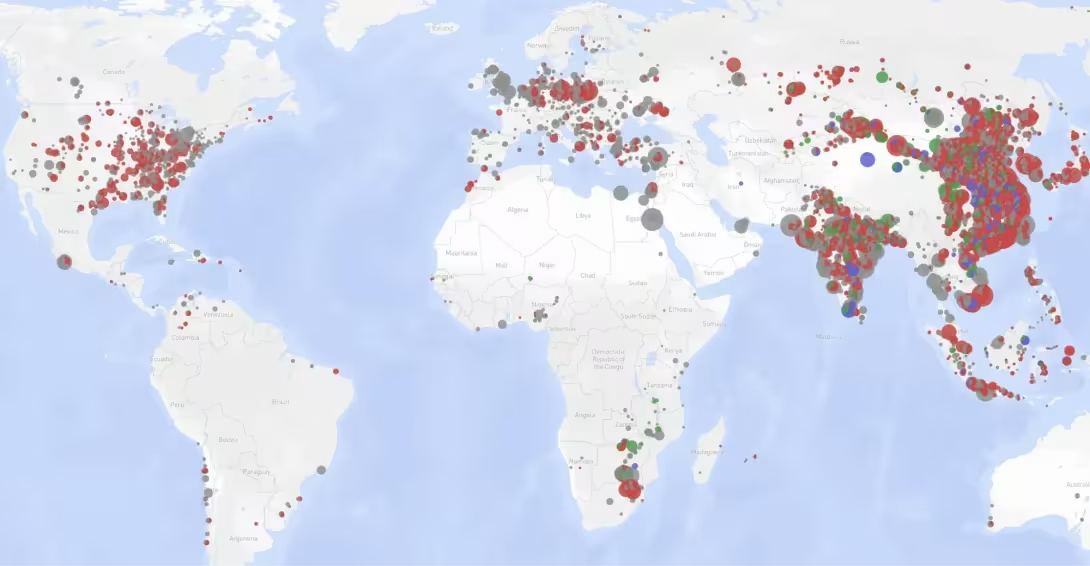
Global Energy Monitor’s Global Iron and Steel Tracker (GIST) tracks crude iron and steel plants around the world, revealing technology pathways, capacity distribution, and implications for the transition away from coal-based steel.
The Global Iron and Steel Tracker (GIST) provides information on global crude iron and steel production plants and includes every plant currently operating with a capacity of 500,000 tonnes per year (ttpa) or more of crude iron or steel. The GIST also includes all plants meeting this threshold that have been proposed or under construction since 2017 or retired or mothballed since 2020. Plants consist of multiple units, depending on the iron and steel production method used.
Iron and steel are typically produced through coal-based methods — blast furnace and basic oxygen furnace (BF-BOF) or open hearth furnace (OHF) — or electricity-based production — electric arc furnace (EAF) charged with scrap metal, pig iron, direct reduced iron, or a combination. The GIST map and underlying data are updated annually. Each plant included in the tracker is linked to a wiki page on GEM.wiki, which provides additional details.
Continued coal-based BF-BOF investment, rather than a shift to lower-emissions technology, risks decades of carbon lock-in from the industry.
China operates around 60% of existing BF-BOF capacity globally, while India accounts for 57% of BF-BOF developments.
What's inside?

Methodology
Global Energy Monitor’s Global Iron and Steel Tracker uses a two-level system for organizing information, consisting of both a database and wiki pages with further information. The database tracks individual iron and steel plants and units and includes information such as plant owner and parent company, plant status, iron and steel production method, unit and plant capacity, annual production, location, and furnace details (capacity, age, model, etc.). The dataset consists of three documents: a plant-level file, steel units file, and iron units file. Data on individual electric arc furnaces, basic oxygen furnaces, and open hearth furnaces can be found in the steel units file, and data on blast furnaces, blast furnace relinings, and direct reduced iron furnaces can be found in the iron units file. A wiki page for each plant is created within GEM.wiki, and contains more detailed, footnoted information such as plant history, labor/social issues, and environmental records. The database and wiki pages are updated annually.
A preliminary list of iron and steel plants in each country/area was gathered from public and private data sources including Steel On The Net, OECD Steel Committee, SteelOrbis, SteelGuru, South East Asian Iron and Steel Institute (SEAISI), Association for Iron & Steel Technology (AIST), Fastmarkets News, and USGS Mineral Yearbooks, as well as various company and government sources. Data for proposed iron and steel plants was gathered from company announcements, press releases, government permits, and the OECD papers on steelmaking capacity developments, and includes global coverage of iron and steel plants proposed as of February 15, 2025. The data was then vetted against additional sources of information, listed below.
Iron and steel plant data is updated and maintained through six main sources:
- Corporate reports and data sources from iron and steel plant owner and parent companies
- Government data on individual iron and steel plants
- Reports by national and regional iron and steel industry groups
- News and media reports
- Reports from iron and steel technology manufacturers
- On the ground contacts who can provide first-hand information about a project or plant
Where possible, iron and steel plant data is circulated for review to researchers familiar with local conditions and languages. Reviewers and collaborators include Global Efficiency Intelligence, Centre for Research on Energy and Clean Air, Spatial Finance Initiative, Council on Energy, Environment and Water (CEEW), Ember Climate, Raven Ridge Resources, and many other individual contributors.
For each iron and steel plant, a wiki page is created on Global Energy Monitor’s GEM.wiki. Wiki pages provide a repository for plant details including plant owner, parent company, plant status, iron and steel production method, plant capacity and actual production, location (coordinates and map), and furnace details, as well as additional in-depth information that may include plant background, financing, environmental impacts, raw material sourcing, finished product uses, public opposition, aerial photographs, videos, and links to plant environmental permits. Under standard wiki convention, all information is linked to a published reference, such as a news article, company or government report, or a regulatory permit. In order to ensure data integrity in the open-access wiki environment, Global Energy Monitor researchers review all edits of project wiki pages.
Capacity is defined as the tonnes of crude iron or steel per annum that a plant/unit is capable of producing. Production is actual tonnes of crude iron or steel per annum produced at a plant in a given year. Capacity for each plant is researched on the unit-level and aggregated by operating status and unit type to provide plant-level figures. Production data is only researched at the plant-level.
The Global Iron and Steel Tracker provides a sum total crude steelmaking capacity and ironmaking capacity (across all production methods) for each plant. Steelmaking is a process that uses a furnace to produce crude steel from pig iron/hot metal, direct reduced iron/sponge iron, and/or scrap steel. Thus, steelmaking capacity and actual production refers to the output of steelmaking furnaces. Ironmaking is the process of producing liquid iron by reducing iron ore with either metallurgical coal (to produce pig iron/hot metal) or a reducing gas or elemental carbon produced from natural gas or coal (to produce direct reduced iron/sponge iron). Thus, ironmaking capacity refers to the output of ironmaking furnaces/units.
Raw material preparation for iron and steelmaking requires other units that also have individual capacity and production levels. Preparation of iron ore for the iron and steelmaking process often involves pelletization or sintering to create uniform-sized iron ore pieces. In coal-based iron and steelmaking, metallurgical coal is transformed to “coke” through a baking process in coke ovens.
Capacities for crude steel, iron, ferronickel, coke, iron pellets, and sinter are researched and recorded. When available, actual production of crude iron and steel is provided, beginning with the year 2019. When possible, plant steelmaking capacity and production was distinguished by the production process used (i.e. electric arc furnace, basic oxygen furnace, or open hearth furnace). Ironmaking capacity and production is also distinguished by production process and product (i.e. blast furnace (hot metal/pig iron), direct reduced iron plant (DRI/sponge iron)). When the process for iron or steelmaking is unknown, it appears in the “Other/unspecified capacity” column.
If plant capacity for a given product was known to be greater than zero, but the exact value could not be found or estimated with confidence, capacity was listed as “>0” and production was listed as “unknown”. If plant capacity or production for a given product was known to be zero, capacity and production were each listed as “N/A” (not applicable).
Global Energy Monitor’s wiki pages provide detailed capacity and production information by steel and ironmaking process, as well as capacities for ferronickel, coke, iron pellets, and sinter when available.
Announced: Capacity that has been announced in corporate or governmental planning documents, but has not begun construction.
Construction: Physical furnace structure building has begun.
Operating: Furnace(s) are currently operating and producing iron or steel.
Operating pre-retirement: Company has announced plans to retire this iron or steelmaking capacity but it has not yet ceased operations.
Mothballed: Iron or steelmaking has been idled such that it cannot be brought into operation immediately, but is not retired.
Mothballed pre-retirement: Iron or steelmaking has been idled such that it cannot be brought into operation immediately. It has not yet been permanently retired/decommissioned, but the plant has announced plans to do so in the future.
Retired: Furnace(s) have ceased operations and no longer has ability to produce iron or steel. If the capacity has been mothballed for over 5 years it is considered retired.
Cancelled: Capacity previously planned or under development that has been cancelled. If no progress or announcements for announced capacity are made after 5 years it is considered to be cancelled.
Workforce size for each individual iron and steel plant was researched and recorded if available. Workforce size aims to capture the number of full-time employees working at a given iron and steel plant. In some cases when workforce size could not be found for a specific plant, it was estimated from company-wide workforce data. As the first known attempt to capture the iron and steel industry’s workforce size at the plant-level, GEM presents this data with the caveat that for many plants workforce size remains unknown and/or reported with a lack of transparency for exactly who is included in that workforce size (i.e. full-time vs part-time workers, temporary/contract workers, administrative personnel, etc.). Our aim in providing this data is to create a starting point from which workforce size data can be improved.
To allow easy public access to the results, Global Energy Monitor worked with Earth Genome to develop a map-based and table-based interface. In the case of exact coordinates, locations have been visually determined using Google Maps, Google Earth, Planet Labs, or Wikimapia. For announced projects, exact locations, if available, are from permit applications or other company documentation. If the location of a plant or announcement is not known, GEM identifies the most approximate location.
Frequently Asked Questions
The Global Iron and Steel Tracker (GIST) is a rebranding of the Global Steel Plant Tracker. GIST provides all of the plant and unit-level information on global crude iron and steel production plants previously included in the Global Steel Plant Tracker and Global Blast Furnace Tracker, plus more!
Since the GIST now provides unit-level information for each plant, all blast furnaces are tracked in this dataset, along with other iron furnaces. All data previously housed in the GBFT can now be found in the ‘Iron units’ file of the GIST.
Iron and steel production are two sequential steps of the primary steelmaking process. Some steel is made by remelting scrap steel (secondary steelmaking) without needing to make new iron. Secondary steelmaking typically uses an electric arc furnace (EAF).
Primary steelmaking uses a more diverse set of technologies including blast furnaces (BF) and direct reduced iron (DRI) plants in the ironmaking phase, and basic oxygen furnaces (BOF), electric arc furnaces (EAF), and open hearth furnaces (OHF) in the steelmaking phase.
In ironmaking, pig iron is typically produced from iron ore and coking coal (aka coke) in a BF and DRI is produced in a DRI plant from iron ore (no coking coal) and hydrogen. Some steel plants operate only one type of production route (typically either BF-BOF or DRI-EAF), but some operate multiple different production routes.
In steelmaking, EAFs are mainly fed scrap metal or sponge iron (aka DRI or hot briquetted iron (HBI)), sometimes supplemented with pig iron (aka crude iron or hot metal), or a combination of these iron sources. BOFs and OHFs are typically fed pig iron, but may be supplemented with smaller amounts of scrap metal or DRI.
The downloaded dataset consists of three documents: a plant-level file, a steel units file, and an iron units file.
Plant-level file: this contains all plant-level data. The “Plant capacities and status” tab aggregates all unit-level capacities to the plant level, separated into individual rows according to capacity operating status.
Steel units file: this contains unit-level data on all steelmaking furnaces located at plants in the plant-level file, including electric arc furnaces (EAFs), basic oxygen furnaces (BOFs), and open hearth furnaces (OHFs).
Iron units file: this contains unit-level data on all ironmaking furnaces located at plants in the plant-level file, including blast furnaces (BFs) and direct reduced iron furnaces (DRIs).
As of 2025, quarterly updates of the data are performed and the dataset is adjusted. These updates include:
- Updates to operating status of capacity with planned changes before the 1st of the month of the update
- Updates to development and decommissioning dates for this capacity
- Select capacity additions announced since the previous quarterly or annual release, whichever was most recent
- Adjusted parent field data, now configured to include percent stakes assigned to each parent entity when known
- Removed capacity that was found to be included in error, such as duplicate plant entries
This is not a full-scale update, meaning the data has not been re-researched thoroughly and not all changes are captured. An annual update indicates that each plant has been reviewed for changes.
The colors indicate the iron and steel production method/types of unit at the plant.
“Integrated” steelmaking refers to steel plants that produce both iron and steel onsite (as opposed to plants that only produce iron or produce steel from purchased iron materials only). In other words, integrated plants produce both steel and the iron material used to make the steel. Integrated steel plants may use different combinations of furnaces to produce iron and steel. Emissions from integrated steelmaking are mainly produced during the ironmaking process. Thus, integrated steelmaking processes are divided by ironmaking processes as detailed below.
“Ironmaking” refers to plants that produce iron products only. Ironmaking plants include plants that use blast furnaces and direct reduced iron production.
“Electric” steelmaking refers to steel plants that only produce steel onsite (not iron) and use an electric arc furnace. Electric steelmaking plants may use scrap metal, sponge iron, pig iron, or some combination of these iron materials as feed.
In the GIST, steelmaking routes are categorized as follows:
- Electric: Plants that produce only steel onsite and use an electric arc furnace (EAF).
- Electric, oxygen: Plants that produce only steel onsite and use an electric arc furnace (EAF) and basic oxygen furnace (BOF).
- Oxygen: Plants that produce only steel onsite and use a basic oxygen furnace (BOF).
- Integrated (BF): Plants that produce both iron and steel onsite. Pig iron is produced in a blast furnace (BF). Steel may be produced using one or more types of furnaces.
- Integrated (DRI): Plants that produce both iron and steel onsite. Sponge iron is produced in a direct reduced iron plant (DRI plant). Steel may be produced using one or more types of furnaces.
- Integrated (BF and DRI): Plants that produce both iron and steel onsite. Pig iron is produced in a blast furnace (BF) and sponge iron is produced in a direct reduced iron plant (DRI plant). Steel may be produced using one or more types of furnaces.
- Integrated (other): Plants that produce both iron and steel onsite. Pig iron is produced through a direct smelting process. Steel may be produced using one or more types of furnaces.
- Integrated (unknown): Plants that produce both iron and steel onsite. Furnace(s) used to produce iron is unknown. Steel may be produced using one or more types of furnaces.
- Ironmaking (BF): Plants that produce only iron onsite. Pig iron is produced in a blast furnace (BF).
- Ironmaking (DRI): Plants that produce only iron onsite. Sponge iron is produced in a direct reduced iron plant (DRI plant).
- Ironmaking (BF and DRI): Plants that produce only iron onsite. Pig iron is produced in a blast furnace (BF) and sponge iron is produced in a direct reduced iron plant (DRI plant).
- Iron other/unspecified: Furnace(s) used to produce iron is unknown.
- Steel other/unspecified: Furnace(s) used to produce steel is unknown.
Yes. Go to the legend (bottom right corner of the map) and click in the box next to a color.
Capacity operating status is categorized as follows:
- Announced: Capacity that has been announced in corporate or governmental planning documents, but has not begun construction.
- Construction: Physical furnace structure building has begun.
- Operating: Furnace(s) are currently operating and producing iron or steel.
- Operating pre-retirement: Company has announced plans to retire this iron or steelmaking capacity but it has not yet ceased operations.
- Mothballed: Iron or steelmaking has been idled such that it cannot be brought into operation immediately, but is not retired.
- Mothballed pre-retirement: Iron or steelmaking has been idled such that it cannot be brought into operation immediately. It has not yet been permanently retired/decommissioned, but the plant has announced plans to do so in the future.
- Retired: Furnaces have ceased operations and no longer have the ability to produce iron or steel. If the capacity has been mothballed for over 5 years it is considered retired.
- Cancelled: Capacity previously planned or under development that has been cancelled. If no progress or announcements for announced capacity are made after 5 years it is considered to be cancelled.
In some cases, only approximate location information could be found.
To find out the coordinates of a location and whether a location is exact or approximate, click on the location dot, select the wiki page, and look under “Project Details.”
Yes, click on “Table view” at the bottom of the map.
No. The Global Iron and Steel Tracker includes all operating crude iron and steel production plants with capacity of five hundred thousand tonnes per annum or greater, as well as plants with proposed expansions made by February 15, 2025 that bring the plant’s capacity to this threshold. The GIST is also limited to plants that produce crude iron and/or steel onsite (plants such as rolling mills that process crude steel into final products are omitted).
Capacity is the tonnes of crude iron or steel per annum that an iron and steel plant is capable of producing with units currently onsite. Production is actual tonnes of crude iron or steel per annum produced at a plant in a given year. Capacity utilization may be calculated as the difference between capacity and production over capacity.
The tracker provides separate data on each of the multiple furnaces or pieces of iron and steelmaking equipment that typically exist at a particular location. Each of these furnaces or iron and steelmaking equipment pieces is referred to as a “unit.” The entire collection of units at a given location is referred to as a “plant.”
Capacity operating status indicates whether iron/steel capacity at a plant is operational; possible statuses are: “announced”, “construction”, “operating”, “mothballed”, “mothballed pre-retirement”, “operating pre-retirement”, “retired”, and “cancelled”. The capacity of units at each plant is aggregated to the plant-level and separated into different rows for each applicable operating status in the plant-level “Plant capacities and status” tab. For example, a plant may have 3 basic oxygen furnaces, 2 operating and 1 mothballed. The summed capacity of the operating BOF units will appear in the “Nominal BOF steel capacity” column of the row with the status set to “operating” and the mothballed unit’s capacity will appear in the row with the status set to “mothballed”.
When there are multiple rows for one plant in the dataset this indicates that the plant has units at different stages of development. Each row attached to a particular plant represents capacity associated with distinct operating statuses (see “What is capacity operating status and how is it used?” above). A plant’s total capacity should be taken as the sum of all rows with that plant ID.
Workforce size aims to capture the number of full-time employees working at a given iron and steel plant. In some cases when workforce size could not be found for a specific plant, it was estimated from company-wide workforce data. As the first known attempt to capture the iron and steel industry’s workforce size at the plant-level, GEM presents this data with the caveat that for many plants workforce size remains unknown and/or reported with a lack of transparency for exactly who is included in that workforce size (i.e. full-time vs part-time workers, temporary/contract workers, administrative personnel, etc.). Our aim in providing this data is to create a starting point from which workforce size data can be improved.
The GIST has integrated its owner and parent data with GEM’s Global Energy Ownership Tracker. Please visit that project’s homepage for more information.
The GIST reports the first owner/operator of the plant in the “Owner” column and the ultimate parent companies along with their percent stake in the plant in the “Parent” column. If there is a parent with no stake percentage listed, the exact percentage data has not been confirmed.
Please fill out an error report form here.
The tracker was designed and produced by Global Energy Monitor. To the extent possible, the information in the tracker has been verified by researchers familiar with particular countries/areas. The following people participated in plant-by-plant research for the 2025 update cycle: Astrid Grigsby-Schulte (Global Energy Monitor), Caitlin Swalec (Global Energy Monitor), Gregor Clark (Global Energy Monitor), Hanna Fralikhina (Global Energy Monitor), Henna Khadeeja (Global Energy Monitor), Jessie Zhi (Global Energy Monitor), Rolando Almada (Global Energy Monitor), Natalia Fretz (Global Energy Monitor), Norah Elmagraby (Global Energy Monitor), Zhanaiym Kozybay (Global Energy Monitor), Ziwei Zhang (Global Energy Monitor), Marie Armbruster (formerly Global Energy Monitor), Charlene Hou (formerly Global Energy Monitor), and Yue Hu (Global Energy Monitor intern). The following people participated in plant-by-plant research in previous versions of our iron and steel tracking (2020-2024): Christine Shearer (Global Energy Monitor), Dorothy Mei (Global Energy Monitor), Wynn Feng (Global Energy Monitor), Xiaojun Peng (Global Energy Monitor), Aiqun Yu (Global Energy Monitor), Ali Hasanbeigi (Global Efficiency Intelligence), Harshvardhan Khutal (Global Efficiency Intelligence), Pinchookorn Chobthiangtham (Global Efficiency Intelligence), Nihan Karali (Lawrence Berkeley National Laboratory), Reza Shamshirgaran (Universiti Teknologi PETRONAS of Malaysia), Zulfikar Yurnaidi (ASEAN Center for Energy), Zakariae Mellouk (consultant, Morocco), Ray Pilcher (Raven Ridge Resources), Ariane DesRosiers (formerly Global Energy Monitor), Nele Merholz (formerly Global Energy Monitor), and Kate Logan (formerly Global Energy Monitor). The project is managed by Astrid Grigsby-Schulte within GEM’s Heavy Industry Program, managed by Caitlin Swalec, with support from Louisa Plotnick and Ted Nace.
Please refer to the Download Data section for citation guidance.
Contact
For questions about the Global Iron and Steel Tracker, contact Astrid Grigsby-Schulte: