countries included
oil and gas units tracked
plant owners
gigawatts of oil and gas capacity in development
Overview
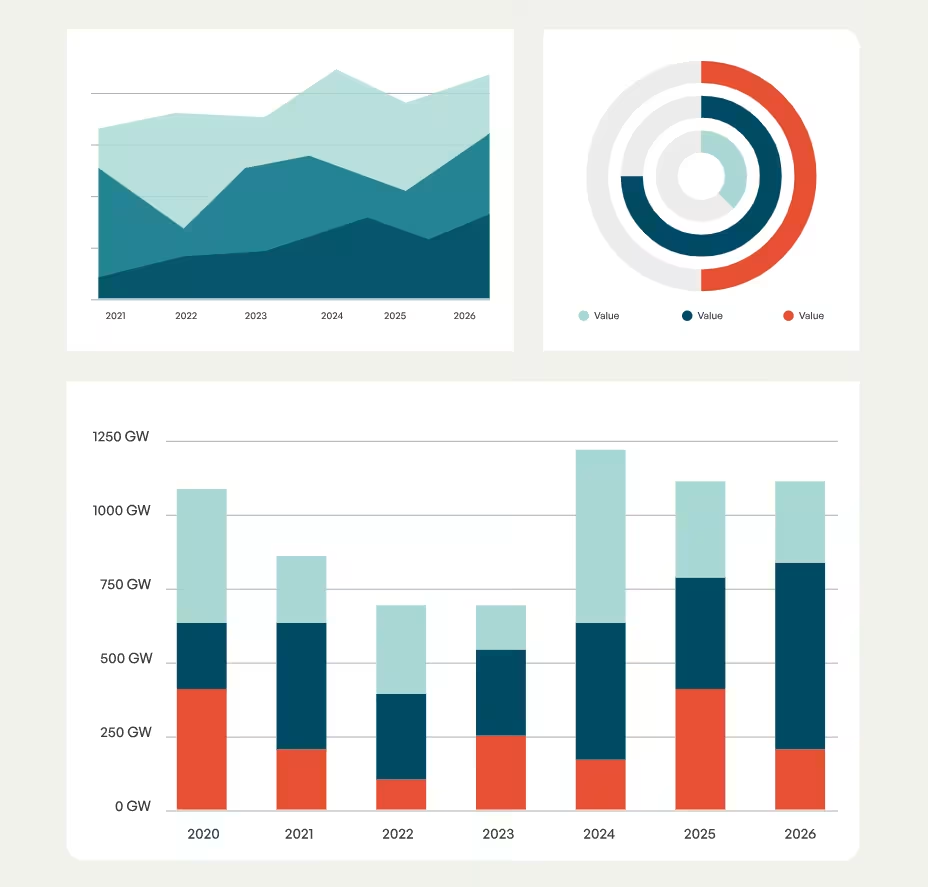
Gas-fired capacity in development has risen in the last few years, due to increasing demand from electrification, industrialization, and data centers.
Global oil- and gas-fired capacity in development rose nearly a third in 2025, reaching a total of 1,047 gigawatts (GW). The United States (252 GW) surpassed China (153 GW) for the first time as the top developer of gas power. In the U.S., more than one-third of this capacity is slated to directly power data centers on site, and many more on-grid projects are planned to meet an anticipated increase in energy demand from AI. Together, the U.S. and China make up over one-third of global gas power capacity in development.
Over 50% of in-development gas power capacity is concentrated in five countries, with the remaining 50% spread across 106 countries. Notably, coal-to-gas switching (conversions or replacements) accounts for 18% of in-development gas power globally. Oil is a small percentage of the global oil and gas power capacity fuel mix — approximately 6% of operating and 3% of in-development power capacity is exclusively oil.
Global gas power expansion is bottlenecked by turbine production capacity, with manufacturer backlogs now stretching through 2030. Two-thirds of projects in development do not have a named manufacturer, potentially limiting the scale of the gas power expansion.
The U.S. now leads the world in gas-fired capacity in development, surpassing China for the first time.
Texas alone accounts for nearly a third of U.S. gas power capacity in development — more than the next seven states combined.
What's inside?
The most recent release of this data was in January 2026.
Methodology
Global Energy Monitor’s Global Oil and Gas Plant Tracker (GOGPT) uses a two-level system for organizing information, consisting of both a database and wiki pages with further information. The database tracks individual oil and gas plant units and includes information such as plant owner and parent company, plant status, plant type, and location. A wiki page for each power station is created within the GEM.wiki, and contains more detailed, footnoted information such as project history and public opposition. The database and wiki pages are updated bi-annually, in January and July.
The GOGPT tracks all oil and gas-fired power plants that generate electricity in any setting (i.e.: peaking and base load generation, captive industrial plants, and co-generation). It includes units with capacities of 50 megawatts (MW) or more (20 MW or more in the European Union and the United Kingdom). For combined cycle units, the capacity threshold is applied to the entire combined cycle set and not to the individual components. For internal combustion units, or those units that have multiple identically sized engines, the threshold applies to the total capacity of the set of engines. The tracker does not include gas boilers only generating district or industrial heat.
Announced: Projects that have been publicly reported but have not yet moved actively forward by applying for permits or seeking land, material, or financing.
Pre-Construction: Projects that are actively moving forward in seeking governmental approvals, land rights, or financing.
Construction: Site preparation and equipment installation are underway.
Shelved: Suspension of operation has been announced, or no progress has been observed for at least two years.
Cancelled: A cancellation announcement has been made, or no progress has been observed for at least four years.
Operating: The plant has been formally commissioned; commercial operation has begun.
Mothballed: The project is disused, but not dismantled.
Retired: The plant has been decommissioned.
The Global Oil and Gas Plant Tracker data set draws on various public data sources, including:
- Government data on individual power plants, country/area energy and resource plans, and government websites tracking oil/gas plant permits and applications;
- Reports by state-owned and private power companies;
- News and media reports;
- Local non-governmental organizations tracking oil/gas plants or permits.
A partial list of data sources can be found here.
Global Energy Monitor researchers perform data validation by comparing our dataset against proprietary and public data such as Platts World Energy Power Plant database and the World Resource Institute’s Global Power Plant Database, as well as various company and government sources.
Where possible, gas plant data is circulated for review to researchers familiar with local conditions and languages. Reviewers and collaborators include Centre for Research on Energy and Clean Air, Beyond Fossil Fuels, Environmental Integrity Project, Sierra Club, and others.
For each gas plant unit, the tracker calculates annual and lifetime carbon dioxide emissions. Further details including parameters and sources can be found at Estimating Carbon Dioxide Emissions from Gas Plants on GEM.wiki.
For each oil or gas-fired power plant, a wiki page is created on Global Energy Monitor’s wiki. Wiki pages provide a repository for in-depth information including project background, financing, environmental impacts, public opposition, coordinates, and maps. Under standard wiki convention, all information is linked to a publicly-accessible published reference, such as a news article, company or government report, or a regulatory permit. In order to ensure data integrity in the open-access wiki environment, Global Energy Monitor researchers review all edits of project wiki pages.
To allow easy public access to the results, Global Energy Monitor worked with Earth Genome to develop a map-based and table-based interface. In the case of exact coordinates, locations have been visually determined using Google Maps, Google Earth, Planet Labs, or Wikimapia. For proposed projects, exact locations, if available, are from permit applications or other company documentation. If the location of a plant or proposal is not known, Global Energy Monitor identifies the most accurate location possible based on available information.
January 2026
- The January 2026 supplement to the GOGPT offers an additional supplementary dataset on gas power proposals found in integrated resource planning (IRP) utility filings in the United States. References available upon request.
August 2025
- Column name changes/additions
- “Owner GEM Entity ID” column added
- “Parent GEM Entity ID” column added
- “Fuel classification?” column added
January 2025
- Column name changes/additions
- “Conversion to (fuel)” column added
- “Conversion to (GEM unit ID)” column added
August 2024
- Column name changes/additions
- “Other plant names” changed to “Other Name(s)”
- “Technology” changed to “Turbine/Engine Technology”
- “Equipment Manufacturer/Model” added. Prioritized researching gas turbines in pre-construction or construction status with “combined cycle” and “gas turbine” technology for this data release.
- “Coal-to-gas conversion/replacement?” changed to “Conversion/replacement?”
- “Conversion from/replacement of (fuel)” column added
- “Conversion from/replacement of (GEM unit ID)” added
- “Operator” changed to “Operator(s)”
- “Owner” changed to “Owner(s)”
- “Parent” changed to “Parent(s)”
- “Subnational unit (province/state)” changed to “State/Province”
- “Sub-region” changed to “Subregion”
- “Captive [heat/power/both]” changed to “Captive industry use”
- “Captive non-industry use” changed to “Captive non-industry use [heat/power/both/none]”
- Additional notes
- Status categories expanded to include “shelved – inferred 2 y” and “cancelled – inferred 4 y”
- Sub threshold units, or those that do not meet inclusion criteria, are now included in a separate “Sub-threshold units”
August 2023
- The Global Gas Plant Tracker (GGPT) was renamed the Global Oil and Gas Plant Tracker (GOGPT).
- The Global Oil and Gas Plant Tracker now includes oil and gas-fired power plants using internal combustion technology, also known as engines. For internal combustion units, or those units that have multiple identically sized engines, the 50 MW capacity unit threshold applies to the total capacity of the set of engines.
- The Global Oil and Gas Plant Tracker now includes exclusively oil-fired power plants.
February 2023
- Global Energy Monitor has transitioned to using the United Nations’ region and subregion definitions.
- Global Energy Monitor has adopted the name “Türkiye” as a replacement for “Turkey.”
Frequently asked questions
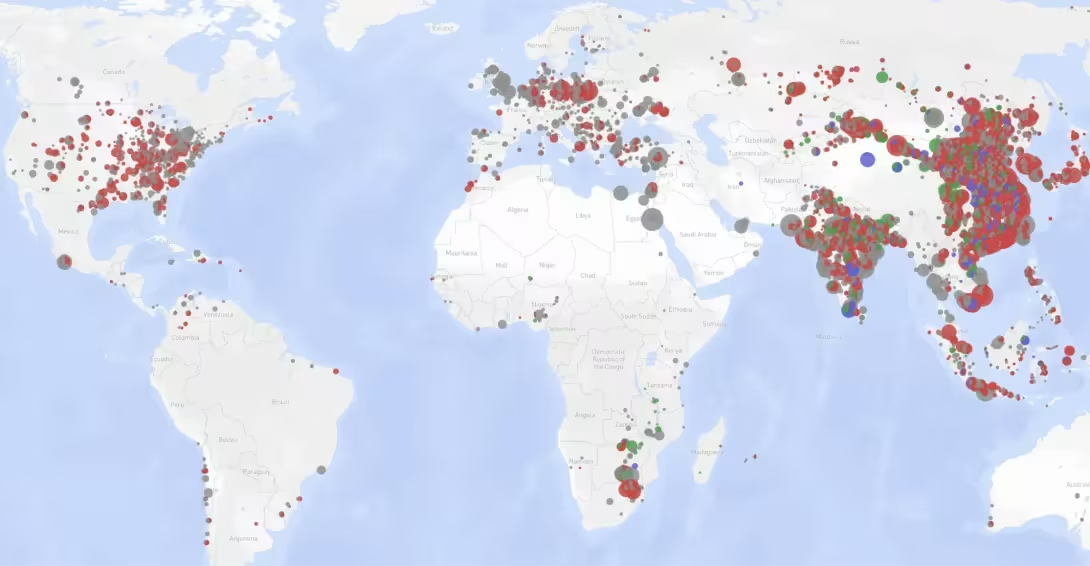
The colors indicate the status category:
- Announced: Projects that have been publicly reported but have not yet moved actively forward by applying for permits or seeking land, material, or financing. Examples: (1) projects are the potential “Phase II” at a location where “Phase I” is currently under development, (2) Projects that are described in long-range company or governmental planning documents.
- Pre-construction: Projects that are actively moving forward in seeking governmental approvals, land rights, or financing.
- Construction: Projects where physical construction (i.e. equipment or building, not just a ground-breaking ceremony or early site preparation) has begun.
- Shelved: Projects where sufficient evidence is found to indicate that it is no longer moving forward. A project that shows no activity over a period of 2 years is categorized as “Shelved – inferred 2 y”. Projects where construction has been put on hold for over 2 years are also designated “Shelved.” If a company or government announces that a project is on hold, it is marked shelved until it meets the criteria for cancellation (below).
- Cancelled: In some cases, an owner announces that it has cancelled a project. More often, a project fails to advance and then quietly disappears from company documents. A project that was previously in an active category is moved to “cancelled” if it disappears from company documents, even if no announcement is made. In addition, a plant that shows no activity over a period of 4 years is categorized as “cancelled – inferred 4 yr”.
- Operating: The project has been formally commissioned; commercial operation has begun.
- Mothballed: Units that are disused but not dismantled.
- Retired: Units that have been permanently decommissioned.
Each unit location is marked “exact” or “approximate.” In the case of exact coordinates, locations are either specifically identified on a mapping service such as Google Maps, Open Street Maps, etc., or gathered from company or government documentation. If the location of a unit is not known, Global Energy Monitor identifies the most accurate location possible based on available information.
If a project is still in the pre-operational phases (announced, pre-construction, or construction), there may be no sign of activity. In other cases, only approximate location information could be found. Finally, satellite photos in some geographies are updated infrequently, so recent activity is not shown.
Location accuracy improves as plants move from early stages of development toward operation. To find out the coordinates of a location and whether a location is exact or approximate, click on the location dot, select the wiki page, and look under “Project Details.”
The objective of the tracker is to provide information on oil and gas-fired power plants in the operational or developmental phases since 2020. Plants that were cancelled or retired before 2020 are not included.
The tracker covers units totaling 50 MW or more (20 MW or more in the EU and UK) at a given location. For combined cycle units, this threshold applies to the entire combined cycle set and not to individual components. For internal combustion units, or those units that have multiple identically sized engines, the threshold applies to the total capacity of the set of engines.
Capacity is measured in gross megawatts, prior to subtracting capacity used for plant operations.
As of the July 2022 update, the tracker explicitly tracks coal to gas conversions or replacements. The tracker includes coal plants that have announced or are in the process of a switch from coal to gas as a fuel source. These coal-to-gas conversions are added as “announced”, “pre-construction”, or “construction” into the GOGPT until the conversion is completed, when the status is switched to “operating”.
The data does include LNG power projects, and these are distinguished by a “Fuel type” of “LNG,” but we do not have a separate list of these at this time.
The tracker provides separate data on each of the multiple power-generating facilities that typically exist at a particular location. Each of these facilities is referred to as a “unit.” The entire collection of units at a given location is referred to as a “plant.”
Please fill out an error report here.
The tracker was designed and produced by Global Energy Monitor. To the greatest extent possible, the information in the tracker has been verified by researchers familiar with particular countries.
Contact
For questions about the Global Oil and Gas Plant Tracker, contact Jenny Martos: