
country/areas included
chemical plants tracked
primary chemicals tracked
plant owners
Overview
Global Energy Monitor's Global Chemicals Inventory (GChI) tracks production of eight building block chemicals worldwide, revealing feedstock dependencies and ownership patterns that underpin future decarbonization pathways for the chemical sector.
The Global Chemicals Inventory provides information on global production of eight “building block” chemicals: ethylene, propylene, and butadiene (“olefins”); benzene, toluene, and xylene (“aromatics”); ammonia; and methanol. The GChI was developed as a joint effort between Global Energy Monitor and the Spatial Finance Initiative. The Spatial Finance Initiative is hosted at the Oxford Sustainable Finance Programme at the University of Oxford.
The GChI includes plant-level data on location, ownership, primary and secondary chemical products, and feedstocks. It comprises facilities that produce any of the eight building block chemicals, including standalone chemical plants, oil refineries, integrated refinery and chemical complexes, and ammonia and methanol production facilities. Each of these plant types consist of multiple units, which vary depending on chemical type and production method. Each plant included in the inventory is linked to a wiki page on GEM.wiki that provides additional details.
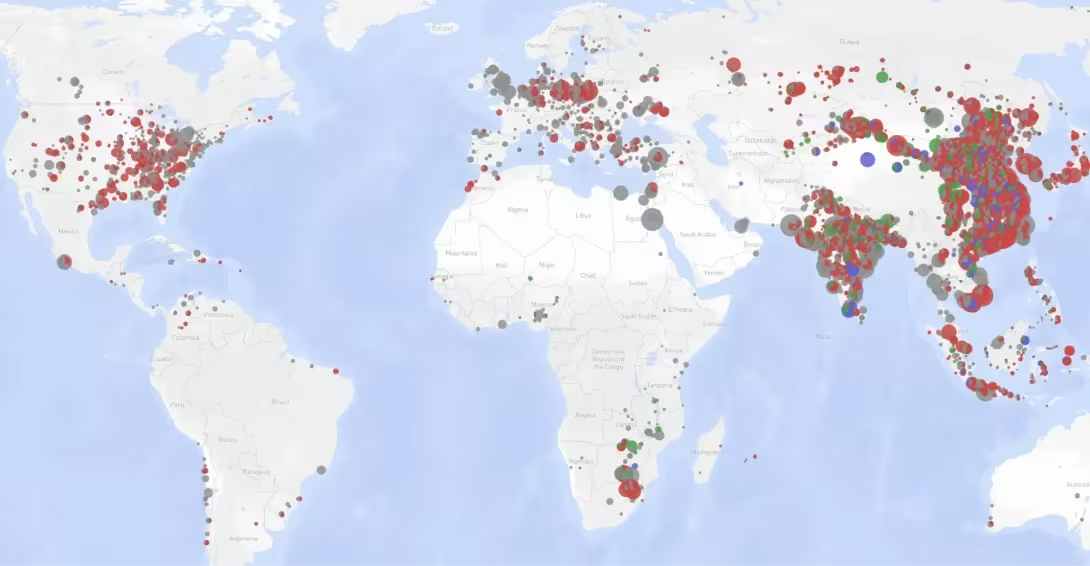
China dominates global chemical production, with over 40% of total operating chemical plants.
These eight building block chemicals account for roughly two-thirds of total energy demand in the global chemicals industry.
Natural gas and coal derivatives are the most common global feedstocks used in building block chemical production.
What's inside?

Methodology
The Global Chemicals Inventory, a joint effort from Global Energy Monitor and Spatial Finance Initiative, uses a two-level system for organizing information, consisting of both a database and wiki pages with further information. The database tracks individual chemical plants and includes information such as plant owner, location, operating status, primary and secondary chemical products, and feedstocks. A wiki page for each plant is created within GEM.wiki, and aims to contain more detailed, footnoted information such as plant history and ESJ issues.
A preliminary list of chemical plants in each country/area was gathered from public and private data sources, including Spatial Finance Initiative’s Petrochemical Production Databases and data from various company and government sources. Data was included for chemical plants operating as of September 1, 2025. The data was then vetted against additional sources of information, listed below.
Chemical plant data is updated and maintained through five main sources:
- Corporate reports and data sources from chemical plant owner and parent companies
- Government data on individual refineries and chemical plants
- Reports by national and regional chemical industry groups
- News and media reports
- Reports from chemical technology manufacturers
Where possible, chemical plant data is circulated for review to researchers familiar with local conditions and languages. The Spatial Finance Initiative prepared the preliminary list of global ethylene and ammonia plants and also served as reviewers of the full list of global chemical plants. The Spatial Finance Initiative is hosted at the Oxford Sustainable Finance Programme at the University of Oxford.
The majority of research was completed through conventional internet searching and reviews of published datasets, reports, and news articles. AI tools including ChatGPT and DeepSeek were used to support and deepen these research efforts in the following ways:
- Search for information sources not found through conventional means.
- Identify and explain feedstock types.
- Summarize asset information for GEM wiki pages.
All information presented through the use of AI was vetted by human researchers for accuracy, with a focus on identifying miscommunication of reported information and hallucination of facts. In cases where AI-reported information was used, primary sources are linked. All text generated through AI was edited and drafted by GEM staff.
For each chemical plant, a wiki page is created on Global Energy Monitor’s GEM.wiki. Wiki pages provide a repository for plant details including plant owner, plant status, chemical product and feedstock information, and location (coordinates and map), as well as additional in-depth information that may include plant background, financing, environmental impacts, raw material sourcing, finished product uses, public opposition, and aerial photographs. Under standard wiki convention, all information is linked to a published reference, such as a news article, company or government report, or a regulatory permit. In order to ensure data integrity in the open-access wiki environment, Global Energy Monitor researchers review all edits of project wiki pages.
The November 2025 release of Global Energy Monitor and Spatial Finance Initiative’s Global Chemicals Inventory only includes plants that are operating as of September 1, 2025. An operating chemical plant is currently producing at least one of the eight tracked chemicals.
Primary products: This chemical product category includes any of the eight tracked chemicals produced on-site: ethylene, propylene, and butadiene (“olefins”); benzene, toluene, and xylene (“aromatics”); methanol; and ammonia. These chemical products are denoted as “Primary” even if they are consumed immediately downstream. In the few instances where the exact type of olefin or aromatic is unconfirmed, the primary product is listed as “olefins (unknown type)” or “aromatics (unknown type),” respectively.
Secondary products: This chemical product category includes any chemical other than the Primary products that are known to be made on-site (e.g., polyethylene, fertilizers, gasoline). These chemical products are denoted as “Secondary” even if they are the main economic product at the chemical plant, and are not comprehensive.
The feedstock accuracy indicates the confidence level of the identified feedstock.
Exact: The plant’s feedstock is explicitly confirmed by a credible source, such as company reports or government data.
Assumed: The plant’s feedstock is inferred based on process type and/or region (e.g., steam methane reforming implies natural gas), but is not explicitly stated in publicly available documentation.
Unknown: No credible source is available to explicitly identify the plant’s feedstock or to serve as the basis for an assumption of the plant’s feedstock.
To allow easy public access to the results, Global Energy Monitor worked with Earth Genome to develop a map-based and table-based interface. In the case of exact coordinates, locations have been visually determined using Google Maps, Google Earth, Planet Labs, or Wikimapia. If the location of a plant is not known, GEM identifies the closest approximate location.
Frequently Asked Questions
The Global Chemicals Inventory comprises an inventory of global chemical plants, including location, immediate ownership, primary and secondary chemicals produced, and the feedstocks used in their production. GEM trackers typically include the previously mentioned data types, plus unit-level capacity and production data, all operational statuses including proposed and under construction plants, full parent ownership trees, and other plant- and unit-level details. The Global Chemicals Inventory provides the foundation to develop the full Global Chemicals Tracker with plans for release in Q4 2026.
Each plant location is marked “exact” or “approximate.” In the case of exact coordinates, locations have been visually determined using Google Maps, Google Earth, or Wikimapia. If the location of a plant is not known, GEM identifies the most approximate location.
To find out the coordinates of a location and whether a location is exact or approximate, click on the location dot, select the wiki page, and look under “Project Details.”
In some cases, only approximate location information could be found. Additionally, satellite photos in some geographies are updated infrequently, so recent activity is not shown.
Yes, click on “Table view” on the bottom of the map.
The Global Chemicals Inventory aims to include all operating chemical plants that produce at least one of the eight tracked chemicals in each country or area, regardless of size.
The standard naming convention of the Global Chemicals Inventory is “[Company] [Municipality] Chemical Plant”. Some plants are given unique names by the owners, or based on local conventions that fall outside of the standard naming convention. Those unique names are indicated when relevant.
The GChI tracks global production of eight “building block” chemicals: ethylene, propylene, and butadiene (“olefins”); benzene, toluene, and xylene (“aromatics”); ammonia; and methanol. Where possible, the GChI also tracks secondary chemical products produced within the same plants that produce one of the eight primary chemical products.
Yes, chemical plants can produce one or more of the eight primary chemical products tracked by the GChI, plus any number of other secondary chemical products that are produced on-site within the same chemical plant.
As there are many thousands of distinct chemical products, it is important to distinguish which chemicals fall within the scope of the Global Chemicals Inventory. The chemicals tracked within this dataset are categorized as follows:
- Primary products: This chemical product category includes any of the eight tracked chemicals produced on-site: ethylene, propylene, and butadiene (“olefins”); benzene, toluene, and xylene (“aromatics”); methanol; and ammonia. These chemical products are denoted as “Primary” even if they are consumed immediately downstream. In the few instances where the exact type of olefin or aromatic is unconfirmed, the primary product is listed as “olefins (unknown type)” or “aromatics (unknown type),” respectively.
- Secondary products: This chemical product category includes any chemical other than the Primary products that are known to be made on-site (e.g., polyethylene, fertilizers, gasoline). These chemical products are denoted as “Secondary” even if they are the main economic product at the chemical plant, and are not comprehensive.
Any Secondary chemicals other than the eight Primary chemicals products that are known to be made on-site are included in the data for a given chemical plant. The list of Secondary chemical products is not comprehensive. Secondary chemicals are only listed if they are confirmed to be made on-site according to credible public sources. A given plant could have no Secondary chemical products listed because it only produces Primary chemical products, or because no credible data source is available to confirm any Secondary chemical production.
Feedstocks are the raw materials which are converted into chemical products through industrial processes. The summary tables contain regional plant information summarized by feedstock type. Given the wide array of feedstocks utilized by the global chemical industry, the feedstocks are combined into categories with similar characteristics:
- Natural Gas and Derivatives: This category includes plants that use some combination of Natural Gas, Methane, Ethane, Propane, Butane, Natural Gas Liquids (NGL), Liquefied Natural Gas (LNG), Liquid Petroleum Gas (LPG), or Coal Bed Methane as feedstocks.
- Coal and Coke: This category includes plants that use some combination of Coal, Coke, or Coke Oven Gas as feedstocks.
- Crude Oil and Non-Naphtha Fractions: This category includes plants that use some combination of Crude Oil, Condensate, Fuel Oil, Gas Oil, Heavy Fuel Oil, Heavy Oil, Hydrotreated Residue, Light Oil, Pyrolysis Oil, or Vacuum Gas Oil as feedstocks.
- Naphtha: This category includes plants that primarily use Naphtha (a fossil-based hydrocarbon mixture, generally a fraction of crude oil) as feedstock.
- Hydrogen and Carbon Dioxide: This category includes plants that use some combination of Hydrogen, Green Hydrogen, or Carbon Dioxide as feedstocks.
- Intermediate Chemicals: This category includes plants that use some combination of Acetic Acid, Benzene, Ethylene, Methanol, Mixed C4s, Mixed Xylenes, Propylene, Pyrolysis Gasoline, Reformate, or Sulfuric Acid as feedstocks.
- Bio-based: This category includes plants that use some combination of Biomass, Bioethanol, Bio-oils, Biogas, or Biomethane as feedstocks.
- Unknown: This category includes plants in which the feedstock is unknown.
- Multi-category: This category includes plants that use feedstocks from 2 or more of the above categories.
The GChI reports the first owner/operator of the plant in the “Owner (English)” column along with their percent stake in the plant. If there is an owner with no stake percentage listed, the exact percentage data has not been confirmed.
Please fill out an error report here.
The inventory was designed and produced by Global Energy Monitor. To the extent possible, the information in the inventory has been verified by researchers familiar with particular countries/areas. The following people participated in plant-by-plant research: David Kampmann (Spatial Finance Initiative), Smriti Jalihal (Spatial Finance Initiative), Christophe Christiaen (Spatial Finance Initiative), Alok Singh (Spatial Finance Initiative), Neetu Kushawa (Spatial Finance Initiative), Ben Caldecott (Spatial Finance Initiative), Joe Hittinger (Global Energy Monitor), Caitlin Swalec (Global Energy Monitor), Charmaine Dalisay (Global Energy Monitor), Fanwei Liu (Global Energy Monitor), Henna Khadeeja (Global Energy Monitor), Jessie Zhi (Global Energy Monitor), Norah Elmagraby (Global Energy Monitor), Rolando Almada (Global Energy Monitor), Zhanaiym Kozybay (Global Energy Monitor), Ziwei Zhang (Global Energy Monitor), and Charlene Hou (formerly Global Energy Monitor). The project is managed by Joe Hittinger within GEM’s Heavy Industry Program, managed by Caitlin Swalec, with support from Louisa Plotnick, Ted Nace, and Justin Locke.
Please refer to the Download Data section for citation guidance.
Contact
For questions about the Global Chemicals Inventory, contact Joe Hittinger: