
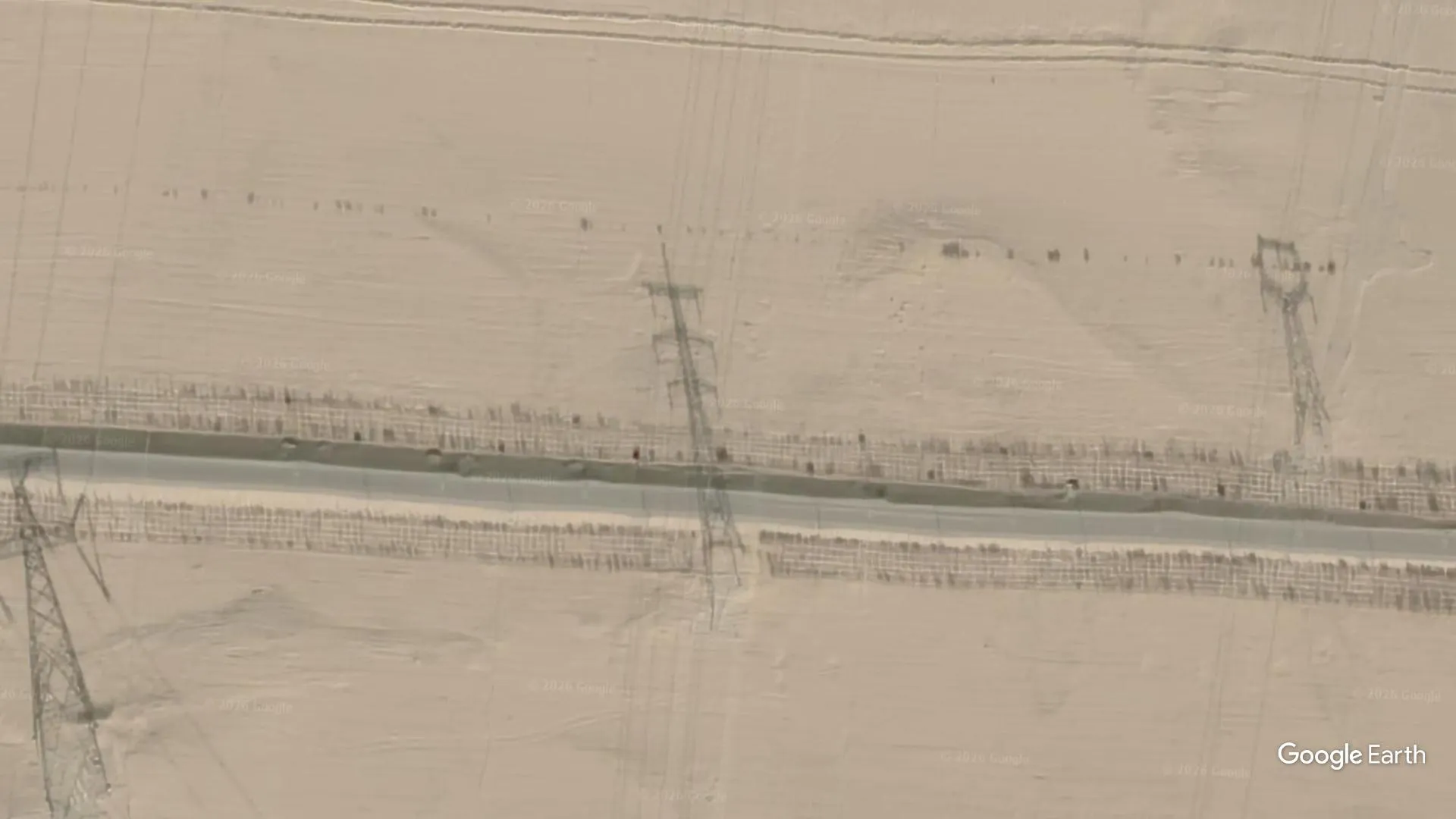
But not all of this additional renewable power can be used on the grid.
Transmission bottlenecks remain a major contraint, while dispatch practices, electricity-market arrangements and coal-related incentives, including long-term contracts, can further limit system flexibility. The result is rising curtailment — wind and solar output that could have been generated under prevailing weather conditions, but was instead reduced or withheld.
Megabases learn to “stand on two legs”
Facing transmission restraints and rising curtailment at a time when supportive policies are fading, renewable generators are increasingly left to compete on the open market. Policymakers are encouraging renewables-rich regions to utilize green electricity locally by attracting high-consumption industries close to where it is generated. Alongside outbound transmission as the primary pillar, local industrial use forms a “second leg” for the megabase model.
These industries fall into two categories: direct electricity users, such as data centers, computing facilities, and advanced manufacturing; and indirect users, including heavy industry that relies on renewable-derived feedstocks and fuels such as green hydrogen, green ammonia, and green methanol.
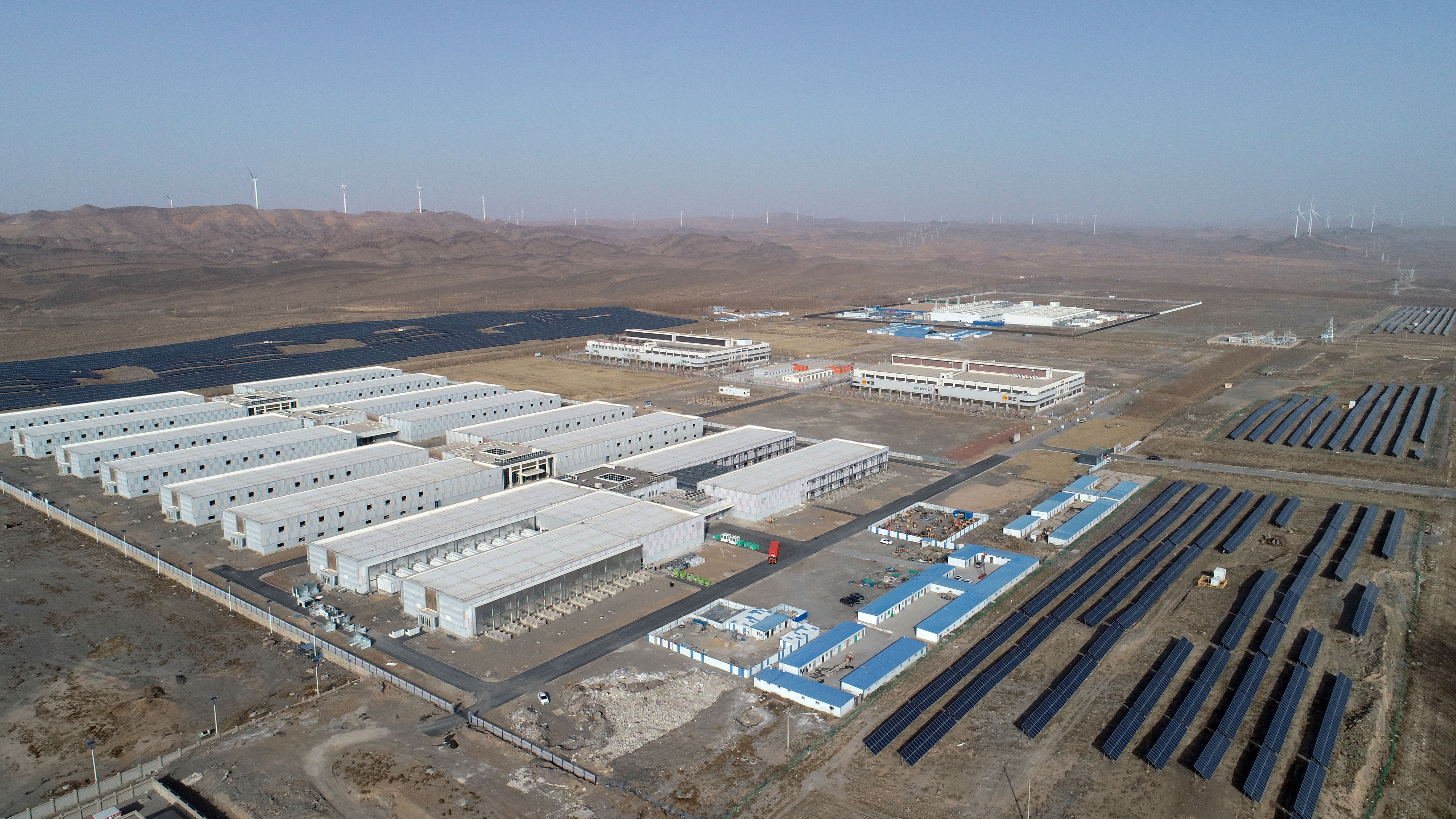
A data center in Zhongwei, Ningxia. Image: Xinhua/Shutterstock
China’s rapidly expanding, standalone battery storage and green hydrogen sectors best illustrate these trends. Standalone battery projects are increasingly used to provide around-the-clock power to industrial users requiring a stable electricity supply. Following the removal of mandatory storage requirements for new renewable projects in 2025 and the introduction of capacity payments for standalone storage in 2026, investment has shifted from co-located storage toward grid-tied standalone battery systems.
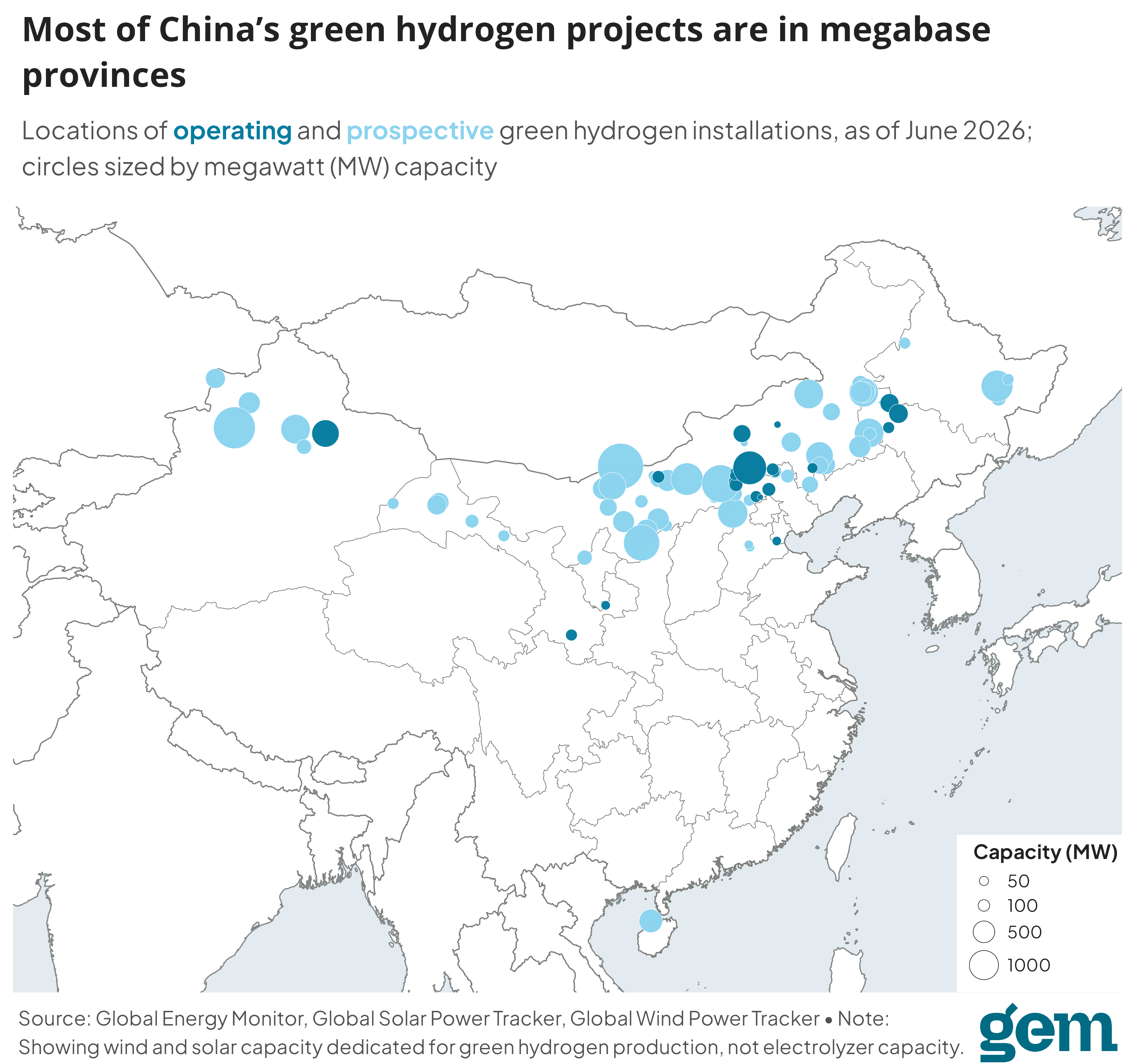
Green hydrogen is also expanding rapidly. According to GEM, China already has more than 10 GW of wind and solar capacity dedicated to green hydrogen production, yielding at least 250,000 tonnes per year, nearly eight times the operating green hydrogen capacity across the rest of the world.
GEM data show an additional 53 GW of wind and solar capacity dedicated to green hydrogen production under development, capable of producing 1.6 million tonnes annually.
Green hydrogen projects are currently concentrated in provinces with high renewable penetration and strong policy support. In Inner Mongolia, for example, around 12% of all prospective wind and utility-scale solar capacity is earmarked for green hydrogen production.
Coal lock-in risks cast a shadow over megabase localization
Many of China's renewables-rich regions are also major coal-producing areas. While renewable development creates opportunities for economic diversification and industrial transformation, it can also provide a new rationale for expanding coal-based industries. The coal-to-chemicals sector illustrates this risk.
According to new GEM research, all coal-to-olefins projects currently under construction in China’s northwestern and northern regions include planned associated green hydrogen facilities, as regulators increasingly require renewable integration as a condition for project approval. However, in many cases, the renewable component represents only a small fraction of overall energy use.
Baofeng Energy, the world’s largest coal-to-olefin producer, provides a notable example. Its flagship coal-to-olefins project in Inner Mongolia, commissioned in 2025, is paired with a 1 GW co-located wind and solar project that could reduce coal consumption by approximately 210,000 tonnes per year. Yet this represents just 2.2% of the facility’s total annual coal consumption.
In such cases, renewable integration accounts for a relatively small cost of securing project regulatory approval. This raises the risk that renewable energy would only supplement, rather than replace, coal consumption, and could enable the continued expansion of fossil-based industries under a lower-emissions label.
The 15th Five-Year Plan for the energy sector sets modest renewable goals while leaving room for fossil fuels
China has demonstrated both the political commitment and industrial capability to deploy renewable energy at an unprecedented scale. The remaining question is whether this expansion can accelerate the transition away from coal.
The newly released Five-Year Plan for the energy sector (2026–2030) continues renewable expansion but also preserves room for fossil fuel growth to support energy security and economic development.
While the plan states that coal and oil consumption will peak during this period, coal-fired generation could still rebound if electricity demand growth outpaces renewable deployment due to constraints in grids, markets, storage, and demand response. Gas consumption is expected to continue increasing beyond 2030.
Additionally, the target to increase northwest–to–east power transmission capacity from 340 GW to 420 GW appears conservative. The additional 80 GW is equivalent to roughly ten UHVDC lines, and not all capacity would serve wind and solar megabases, as some would support hydropower exports.
This suggests that previously announced plans by State Grid to build fifteen new UHVDC transmission lines are not fully reflected in the 15th Five-Year Plan, and power transmission is likely to remain a bottleneck for renewable megabases.
Next steps should focus on accelerating decarbonization
While the megabases are learning to stand on two legs — power transmission and local utilization — multiple industries seek opportunities from this transition to maximize their interests. Amid competing priorities, policymakers should keep the original objective firmly in sight: The purpose of the renewable megabases is to accelerate decarbonization across the entire country.
This will require a decisive shift in policy toward prioritizing renewable energy over fossil fuels. Since 2022, China has followed the principle of “establishing the new before phasing out the old” to guide its energy transition. This approach has driven unprecedented investment in both renewable and fossil fuel infrastructure over the past four years.
As the carbon peak target approaches, policy emphasis will need to shift toward the second half of this principle, phasing out the old.
Ultimately, the success of China’s renewable megabases will be measured not by how many gigawatts are added, but by how much coal they displace.
Media contacts
For questions about the report, contact Aiqun Yu or James Norman.