
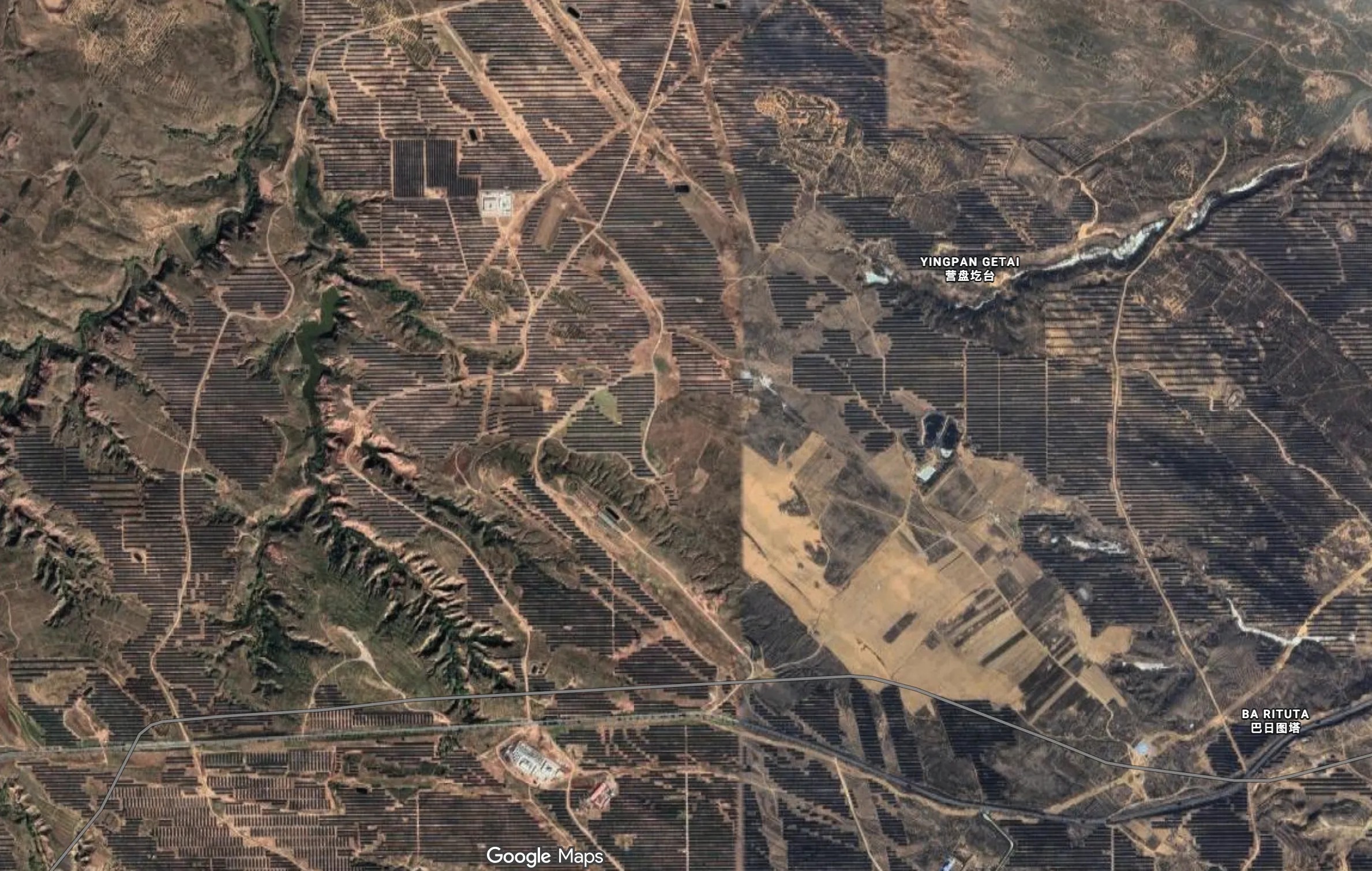
Picture a dry tract of land at the base of a mountain range. This now-abandoned plot once used for mining coal was a source of economic vitality for a nearby city of more than three million people. But now, erosion, chemical runoff, and habitat loss are evident on the scarred landscape.
Now imagine that land transformed by the installation of solar panels to provide reliable, clean energy to the city, the barren ground turned into a park that restores nature’s gifts.
Consider rows of solar panels providing reliable, clean power to the city. Meanwhile, native vegetation restores soil, water, and habitat, changing a damaged landscape into a living park.
This is China’s Shanxi Province, the country’s coal mining powerhouse, with coal dominating the region’s economy.
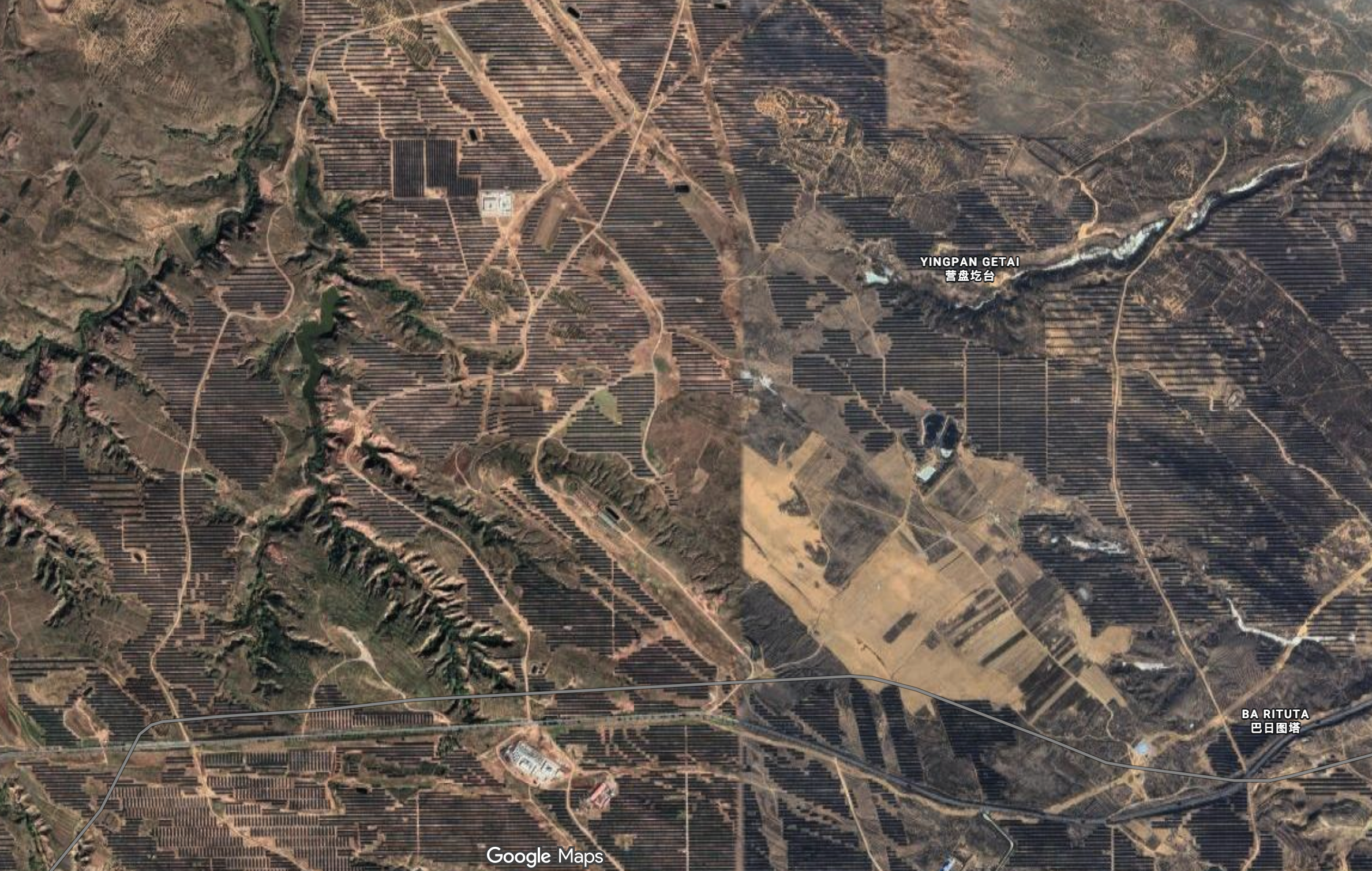
Tianjiao Green Power solar farm, located on a former coal mine in Ordos, Inner Mongolia
This type of transformation is an enormous opportunity that China is starting to capitalize on, and asset-level energy data plays a fundamental role carrying out this vision strategically. In the city of Datong, three abandoned coal mines to solar projects, totaling 5,000 megawatts, are currently being built and expected to come online in 2026 and 2027.
China leads the world in both renewable energy development and coal consumption. As the world’s largest consumer of electricity, the country plays a pivotal role in the global energy transition. Keeping an eye on progress toward clean energy is done at the granular level, where real trends are uncovered. To this end, GEM extensively researches China’s power sector, and although the China research team is now sixteen employees strong, it began with just a few people and a bold vision.
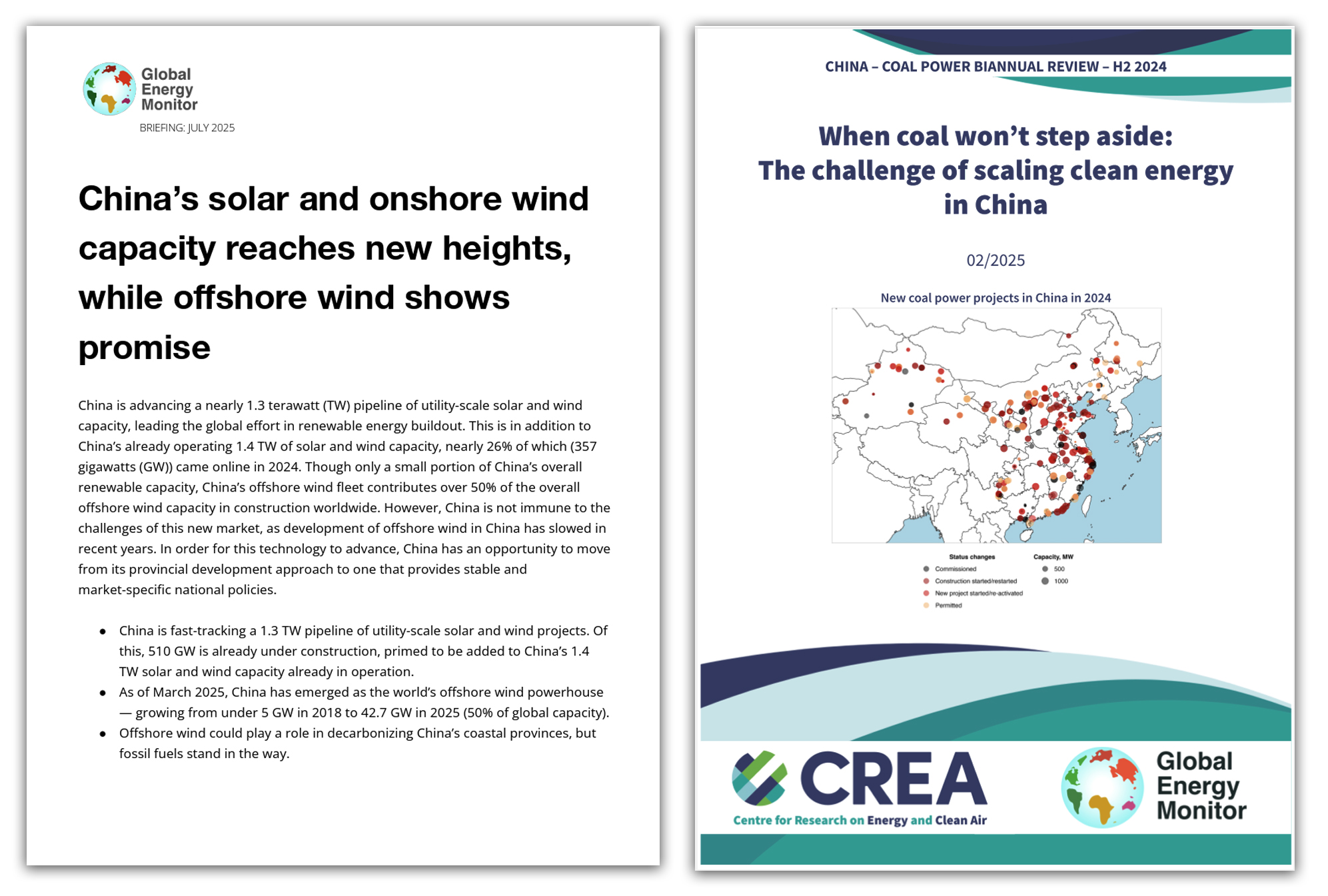
Two recent articles by GEM on the power sector in China, available at the links in the previous paragraph
In 2014, GEM — then a very small nonprofit known as CoalSwarm — hired Aiqun Yu to track China’s energy infrastructure. At the time, no open information was available on China’s coal power fleet. Commercial databases were expensive and often inaccurate and incomplete. The government would release aggregate top-line figures. Aiqun created the China tracker from scratch, piecing the puzzle together from scattered information in bureaucratic government documents, company financial reports, and news articles.
In 2015, GEM launched the Global Coal Plant Tracker (GCPT), the world’s first and most complete publicly available dataset tracking coal plants down to the asset level. The tracker doesn’t just look into which coal plants are currently operating; it also keeps tabs on every stage in the life cycle of a plant, from announced to retired and many stages in between. The tracker has a footnote linking each facility to a GEM.wiki page, essentially a biography for every single coal power plant in the world. This wealth of detail has important implications for forecasting the future of every energy source in any given country or region.
GEM now maintains 26 asset-level trackers all developed and updated through meticulous research across different languages and sources. Christine Shearer, GEM’s GCPT Project Manager, explains that partner organizations are irreplaceable in ensuring the reliability of the data. For example, partners in Indonesia have taken photos of a coal plant because none could be found online and then shared the geocoordinates so the asset can be properly mapped on the GCPT Tracker Map. GEM staff reciprocate: Christine recalls a rewarding trip to Indonesia after a conference to see the Trend Asia office — which has a fascinating mural of Indonesia’s history — and to work with her colleagues in person.
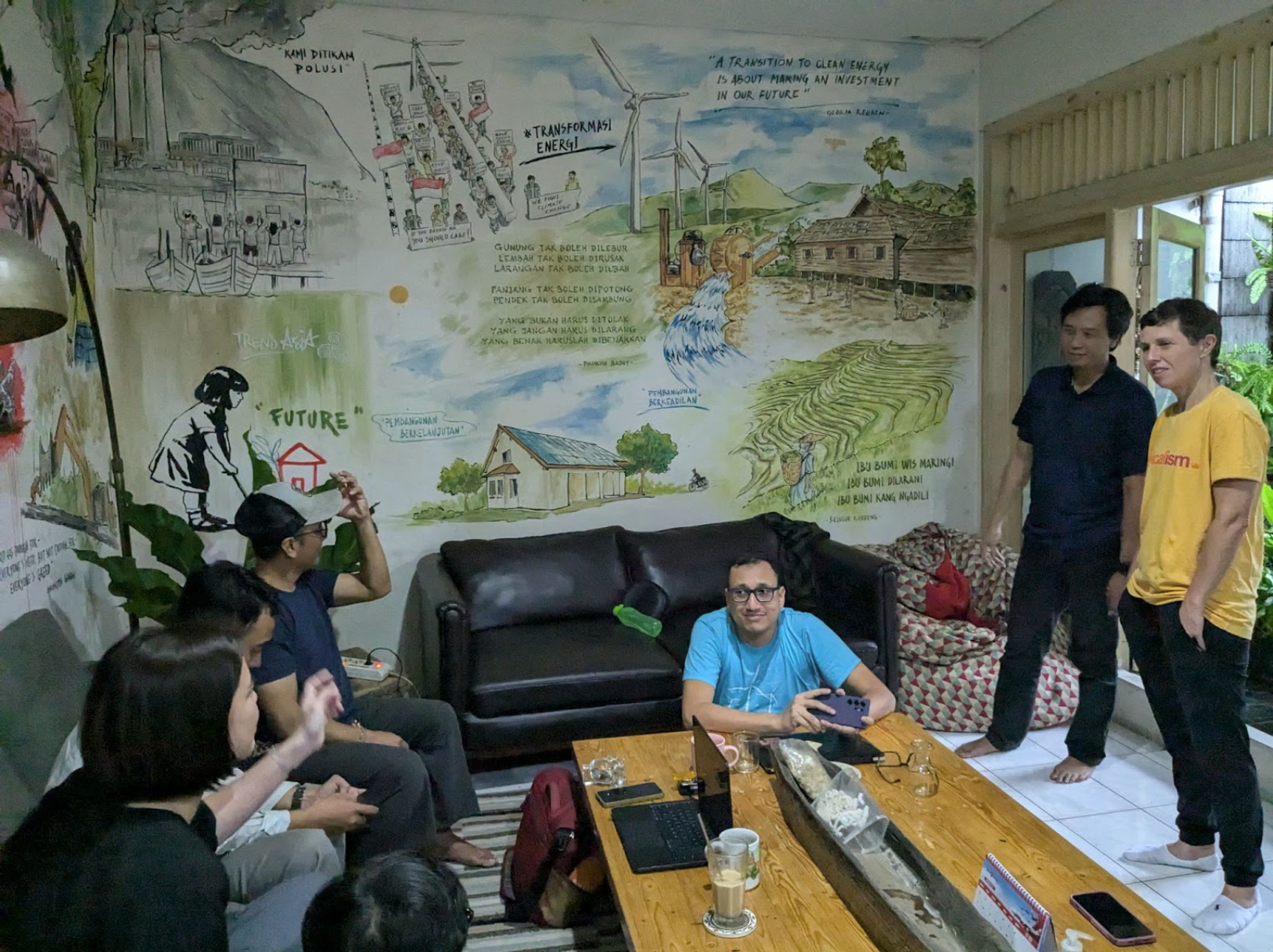
Christine (right) with Trend Asia partners in their office in Indonesia
Shearer emphasizes that GEM’s commitment to thorough research and tracking all stages of an asset’s life cycle allows analysts to not only see what’s happening today in a country like China that would otherwise be impossible to decipher, but also predict what’s coming — sometimes in stark contrast to what might be circulating in the public discourse.
GEM research acts as an early warning system, calling out new plants in development and identifying how that reality stacks up against a country’s targets.
This data doesn’t just fuel GEM’s own analysis. Thousands of NGOs, governments, journalists, and investors rely on GEM data to deepen their research and inform decision making. Yujia Han, a researcher for GEM’s renewables and other power program who works on GEM’s collaborative China team, knows countless colleagues and friends who work in the energy field and regularly rely on GEM’s data — such as at the New Climate Institute and Tsinghua University, one of GEM’s most frequent data users. In the words of Xiaoli Zhang of Georgetown University:
GEM's database has been an indispensable resource for my research on clean energy transition tracking and modelling over the years. I deeply appreciate the team's persistence in maintaining accurate, transparent, and regularly updated data. I'm also deeply inspired by their commitment to providing accessible information to advance a sustainable future.
- Xiaoli Zhang, Georgetown University
Yujia previously worked for the International Energy Agency (IEA) and Peking University, where GEM’s data informed key analyses. At the IEA, she used the Global Iron and Steel Tracker to model the benefits of extending China’s emissions trading system to the industrial sector. At Peking University, GEM data supported her research identifying “low-hanging fruit” for coal plant retirements, leading to opportunities to cut emissions while improving health and environmental outcomes.
In the coming year, GEM’s cross-departmental China research team will add new and updated asset-level power sector data and make the information available through the Global Integrated Power Tracker, enhancing the coverage of an open data tool that is already one of the most comprehensive of its kind. The team also produces analyses that shape the global narrative on China’s energy sector, such as:
- “China’s solar and onshore wind capacity reaches new heights, while offshore wind shows promise” by Yujia Han, Mengqi Zhang, and Janna Smith
- “Coal is losing ground, but not letting go: Structural inertia and the struggle to shift coal’s role in China’s power system” by GEM’s Christine Shearer and Qi Qing of CREA, a close partner of GEM on China power sector research
- “China’s ‘capacity payments’ boosted coal-plant revenue by up to 8%,” a guest post published in CarbonBrief by GEM coal researcher Mingxin Zhang
These publications and GEM’s tracker data are widely cited by sources such as the Financial Times, The Guardian, South China Morning Post, Bloomberg, Associated Press, Reuters, CNN, Forbes, PolitiFact, and NPR’s Planet Money.
The global goal to limit planet warming to well below 2° sounds straightforward, but progress is made up of countless individual, asset-level steps that are essential along the way — an LNG pipeline plan shelved, a steel plant converted to clean energy sources, or an abandoned coal mine converted to a solar farm. Because GEM’s data are not just open access but also free of charge, they have become foundational to anyone seeking to analyze the energy landscape and predict what’s coming next. Safeguarding trustworthy, open data in this pivotal moment of the energy transition continues to be GEM’s calling, and when it comes to a country as influential as China, this work has never been more important.