Wind and solar power have become the main drivers of the global clean energy transition. As their share in electricity systems grows, the need for system flexibility resources, such as energy storage, increases. China, the U.S., and the EU lead on global energy storage installations, while emerging markets, such as Chile, are planning notably high shares of energy storage colocated with wind and solar, supporting ambitious renewable expansions.
Energy storage is a critical enabler for integrating variable renewables like wind and solar. Tracking energy storage deployment across countries and regions offers a clear view of power system evolution. This helps explain not just that renewable energy is expanding, but reveals how grids are adapting to integrate higher shares of renewables and move toward flexible, reliable, and decarbonized energy systems.
The global energy storage boom is powering wind and solar integration
Global Energy Monitor (GEM) data from the 2026 release of the Global Wind and Solar Power trackers show that the combined global installed capacity of wind and solar has reached 3,222 gigawatts alternating current (GWac). Wind and solar accounted for more than 70% of all new electricity capacity growth globally in the past five years, underscoring the central role of these power sources in system growth worldwide.
Since wind and solar output vary with weather and time of day, higher deployment levels increase the need for system flexibility to balance real-time electricity supply and demand. Globally, energy storage projects are being deployed at scale to ensure secure integration of renewable capacity and to enable increasing wind and solar buildouts to start to displace fossil fuel generation.
Battery energy storage systems (BESS) account for the majority of new storage additions because of their strong integration with wind and solar power, as well as technological improvements. From 2010 to 2024, battery storage costs declined by 93%, which has enabled the rapid scaling of BESS deployment. BESS can be configured in different ways to provide support across the grid. Colocated BESS projects primarily smooth renewable output, support renewable integration, and reduce curtailment. Standalone grid-connected BESS projects provide frequency regulation, capacity, and energy arbitrage. Distribution-level BESS projects alleviate local congestion and support voltage control. Behind-the-meter BESS projects reduce peak demand, provide backup power, and shift consumption to lower‑cost periods. Realizing the potential of these services depends on effective market design and regulation.
In response to the uptake of energy storage, GEM has begun tracking the presence of storage associated with wind and solar power plants when data are readily available. At present, GEM is tracking 2,144 utility-scale solar farms and 822 wind farms globally with associated storage systems. China, Greece, and Australia are planning the most storage projects associated with wind and solar farms. China dominates the refinement and processing of battery raw materials, making it the primary hub of the global battery supply chain.
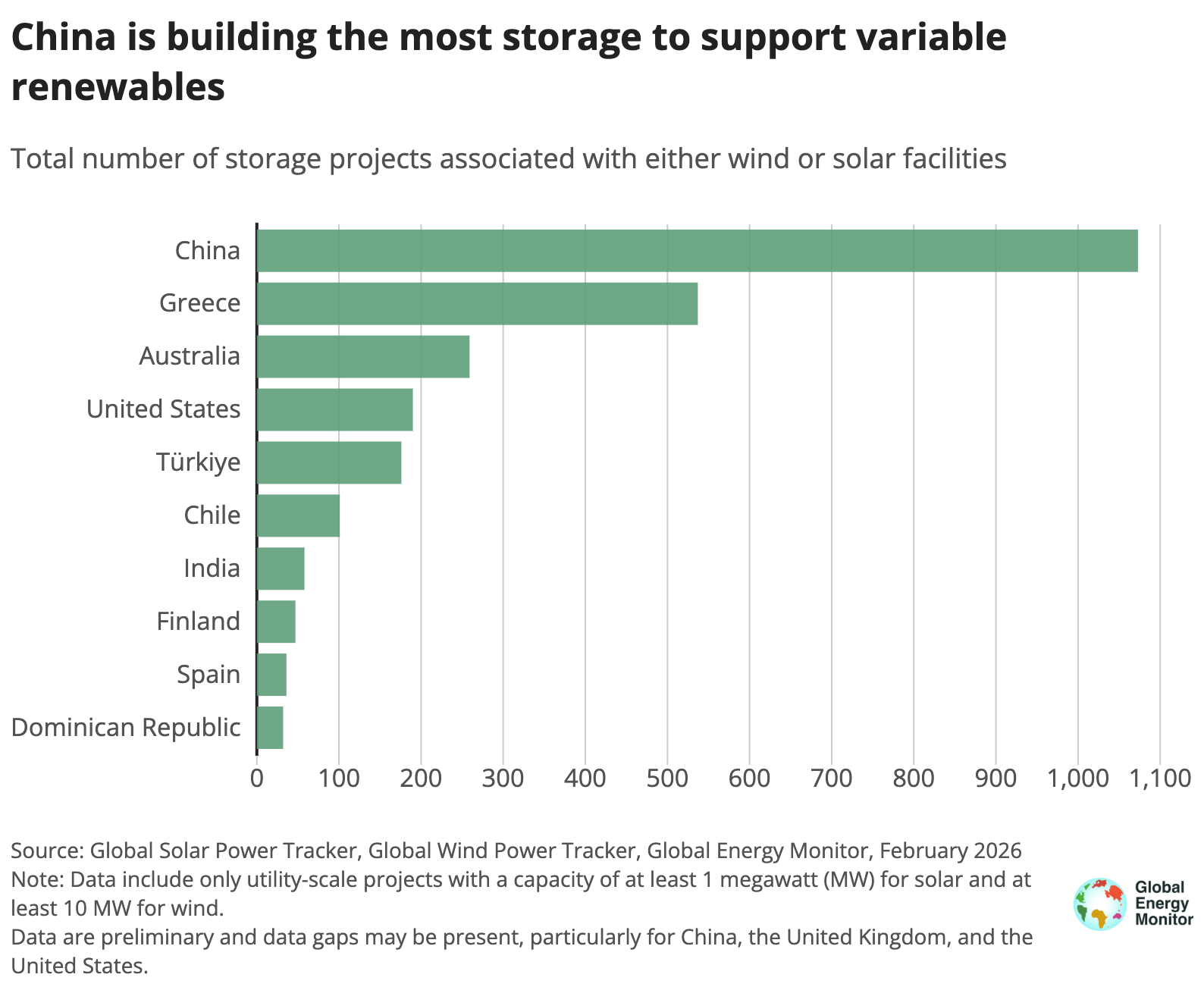
Figure 1
Although China, the U.S., and the EU lead the world in total energy storage capacity, many emerging markets are planning a significant share of storage paired directly with their planned wind and solar buildouts. COP31 hosts Türkiye and Australia are leading this trend, showing that combining renewable generation with energy storage can be cost‑competitive, provide reliable electricity, and reduce reliance on fossil fuels. Nigeria is deploying BESS to support its 4,200 megawatt (MW) solar expansion target by 2030 and strengthen the country’s evolving power system. Most of the planned BESS installations in Nigeria are colocated with solar plants and are relatively small in capacity. The growth of colocated BESS reflects an early stage of system modernization, setting the foundation for larger standalone and distribution-level storage to deliver broader grid services in the future.
Figure 2
Chile leads Latin America in BESS deployment
Chile occupies a strategic energy position, as a country rich in renewable resources and critical energy transition minerals. BESS is set to play a central role alongside continued wind and solar expansion, as the country continues on its pathway to achieving at least 80% renewable electricity generation by 2030.
With some of the world’s strongest solar resources and significant wind potential, Chile has seen rapid growth in solar and wind capacity over the past decade. As of February 2026, Chile reached nearly 19.2 GWac of total operating capacity between the two sources, with 60.4 GWac of prospective capacity in the pipeline. This expansion has been accompanied by rising curtailment and increased price volatility as the system absorbs increasing variable generation while facing persistent transmission constraints, particularly between northern generation hubs and central demand centers, as well as a lack of flexibility in the electricity system.
Since Chile allowed energy storage to participate in electricity markets for energy arbitrage and capacity payments in 2022, BESS deployment has accelerated. Chile currently leads Latin America in installed BESS capacity. GEM data show that Chile currently has 1.6 GW (6.5 gigawatt-hours (GWh)) of operating BESS and roughly 7.7 GW (34 GWh) under construction and in testing. Operating projects average 4.1 hours of duration, while those under construction average 4.4 hours. This roughly four-hour duration design allows batteries to store midday solar surplus and discharge through most of the evening ramp, effectively reducing reliance on coal and natural gas while making the most economic sense for developers.
Figure 3
More than 80% of operating and under-construction BESS projects in Chile are colocated with wind and solar farms. Built primarily to address rising curtailment and ease transmission bottlenecks, these BESS projects store excess renewable generation that cannot be immediately delivered to demand centers. The high degree of colocation signals that the pace of transmission infrastructure development lags behind the rapid expansion of renewable generation in Chile. BESS is expected to continue growing alongside renewables as Chile advances its clean energy transition. Careful planning of storage capacity that takes into account wind and solar resources and grid constraints is critical to ensure efficient renewable integration and enhance the system’s flexibility.
Figure 4
The International Energy Agency (IEA) has emphasized that energy storage is essential for tripling global renewable capacity by 2030, estimating that total storage capacity must reach approximately 1,500 GW by then. Uptake to achieve that scale requires faster but responsible permitting processes, better coordination across market and grid stakeholders, and smarter investment. Together with renewables, energy storage will support the power system to evolve toward a more flexible, reliable, and decarbonised future. Open, high-quality, asset-level data on energy storage infrastructure is crucial not only for Chile but for all countries navigating the next critical phase of the clean energy transition.
About the Global Solar and Wind Trackers
The Global Solar Power Tracker is a worldwide dataset of utility-scale solar photovoltaic (PV) and solar thermal facilities. It covers all operating solar farm phases with capacities of one megawatt (MW) or more and all announced, pre-construction, construction, and shelved projects with capacities greater than 20 MW. Distributed (<1 MW) solar data, aggregated at the national level, has been included for select countries/areas. The Global Wind Power Tracker is a worldwide dataset of utility-scale, on- and offshore wind facilities. It includes wind farm phases with capacities of 10 MW or more.
Media Contact
Ye Huang
Senior Researcher