country/areas included
phases tracked
gigawatts current operating capacity
gigawatts prospective capacity
Overview
GWPT provides information integral to a just energy transition by monitoring utility-scale on and offshore wind projects worldwide.
It includes over 33,000 operating and prospective wind power projects worldwide, comprising 1 terawatt (TW) of operating utility-scale wind power, and a further 2.7 TW of wind in announced, pre-construction and construction phases.
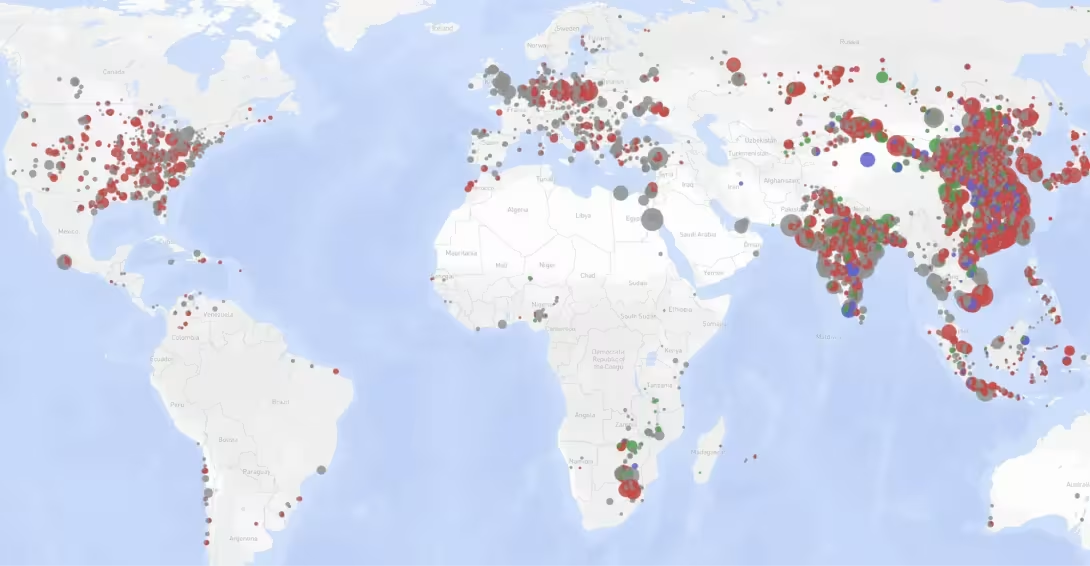
China leads the world in wind energy, accounting for nearly half of the global operating capacity, followed by the United States with 14%. While two-thirds of all wind capacity under construction is in China, India is a noteworthy developer of wind, with 50% of its planned wind capacity under construction — a rate nearly twice that of China and greater than the top 20 countries leading in planned wind capacity.
Offshore wind is growing quickly, with significant contributions to global prospective wind capacity worldwide. Although 90% of planned wind projects are onshore, offshore wind projects contribute over 40% of all future wind capacity. China has the largest operating offshore wind fleet, followed by the UK, while Brazil has the largest planned capacity of offshore wind globally. As offshore wind markets mature, policy expansion and energy storage solutions continue to enable offshore wind development worldwide.
In 2025, 97 gigawatts (GW) of wind capacity came online, however GEM research finds that the rate of new additions to the wind pipeline dropped by 13% from 2024. Between 2026 and 2030 nearly 365 GW of onshore wind is planned to become operational alongside around 200 GW of offshore wind for the same time period. However, even if this capacity becomes operational on time, worldwide wind capacity is still short of global tripling goals by 1 TW.
Global operating wind capacity exceeds 1.1 TW, while 2.7 TW are in the pipeline.
China is home to half of all operating offshore wind capacity, and Brazil leads in planned offshore projects, with 90% of the country’s future wind capacity growth expected to come from offshore wind.
Methodology
View the methodology on the GEM.wiki
Global Energy Monitor’s Global Wind Power Tracker uses a two-level system for organizing information, consisting of both a database and wiki pages with further information. The database tracks individual wind farm phases and includes information such as project owner, status, installation type, and location. A wiki page for each wind farm is created within the Global Energy Monitor wiki. The database and wiki pages are updated annually.
The Global Wind Power Tracker includes onshore and offshore electricity generating projects. Wind projects for captive industry, including hydrogen production, are also tracked. The Global Wind Power Tracker aims to comprehensively track all project phases larger than 10 MW globally. Below threshold projects are also included for some countries.
Announced: Proposed projects that have been described in corporate or government plans or media releases but have not yet taken concrete steps such as applying for permits.
Pre-construction: Projects that are actively moving forward in seeking governmental approvals, land rights, or financing.
Construction: Site preparation and equipment installation are underway.
Operating: The project has been formally commissioned; commercial operation has begun.
Shelved: Suspension of operation has been announced. The status is marked as ‘shelved – inferred 2 y’ if no progress has been observed for at least two years.
Cancelled: A cancellation announcement has been made. The status is marked as ‘cancelled – inferred 4 y’ if no progress has been observed for at least four years.
Retired: The project has been decommissioned.
Mothballed: The project is fully built but is currently disused. However, the project has not been dismantled or decommissioned.
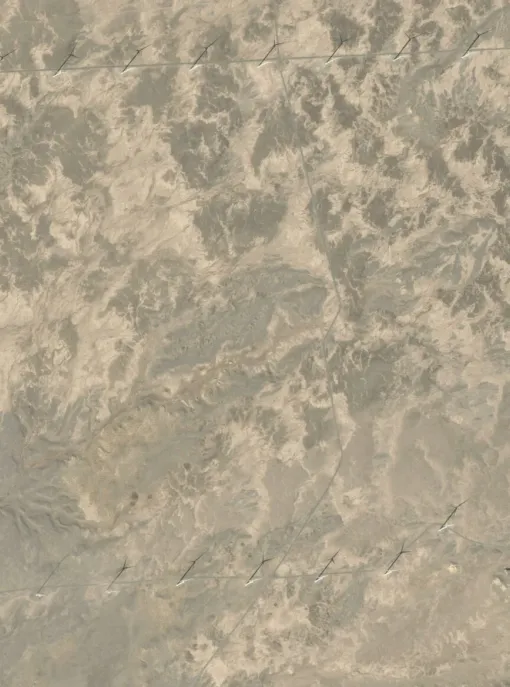
Onshore: projects that utilize wind turbines on land to generate electricity from wind energy. These farms consist of multiple wind turbines, typically arranged in rows.
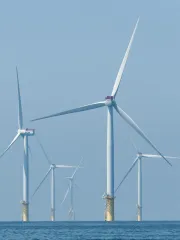
Offshore: projects that utilize wind turbines to generate electricity from wind energy located in bodies of water, typically in coastal areas or at sea.
- Offshore hard mount: have wind turbines that are usually designed for installation in water no deeper than 60 meters and are typically larger and taller than onshore turbines, with some models capable of producing up to 15 MW of power. These turbines are mounted directly onto the sea floor.
- Offshore floating: are an emerging technology designed for installation in deeper waters, where the water depth is greater than 60 meters. The turbine is floated on a platform and anchored to the sea floor via cables, allowing it to remain stable in rough seas.
- Offshore mount unknown: the project is an offshore project, but the mount type is not specified.
Unknown: Installation Type not specified
The Global Wind Power Tracker dataset draws on various public data sources, including:
- Government data on individual power wind farms (such as UK’s Renewable Energy Planning Database and the U.S. EIA 860 Electric Generator Inventory), country energy and resource plans, and government websites tracking wind farm permits and applications;
- Reports by power companies (both state-owned and private);
- News and media reports;
- Local non-governmental organizations tracking wind farms or permits.
A partial list of data sources can be found here.
Global Energy Monitor researchers perform data validation by comparing our dataset against proprietary and public data such as S&P Global’s World Energy Power Plant database and the World Resource Institute’s Global Power Plant Database, as well as various company and government sources.
For each wind farm, a wiki page is created on Global Energy Monitor’s wiki. Under standard wiki convention, all information is linked to a publicly-accessible published reference, such as a news article, company or government report, or a regulatory permit. In order to ensure data integrity in the open-access wiki environment, Global Energy Monitor researchers review all edits of project wiki pages.
To allow easy public access to the results, Global Energy Monitor worked with Earth Genome to develop a map-based and table-based interface. In the case of exact coordinates, locations have been visually determined using Google Maps, Google Earth, Wikimapia, or OpenStreetMap. Exact locations for proposed projects, if available, are obtained from sources such as permit applications, other government documentation, or company reports. If the location of a project or proposal is not known, Global Energy Monitor identifies the most accurate location possible based on available information.
February 2026
- A new data field has been added to indicate when a project phase has associated storage either planned or existing.
February 2025
- This update covers research on Africa, Americas, Asia and Oceania as defined by the United Nations’ region definitions, as well as global updates to 2024 operating projects.
June 2024
- This update covers research on Europe and China as defined by the United Nation’s region definitions.
- Project phases below the 10 MW global threshold are provided for some countries when the data were readily available. Data on the below threshold phases is available in the downloadable dataset in a separate tab called ‘Below Threshold.’
- A new data field has been added to indicate when a project phase is dedicated for green hydrogen production.
- Operator information is no longer researched or updated for countries outside of China.
- GEM ID formats have changed from an L8+5 digit number to L1+11 digit number for location IDs and a G8+5 digit number to a G1+11 digit number. Previous GEM ID numbers have been preserved. For example, a previous GEM ID of L812345 is now L100000812345.
- Shelved and cancelled statuses have been broken down into two subcategories depending on if there was an announcement of delay or cancellation, or if the status is inferred by lack of observed progress.
- The June 2024 release includes the change from the column name “Country” to “Country/Area”. The Country/Area column presents energy data within various economic contexts, and the geographical unit does not strictly follow political boundaries.
December 2023
- This update covers research on Africa, Americas, Asia, and Oceania as defined by the United Nation’s region definitions.
- Project phases below the 10 MW global threshold are provided for some countries when the data were readily available. Data on the below threshold phases is available in the downloadable dataset in a separate tab called ‘Below Threshold.’
May 2023
- This update covers research on Europe, Cyprus and mainland China, as per United Nations’ region and subregion definitions.
- Project phases below the 10 MW global threshold are provided for some countries when the data were readily available. Data on the below threshold phases is available in the downloadable dataset in a separate tab called ‘Below Threshold.’
January 2023
- All global regions with the exception of Europe and China have been researched for this update.
- Global Energy Monitor has transitioned to using the United Nations’ region and subregion definitions.
- The Global Wind Power Tracker has replaced the word “development” in the status domain with the term “pre-construction” to support consistent language across all of Global Energy Monitor’s trackers. The definition of “pre-construction” is consistent with the tracker’s previous definition of “development.”
- Global Energy Monitor has adopted the name “Türkiye” as a replacement for “Turkey.”
Frequently Asked Questions
The colors indicate the status category:
- Announced: Proposed projects that have been described in corporate or government plans or media releases but have not yet taken concrete steps such as applying for permits.
- Pre-construction: Projects that are actively moving forward in seeking governmental approvals, land rights, or financing.
- Construction: Site preparation and equipment installation are underway.
- Shelved: Suspension of operation has been announced. The status is marked as ‘shelved – inferred 2 y’ if no progress has been observed for at least two years.
- Cancelled: A cancellation announcement has been made. The status is marked as ‘cancelled – inferred 4 y’ if no progress has been observed for at least four years.
- Operating: The project has been formally commissioned; commercial operation has begun.
- Mothballed: The project is disused, but not dismantled.
- Retired: The project has been decommissioned.
Each wind phase location is marked “exact” or “approximate.” In the case of exact coordinates, locations are either specifically identified on a mapping service such as Google Maps, Open Street Maps, etc., or gathered from company or government documentation. If the location of a wind farm or proposal is not known, Global Energy Monitor identifies the most accurate location possible based on available information.
If a project is still in the pre-operational phases (announced, pre-construction, or construction), there may be no sign of activity. In other cases, only approximate location information could be found. Finally, satellite photos in some geographies are updated infrequently, so recent activity is not shown.
Location accuracy improves as plants move from early stages of development toward operation. To find out the coordinates of a location and whether a location is exact or approximate, click on the location dot, select the wiki page, and look under “Project Details.”
We aim to track all operating natural gas transmission pipelines, though in some cases and countries we may not have comprehensive coverage. Prior to May 2022, we focused primarily on pipelines longer than 100 km, and we still prioritize these projects but are continually filling in gaps we have for smaller projects. If you are searching for a pipeline that is not on the map, we may still track it in our full database, which includes pipelines without routes, available at the “Download Data” link.
Capacity is measured in megawatts, and refers to the collective nameplate capacity of the wind farm phase.
A wind farm phase is generally defined as a group of one or more wind turbines that are installed under one permit, one power purchase agreement, and typically come online at the same time. A wind farm project can be composed of several phases, or just a single phase.
Please fill out an error report here.
The tracker was designed and produced by Global Energy Monitor, a network of researchers seeking to develop collaborative informational resources on fossil fuel impacts and alternatives.
Contact
For questions about the Global Wind Power Tracker, contact Janna Smith: