oil pipeline projects
kilometers of oil pipeline length
NGL pipeline projects
kilometers of NGL pipeline length
Overview
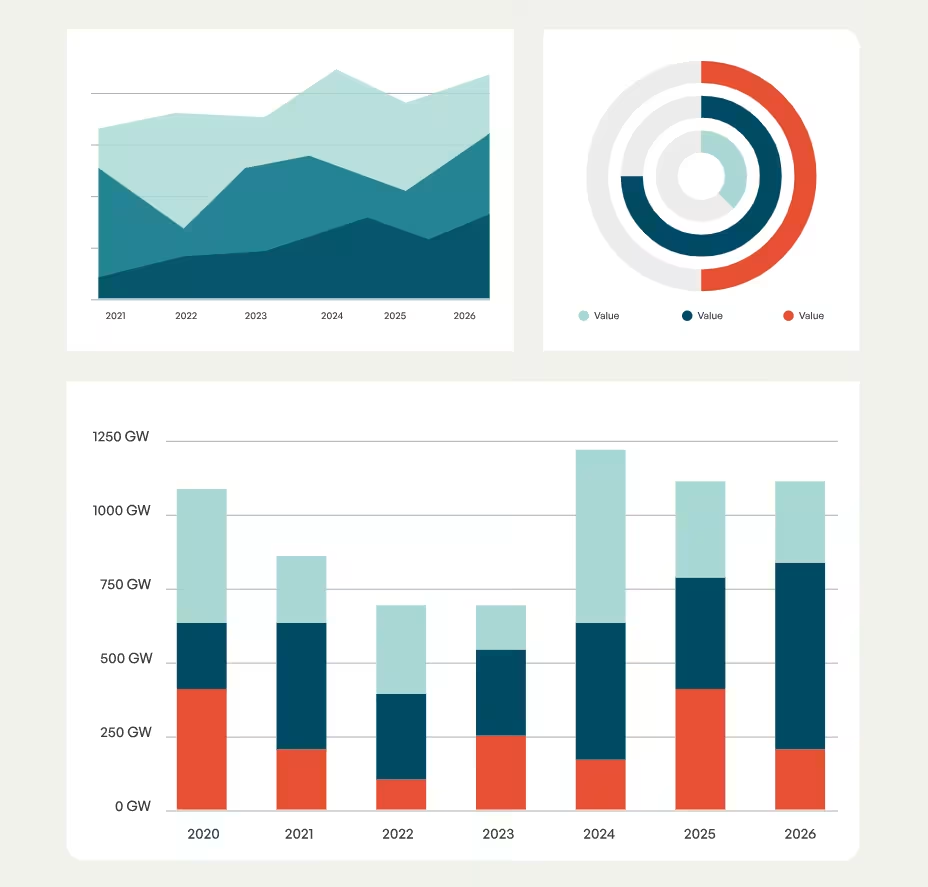
Global oil transmission pipeline development has slowed since 2019, but Asia and the Americas continue major planned expansions to serve export capacity and refinery supply.
Crude oil and natural gas liquids (NGL) transmission pipelines continue to expand worldwide, despite climate targets requiring rapid phaseout of fossil fuels. NGLs are used primarily as petrochemical feedstocks and blending components, and they face growing demand even as crude oil consumption plateaus. As of 2025, about 15,000 km of crude oil and NGL pipelines were under construction globally, with an additional 27,000 km proposed, representing a 16% year-over-year increase.
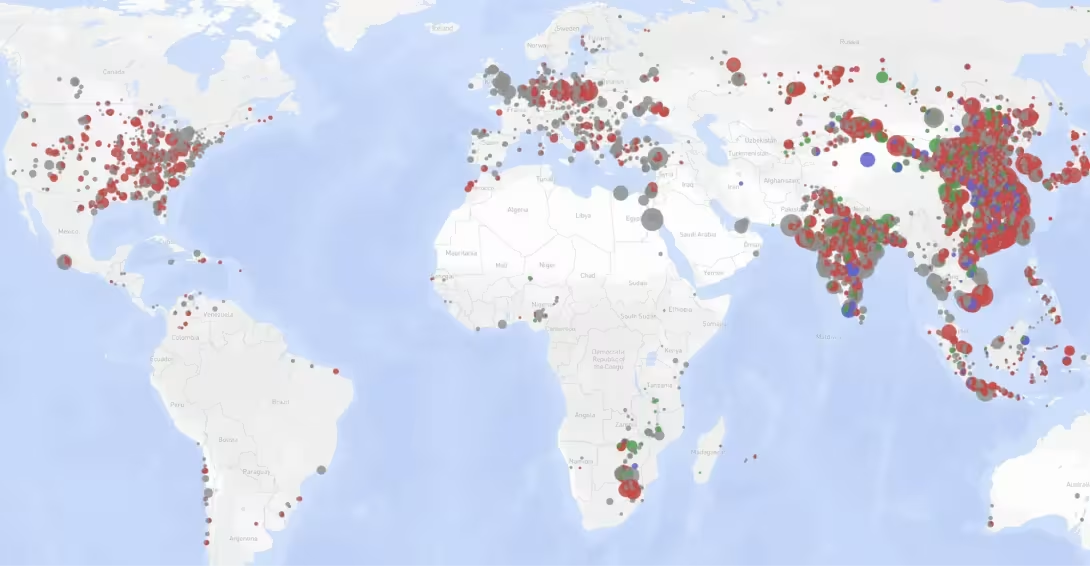
Asia alone accounts for over 60% of oil pipeline development activity globally, with China, Iraq, and India in the lead. Traditional exporters like the U.S. Gulf Coast, Canada, and Persian Gulf nations are expanding to maintain dominance, while emerging producers in Sub-Saharan Africa and South America aim to monetize local reserves and enter global markets.
These projects are primarily led by state-owned enterprises, including Iraq's Ministry of Oil and China National Petroleum Corporation, as well as oil majors like France’s TotalEnergies. While construction has slowed since 2019, due in part to Covid-19 disruptions, development continues largely unchecked.
Global oil demand is projected to peak by 2030, but pipelines are built to operate for 30–50 years. This contradiction highlights a risk of locking developing regions into carbon-intensive infrastructure, burdening their economies with obsolete assets while diverting capital from low-carbon energy transitions.
The oil infrastructure expansion is led by Asia, the Americas, and traditional Middle East exporters.
Ownership of these assets is highly concentrated, enabling outsized control over global energy markets.
Methodology
Global Energy Monitor’s Global Oil Infrastructure Tracker (GOIT) uses a two-level system for organizing information, consisting of both a database and wiki pages with further information. The database tracks individual pipeline phases and includes information such as project owner, status, and location. A wiki page for each project is created within the Global Energy Monitor wiki. The database and wiki pages are updated annually.
GOIT includes oil and natural gas liquids (NGL) transmission pipelines. Distribution and gathering pipelines are not included. Historically, a capacity threshold was used for inclusion, but GOIT now aims to comprehensively track all transmission pipelines longer than 100 km that carry oil or NGL. We also attempt to track shorter pipelines, especially those that are newly proposed or under construction.
Proposed: A company or government has proposed a project.
Construction: Site preparation or other construction activities have begun.
Shelved: Two years have passed with no development on a project after the proposal, or it has been announced as shelved. This status is also used for projects for which construction is complete but they have not entered operation.
Cancelled: Four years have passed with no development on a project after being proposed, or cancellation has been announced, or the project once appeared in company documents and is no longer in them.
Operating: The project has been formally commissioned; commercial operation has begun.
Idle: The project was at one time operational and now sits unused, but has not formally mothballed.
Mothballed: The project has been formally taken offline, but not yet decommissioned.
Retired: The project has been decommissioned.
Pipeline data are collected from and validated through five main sources:
- Government data on individual pipelines, country energy and resource plans/documents, and government websites tracking gas plant permits and applications
- Reports by state-owned and private power companies
- News and media reports
- Local non-governmental organizations tracking oil pipelines or permits
- On-the-ground contacts who can provide first-hand information about a project
For each pipeline project, a wiki page is created on Global Energy Monitor’s wiki. Wiki pages provide a repository for in-depth information including project background, financing, environmental impacts, public opposition, and routes. Under standard wiki convention, all information is linked to a published reference, such as a news article, company or government report, or a regulatory permit. In order to ensure data integrity in the open-access wiki environment, Global Energy Monitor researchers review all edits of project wiki pages.
Pipeline routes are generated by tracing images of route maps when found in the public domain using QGIS. If no map visual can be found, the route is approximated based on the written information (start and end points, and potential midpoints).
In some cases a route may be missing and the pipeline is absent from the map, but it is still tracked in the database.
As of June 2022, route mapping is prioritized in this way:
- For pipelines longer than 100 km in length, we attempt to have a medium- or high-resolution route. We prioritize pipelines that are proposed, under construction, and operating. If we are unable to find a route map to trace in GIS software, we approximate it, typically with a straight line or a curve with a few intermediate points.
- For pipelines whose lengths are not available from research, we attempt to include at least a low-resolution route in the database and Wiki page, so that we can approximate the pipeline’s length using this route.
- For projects less than 100 km in length, we prioritize mapping routes that have easily available routes online (via maps or shapefiles).
If you have questions about the methodology or GOIT, please contact Baird Langenbrunner.
For more information on pipeline ownership see the Global Energy Ownership Tracker (GEOT). The GEOT maps each level of the ownership chain from the direct owner (the lowest-level identified owner in the chain of ownership) to their highest-level ultimate parents (e.g., corporations, investment firms, and governments). Ownership links are reported with the percentage of ownership, including owners that have controlling interest as well as those with minority, non-controlling interests (if over a threshold of 5% ownership). Companies IDs, such as PermIDs, are also included.
Frequently asked questions
As of 2022, the Global Fossil Infrastructure Tracker (GFIT) has been split into two separate trackers for oil and gas. The Global Gas Infrastructure Tracker (GGIT) tracks gas transmission pipelines and liquefied natural gas (LNG) terminals here. The Global Oil Infrastructure Tracker (GOIT) tracks crude oil and natural gas liquids (NGL) pipelines.
Accuracy varies, and we are constantly working to improve our pipeline routes. Historically, we have prioritized mapping pipeline routes that are 100 km or longer, though we are now in the process of adding smaller routes where time allows.
If the route you see is a straight or low-resolution line on the map, it is likely approximated from start and end points (and sometimes midpoints). If it has more curvature, we have either obtained the route from official sources, or we have traced it from an image using GIS software. If you have any suggestions for route improvements, or questions on a specific project, please let us know via the “Improving the tracker” contact info below.
Yes. Pipeline routes are provided in GeoJSON and GeoPackage formats via the download form. Note that we no longer include routes in the downloadable Excel files.
For more information on pipeline ownership see the Global Energy Ownership Tracker (GEOT). The GEOT maps each level of the ownership chain from the direct owner (the lowest-level identified owner in the chain of ownership) to their highest-level ultimate parents (e.g., corporations, investment firms, and governments). Ownership links are reported with the percentage of ownership, including owners that have controlling interest as well as those with minority, non-controlling interests (if over a threshold of 5% ownership). Companies IDs, such as PermIDs, are also included.
We aim to track all operating oil transmission pipelines, though in some cases and countries we may not have comprehensive coverage. Prior to June 2022, we focused primarily on pipelines longer than 100 km, and we still prioritize these projects but are continually filling in gaps we have for smaller projects. If you are searching for a pipeline that is not on the map, we may still track it in our full database, which includes pipelines without routes, available at the “Data Download” link.
Note as of June 2022 we are increasing coverage of operating NGL pipelines, but we have historically only focused on those that are in development, and those will be the most comprehensively covered.
We aim to track all under construction, proposed, and shelved oil and NGL transmission pipelines, though in some cases and countries we may not have comprehensive coverage. Prior to June 2022, we focused primarily on pipelines longer than 100 km. Currently we attempt to track any in-development transmission pipeline, regardless of size. If you are searching for a pipeline that is not on the map, we may still track it in our full database, which includes pipelines without routes, available at the “Download Data” link.
We aim to track all oil transmission pipelines with these statuses, but we historically have prioritized pipelines that are either operating or in development.
Note as of June 2022 we are increasing coverage of NGL pipelines with these statuses, but we have historically only focused on those that are in development, and those will be the most comprehensively covered.
Please fill out an error report here.
The tracker only includes coal-fired electrical generating plants.The tracker was designed and produced by Global Energy Monitor, an organization developing collaborative resources on the global energy system. Researchers who have contributed to GOIT include Nagwa Abdallah, Greig Aitken, Sophia Bauer, James Browning, Natalie Cherot, Gregor Clark, Hanna Fralikhina, Joshua Frank, Christina Haidar, Erik Hazard, Maisie Bird, Ben Inskeep, Ahna Kruciz, Amalia Llano, Baird Langenbrunner, Ted Nace, Lydia Plante, Aiqun Qu, Christine Shearer, Clay Smalley, Janna Smith, Adrian Wilson, Mingxin Zhang, and Scott Zimmerman.
Contact
For questions about the Global Oil Infrastructure Tracker, contact Baird Langenbrunner: