
The United States now has the most gas-fired power capacity in development — projects in the announced, pre-construction, and construction phases — surpassing China and accounting for nearly one-quarter of the world’s total. More than one-third of this capacity is slated to directly power data centers on-site1, and many more on-grid projects are planned to meet an anticipated increase in energy demand from AI (Figure 1).
According to new data in the Global Oil and Gas Plant Tracker2, the U.S. nearly tripled its gas-fired capacity in development in 2025, totalling almost 252 gigawatts (GW). If all in-development plants are built, the U.S.’ existing gas fleet would grow by nearly 50%, at an estimated cost of over US$416 billion in capital costs3.
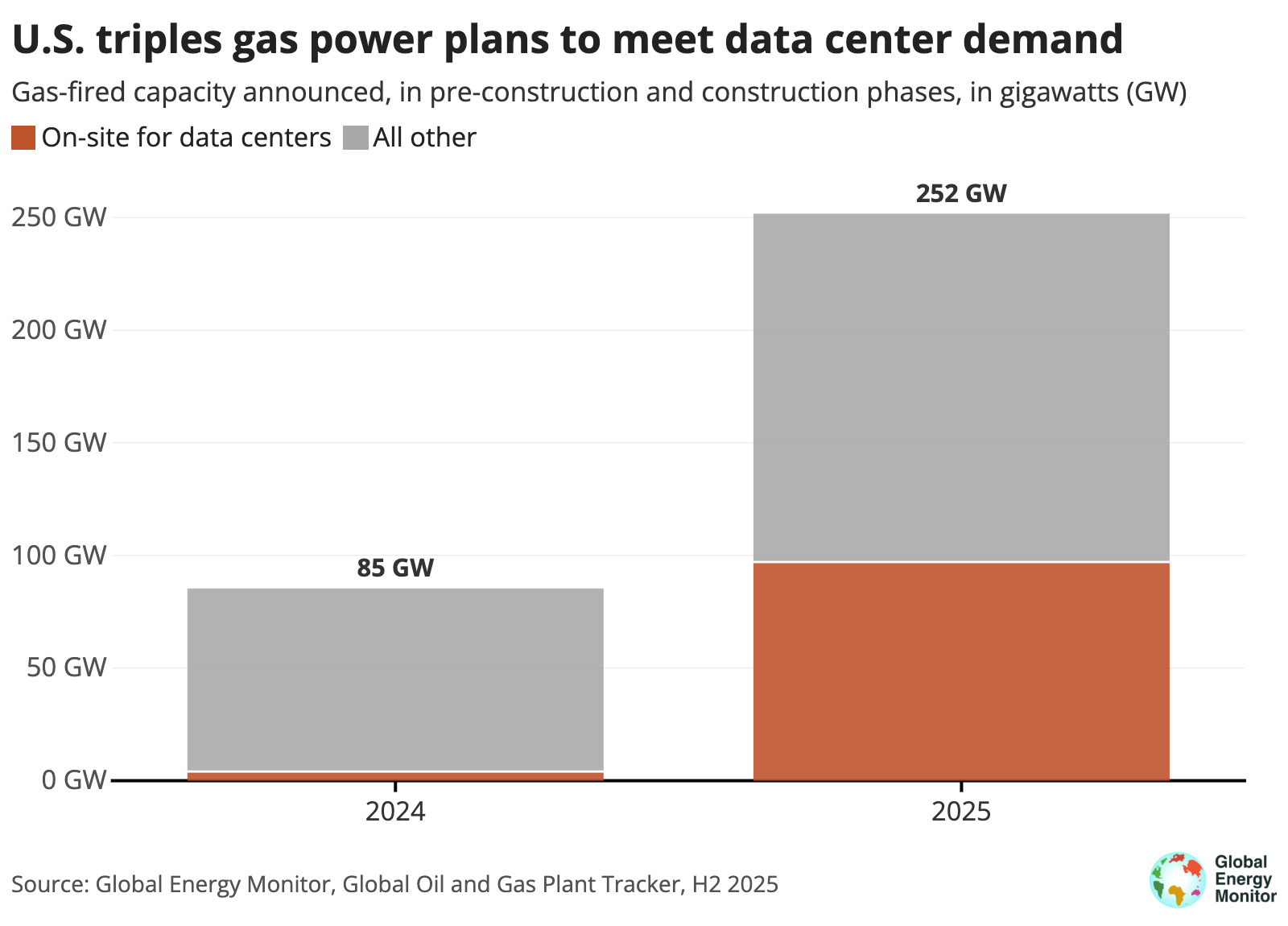
Figure 1
Global gas power pipeline increases nearly a third
Globally, gas-fired power capacity in development rose 31% (+249 GW) in 2025, reaching a total of 1,047 GW. Projects set to operate through 2030 are expected to surge in the last half of the decade (Figure 2). 2026 could be a record for new gas power projects: if all planned capacity starts operation this year, it would exceed the previous record of 100 GW added in 2002 at the height of the U.S. shale boom.
Figure 2
A third of new gas additions concentrated in China
China installed its most ever gas power capacity in a single year, a record 22.4 GW in 2025, or more than a third of the world’s 60.4 GW of newly commissioned capacity last year. While the U.S. leads for total capacity in development, China narrowly leads in capacity under construction (30.9 GW).
Figure 3
Texas - the epicenter of the U.S. gas power expansion
Texas accounts for nearly a third of the U.S.’ planned buildout with 80.6 GW of the gas-fired power capacity in development – more than the next seven states combined and nearly a four-fold increase over the last year. Only China has more gas power in development than Texas. Nearly half of this capacity, 40 GW, is planned to directly power data centers, reflecting the state’s eager appetite to meet energy-hungry tech demands.
Figure 4
Gas power buildout limited by turbine supply constraint
Despite higher costs, turbine supply constraints, and long grid connection queues, gas power proposals have risen drastically in the last year. GE Vernova, Siemens, and Mitsubishi maintain their dominance, collectively holding more than 75% of the market for gas power in development with a named manufacturer.
Yet global gas power expansion is bottlenecked by turbine production capacity, with manufacturer backlogs now stretching through 2030. According to GEM data, two-thirds of projects in development do not have a named manufacturer, potentially limiting the scale of gas power expansion (Figure 5).
Figure 5
1"On-site” generation provides behind-the-meter power produced at the facility to support data center operations independently of the public grid.
2Less than 3% of projects in development are exclusively oil-fired (30.7 GW), with three-quarters concentrated in Iraq. Less than 6% of operating projects are oil-fired only. Since oil is a very small percentage of the global oil and gas power capacity fuel mix, and since most projects are dual fuel projects that primarily run on gas, oil- and gas-fired capacity will be referred to as “gas-fired”.
3Estimate is based on CCGT capital costs ($2000/kW) from GridLab report and OCGT capital cost ($1300/kW) based on average published in Lazard's 2025 LCOE+ Report.
About the Global Oil & Gas Plant Tracker
The Global Oil and Gas Plant Tracker (GOGPT) is a worldwide dataset of oil- and gas-fired power plants. It includes units with capacities of 50 megawatts (MW) or more (20 MW or more in the European Union and the United Kingdom). For internal combustion units, or those units that have multiple identically-sized engines, the 50 MW capacity unit threshold applies to the total capacity of the set of engines. The GOGPT catalogs every oil- and gas power plant at this capacity threshold of any status, including operating, announced, pre-construction, construction, shelved, cancelled, mothballed, or retired. Units often consist of a boiler and gas or steam turbines, and several units may make up one power station.
Media Contact
Jenny Martos
Project Manager, Global Oil and Gas Plant Tracker
Email: [email protected]