

Private equity holds more than $1 trillion in energy assets globally, including power plants, mines and extraction sites, transmission pipelines and terminals, and more. Recent research finds that fossil fuels account for 64% of private equity firms’ energy portfolios. But the ownership over the pollution their assets emit is opaque, with companies responsible for hundreds or thousands of times the amount of emissions they state publicly. When companies are able to operate under cover, the individuals, pension holders, and communities affected by those firms’ holdings might never know who to hold accountable for the air pollution, disasters, and financial risks that fall on their shoulders.
Gauging the full environmental impact of a company’s holdings starts with trustworthy, verified data at the asset level. While calculating the emissions for the latest Private Equity Climate Risks (PECR) Scorecard, a project of Global Energy Monitor (GEM), Americans for Financial Reform (AFREF), and Private Equity Stakeholder Project (PESP), Alex Hurley (Private Equity Tracker Project Manager for GEM) was astonished to see the results come together in this chart:
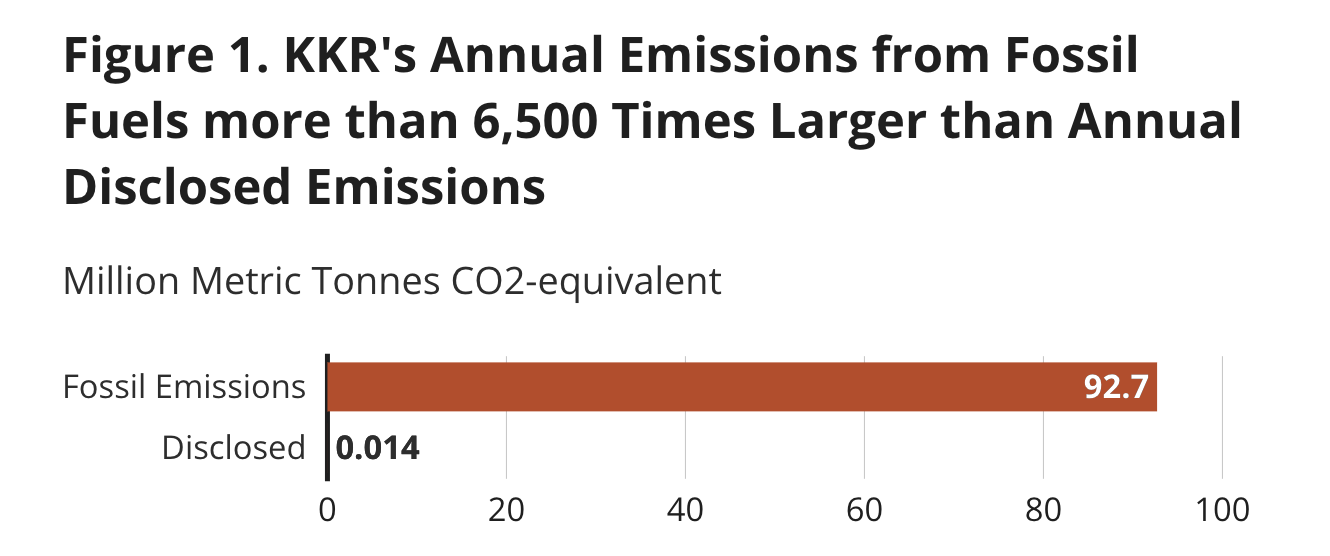
KKR is one of the world’s largest private equity firms. As Alex ran the numbers, he discovered that because the company was only reporting some emissions assets, excluding ones it financed, its true footprint from all assets the company financially backed at the time was actually 6,500 times what they stated publicly. This fact never would have been uncovered without PECR.
PESP defines private equity as “the investment of equity capital in private companies. Private equity firms purchase ownership stakes in these private companies that are specifically not listed on a stock exchange.” Typically, a firm will purchase a company at a controlling stake; make changes such as mergers, layoffs, or restructuring; and sell it within five to seven years, ideally at a profit which provides returns to investors.
Investigating private equity’s climate impacts
Every power plant, mine, and refinery has impacts on nearby cities and towns, the larger region, and the globe. For example, an oil extraction project could bring jobs and economic success to the local community. It will also release pollution into the air and water, impacting local public health and global climate change. The economy could also be negatively impacted by public health costs and the accelerated deterioration of infrastructure. The project could boost the energy security of the nation it’s located in, at the same time as it locks the region into dependence on fossil fuels.
There are energy transition risks, too. For example, infrastructure that was projected to make money for 25 years might actually only generate a profit for a much shorter time because renewables displace the need for so much oil usage while they lower energy costs.
PECR exists to bring this ownership information into the light, so the public can be fully informed about how the largest private equity firms influence the energy sector. PECR focuses on 20 of the firms that are most heavily invested in energy, which include the world’s largest private equity firms, such as KKR and Blackstone, as well as firms that specialize in energy, like IFM and Stonepeak. The figure below is from the interactive 2024 PECR Scorecard.
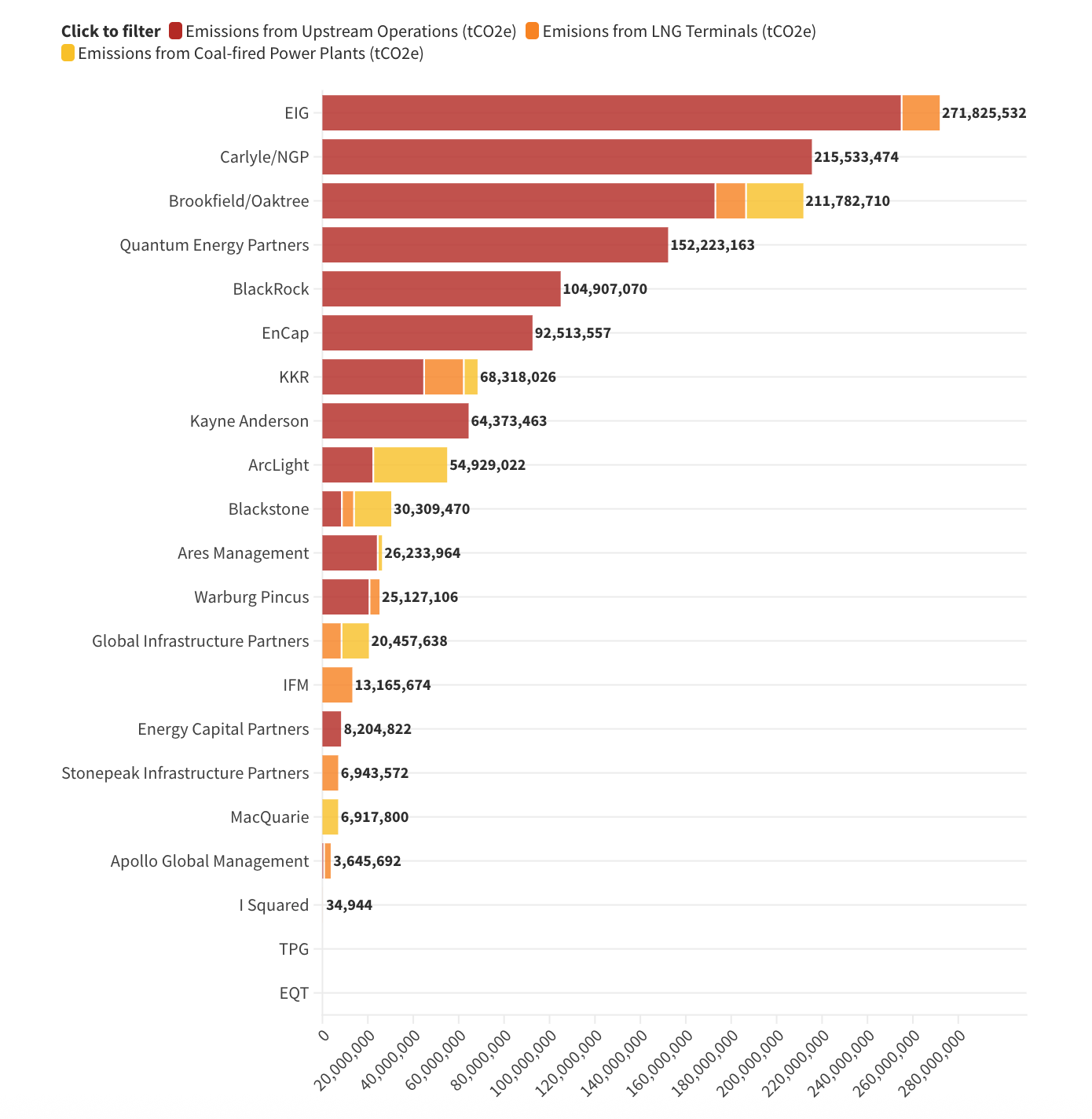
Click here to view this on the PECR site
More than $1 trillion in energy assets are managed by private equity firms, a sizable portion of the $7.5 trillion in all private equity investments, according to PESP. These firms fundraise from large pools of money such as pension funds, investment schemes, and university endowments, meaning that individuals with pension funds can be invested in private equity even if they don’t know or didn’t choose so. By PECR’s calculations, the energy portfolios of leading private equity firms are responsible for 1.17 gigatons of annual emissions (CO2 equivalent). That’s equivalent to approximately 157 million U.S. homes’ energy usage for one year — more than all the occupied homes in the country (sources: U.S. EPA, U.S. Census Bureau).
It is exceedingly difficult to gather comprehensive information on all the energy assets owned by private equity companies. Matthew Parr, Communications Director for PESP, called the industry “purposefully opaque” in an interview for this article. “This consortium is the only way people have to see the impact of this behemoth that is private equity.”
There are limited public disclosure requirements on the industry, even when a firm owns a publicly traded company, and this is where PECR comes in.
The consortium was first convened in 2021 by a partnership of climate funders who envisioned a project strengthened by what each organization could uniquely bring to the team. GEM has specific expertise in energy, database development, and analysis; PESP has deep knowledge of private equity topics and research methodologies; and AFR develops policy advice on private equity and other influences that impact individuals’ financial prosperity.
The data speak for themselves
Together, the team has uncovered remarkable findings and facilitated progress toward energy and investment goals for partners and data users. PECR publishes a bi-annual Scorecard that grades firms from A to F based on a few simple, but meticulously compiled, metrics. Research uncovers not just the assets owned by each firm, but their full estimated emissions, based on a methodology developed by the PECR team. An accompanying report digs into the data that underlie the Scorecard to assess private equity’s full climate impact. The next PECR Scorecard will be released this fall, and a research update was released in January 2026.
PE firms commonly just publish scope 1 (direct emissions) and scope 2 emissions (purchased energy), and omit most or all of scope 3 emissions (indirect emissions). However, it is also common for scope 3 emissions to make up over 90% of the total emissions footprint of a PE firm that invests in fossil fuels. PECR is concerned with Scope 3, Category 15: Investments. According to Asuene, “Scope 3 Category 15 encompasses greenhouse gas (GHG) emissions associated with the reporting company's investments. This applies primarily to financial institutions (e.g., banks, asset managers, and insurers) but also to companies that hold equity or debt in other organizations.”

GEM is proud of its reputation for setting and upholding the gold standard in reliable energy data, and the Private Equity Tracker whose data feeds into PECR is no different. All data published by GEM is verified and cited. Every firm covered in the report is invited to review the data and provide evidence if they dispute any finding. For this project, researchers at GEM, PESP, and AFREF gather data from a variety of sources and then go through each data point to verify its accuracy. In 2025, the team started using GEM’s Global Energy Ownership Tracker to augment its research process. And like all GEM data, PECR is free and open source.
Making an impact
Producing trustworthy data is only half the challenge; what matters is what people do with that information. GEM and our partners in the Private Equity Climate Risks project are motivated to continue this challenging work when we see the real-world impact of our research and analysis, as the following examples illustrate.
Relying in part on data from the PECR Scorecard, the Chicago Teachers’ Pension Fund voted down a proposal to invest an additional $10 million in KKR’s Ascendant Fund. This decision marked the first time in recent history that the Fund voted against the interests of private equity.
“Our job is more important than ever in bringing this research to public pension funds, helping them understand the risks,” said Amanda Mendoza, Senior Campaign and Research Coordinator for Climate at PESP. “They hold the power at the end of the day. If they withhold their $500 million investments, funds won’t reach their fundraising goals.”
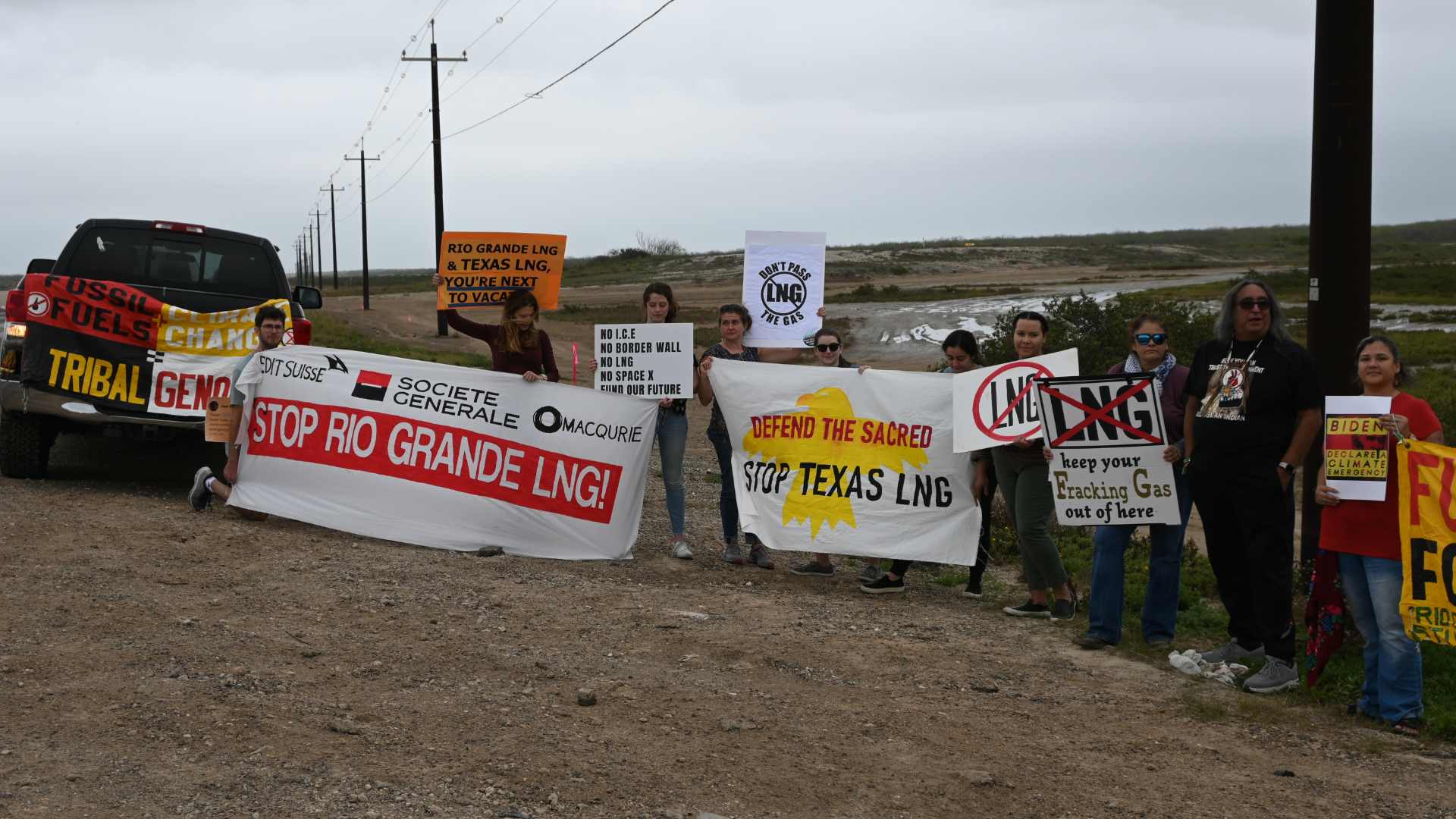
PESP, one of the key partners in the PECR consortium, has provided research findings for an Indigenous-led community group in South Texas raising awareness of the environmental hazards of the buildout of the Rio Grande LNG terminal. PESP also helps groups like this one engage directly with the investors of private equity firms backing new fossil fuel projects.
As individuals and communities continue to discover the facts about the private equity industry, they will be better positioned to hold these influential firms accountable for the energy assets they own and the impacts they are having on climate change and local communities. The Private Equity Climate Risks project plays an irreplaceable role in enabling this important step forward in the just transition to clean energy, and Global Energy Monitor is proud to be a part of it.
To support this work, contact Alex Hurley ([email protected]) and Amanda Mendoza ([email protected]).