Home
Close Tracker Map 

Main navigation

About
About
About GEM

What is a tracker?

People

Careers

Financial information

Contact us

Our impact

Annual reports

Partners

Who uses GEM research

Data in action

Support our work

Subscribe

Give now

Funders and donors

Browse data
Trackers
Oil and gas

Oil and gas plants

Oil and gas extraction

Oil infrastructure

Gas infrastructure

Coal

Coal plants

Coal mines

Coal terminals

Renewables and other power

Solar

Wind

Hydropower

Geothermal

Bioenergy

Nuclear

Heavy industry

Iron and steel

Cement and concrete

Iron ore mines

Chemicals inventory

Finance and corporates

Energy ownership

Private equity

Coal project finance

Gas project finance

Energy transition

Integrated power

Global energy transition

Methane emitters

Latin America energy

GEM.wiki

Insights and updates
Insights
Reports and briefings

Updates
Press releases

In the news

Newsletters
Coal Wire

Inside Gas


Search
Subscribe Download data
Home
July 2026
Press release
Renewables and other power

China’s clean energy boom faces a coal test in new Five-Year Plan

China’s unparalleled renewable energy expansion continued in the last year with over 500 gigawatts (GW) of wind and utility-scale solar capacity currently under construction, more than the rest of the world combined, but severe grid transmission bottlenecks risk prolonging the lifespan of coal well into its new Five-Year Plan, according to a new report by Global Energy Monitor (GEM).

Share on:
   

The report finds that China currently holds 664 GW of prospective utility-scale solar and 698 GW of prospective wind capacity, representing a staggering share of the global total for capacity announced or in the pre-construction and construction phases. This means the country could meet by the end of this year the target in its Five-Year Plan for  wind and solar to exceed 50% of installed power capacity by 2030. 

China’s wind development pipeline alone surged by 37% from 2025 to 2026, while the rest of the world remained flat at just a 1% decrease. With 251 GW of wind capacity already under construction — more than twice the rest of the world combined — it would generate enough annual electricity to match Germany’s entire 2025 output across all sources once fully operational.

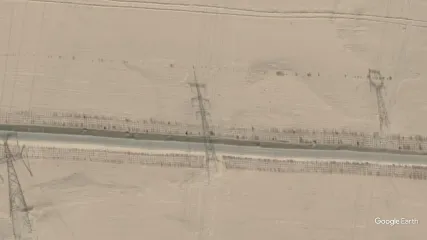
Much of this buildout is concentrated in the northwestern and northern regions that anchor China’s desert energy-base strategy. Together six northwestern and northern provinces and autonomous regions make up over half of China's prospective wind and utility-scale solar capacity.

However, this clean energy surge faces mounting headwinds:

  • Wasted energy is rising: Grid bottlenecks and electricity-market arrangements that limit system flexibility have pushed solar curtailment rates — wind and solar output that could have been generated but was instead reduced or withheld — to between 10% and 17% in northwestern resource-rich provinces like Qinghai, Xinjiang, and Gansu. Wind curtailment across northern and northwestern corridors ranges between 4% and 9%.
  • Grid infrastructure is lagging and heavily reliant on coal: to transmit megabases’ wind and solar requires 27  ultra-high voltage direct current (UHVDC) lines, yet the 15th Five-Year Plan aims to add only ten. Across China’s UHVDC network, wind and solar power represent only around one-fifth of transmitted electricity, while coal accounts for 42%. And planned transmission remains coal-linked, with eleven prospective lines dedicated to wind and solar megabases paired with 129 GW of wind and solar and 40 GW of coal power.

To bypass rising curtailment, China’s megabases are pivoting to a strategy that pairs long-distance exports with local industrial demand, through energy storage, green-power direct connections, industrial parks, and green hydrogen. 

China leads the global green hydrogen sector with over 10 GW of operating wind and solar capacity dedicated to hydrogen production — nearly eight times the operating capacity of the rest of the world combined.

Yet, GEM research finds that this localization strategy creates a dangerous loophole for “coal lock-in.” Industrial regulators increasingly encourage renewable integration to approve high-emissions heavy industry projects. However, the renewable components often represent a minute fraction of overall energy consumption.

For example, Baofeng Energy, the world’s largest coal-to-olefins producer, commissioned an olefins project in Inner Mongolia in 2025 that couples a 1,000 megawatt wind and solar project to produce green hydrogen. While this reduces coal consumption by 210,000 tonnes annually, it accounts for a mere 2.2% of the facility’s total annual coal intake, raising the risk that renewable integration becomes a small compliance cost while long-term coal use remains largely intact.

Aiqun Yu, Research Analyst & Senior East Asia Strategist at Global Energy Monitor, said, “The purpose of the megabases is clear, and that’s to accelerate nationwide decarbonization. But the new Five-Year Plan has so much more room for the country to continue its climate leadership. Ultimately, the success of China’s renewable energy megabases will not be measured by the gigawatts added, but by the volume of coal they actively displace.”

Tracker
Global Solar Power Tracker

Open tracker

Tracker
Global Wind Power Tracker

Open tracker

Report
Renewables and other power
China's wind and solar megabases face a coal test
July 2026

By Aiqun Yu, James Norman, Ye Huang

Read Report


Subscribe to stay informed about our latest work and updates

Join our mailing list

Subscribe to stay informed about our latest work and updates

Join our mailing list

Footer

Browse data
Oil and gas Coal Renewables and other power Heavy industry Finance and corporates Energy transition
Insights and updates
Reports and briefings Press releases In the news Coal Wire Inside Gas
About
What is a tracker? People Financial information Careers Contact Us
© 2026 Global Energy Monitor
All Rights Reserved
440 N Barranca Ave #2878, Covina, CA 91723
Built by 89up
  