country/areas included
geothermal power units
gigawatts operating capacity
gigawatts prospective capacity
Overview
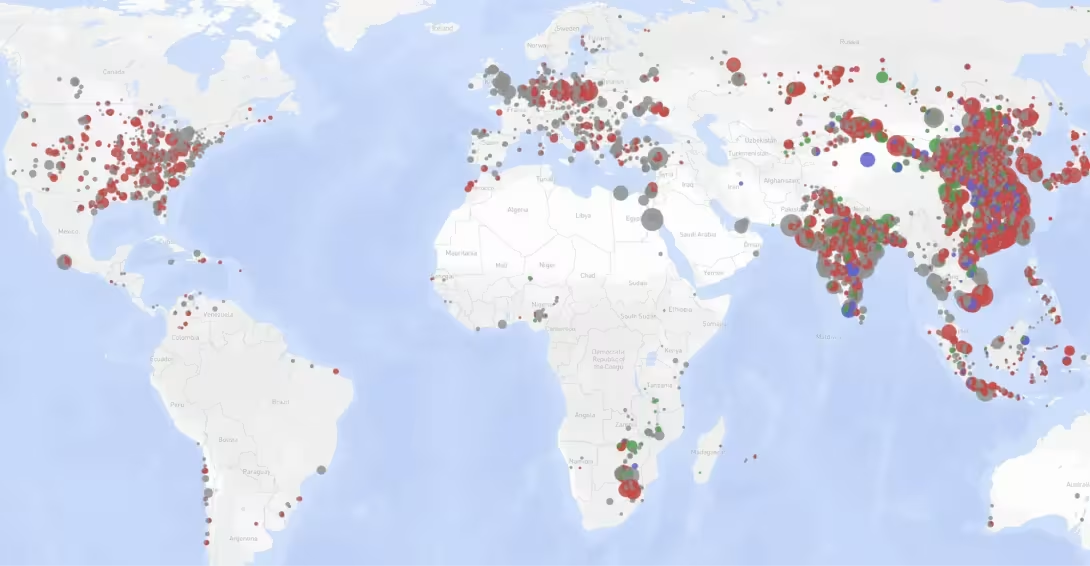
The Global Geothermal Power Tracker (GGPT) shows that expansive growth is coming to the sector, with prospective projects slated to double capacity.
With nearly 14 gigawatts (GW) of prospective geothermal power capacity worldwide, the globe could see a nearly 100% increase of total operating capacity within the next decade.
While technological advancements are decreasing the cost of geothermal power as a baseload power source, the cost and the long construction timeline still hinder growth. As of 2026, the GGPT identifies over 830 active and in-development geothermal power units worldwide. The United States continues to lead the operation and expansion of geothermal power. Outside of the U.S., Kenya, Indonesia, the Philippines, and Taiwan are also slated to see large growth in geothermal capacity related to the data center sector, with policies that support permitting creating demand.
The tracker notes which geothermal power units have established power purchase agreements (PPA) with data centers, showing an emerging trend of tech companies adopting geothermal as a renewable way to power growing AI demands globally. Pivoting expertise from the oil and gas drilling industry to this green technology is a viable option for job creation in a global shift away from fossil fuels.
However, a decrease in project permitting time that sacrifices just community engagement and environmental permitting could lead to geothermal souring relationships with communities. Indonesia and Nevada in the U.S. have seen projects face financial, environmental, and community opposition, causing delays or cancellations. Overall, GEM’s geothermal power plant data paint the picture of an expanding sector that will likely continue to grow as a green baseload power supplement to wind and solar.
The U.S. accounts for more than a third of all new geothermal power under development.
17 geothermal units have established power purchase agreements with data centers.

Methodology
Global Energy Monitor’s Global Geothermal Power Tracker uses a two-level system for organizing information, consisting of both a database and wiki pages with further information. The database tracks individual bioenergy power units and includes information such as project owner, status, and location. A wiki page for each facility is created within the Global Energy Monitor wiki. The database and wiki pages are updated annually.
Announced: Proposed projects that have been described in corporate or government plans but have not yet taken concrete steps such as applying for permits.
Pre-construction: Projects that are actively moving forward in seeking governmental approvals, land rights, or financing.
Construction: Site preparation and equipment installation are underway.
Operating: The project has been formally commissioned; commercial operation has begun.
Shelved: Suspension of the project operation has been announced.
Shelved – inferred 2 y: The project is inferred to be shelved because, or no progress has been observed for at least two years.
Cancelled: A cancellation announcement has been made.
Cancelled – inferred 4 y: The project is inferred to be cancelled because, or no progress has been observed for at least four years.
Retired: The project has been decommissioned.
Mothballed: The project is disused, but not dismantled.
The Global Geothermal Power Tracker data set draws on various public data sources, including:
- Government data on individual power geothermal projects (such as Mexico’s Sistema de Información Energética database and the U.S. EIA 860 Electric Generator Inventory), country energy and resource plans, and government websites tracking project permits and applications;
- Reports by power companies (both state-owned and private);
- News and media reports;
- Local non-governmental organizations tracking geothermal projects or permits.
A list of major data sources can be found here.
Global Energy Monitor researchers perform data validation by comparing our dataset against proprietary and public data such as S&P Global’s World Electric Power Plant Database (WEPP) and the World Resource Institute’s Global Power Plant Database, as well as various company and government sources.
March 2026
- This update covers all regions of the globe, and uses the United Nations’ Statistics Division definitions of region and subregion.
- The March 2026 release includes all geothermal power producing plants with more than a 1 MW capacity.
- A new data field has been added to indicate when a unit has an established Power Purchase Agreement (PPA) with a data center.
March 2025
- This update covers all regions of the globe, and uses the United Nations’ Statistics Division definitions of region and subregion.
- The March 2025 release includes all geothermal power producing plants with more than a 1 MW capacity.
- “AGS (Advanced Geothermal Systems” and “GGS (Geopressured Geothermal System)” were added as technology types.
May 2024
- This update covers all regions of the globe, and uses the United Nations’ Statistics Division definitions of region and subregion.
- Some units below the 30 MW global threshold are provided for some countries when the data were readily available.
- A new data field has been added to indicate when a project phase is dedicated for green hydrogen production.
- The May 2024 release includes the change from the column name “Country” to “Country/Area”.
- GEM ID formats have changed from an L7+5 digit number to L1+11 digit number for location IDs and a G7+5 digit number to a G1+11 digit number. Previous GEM ID numbers have been preserved. For example, a previous GEM ID of L812345 is now L100000812345
- Shelved and cancelled statuses have been broken down into two subcategories depending on if there was an announcement of delay or cancellation, or if the status is inferred by lack of observed progress.
July 2023
- Qualitative notes on employment numbers related to construction or operation of the project have been included for some project units.
- Project units below the 30 MW global threshold are provided for some countries when the data were readily available.
January 2023
- The Global Geothermal Power Tracker has replaced the word “development” in the status domain with the term “pre-construction” to support consistent language across all of Global Energy Monitor’s trackers. The definition of “pre-construction” is consistent with the tracker’s previous definition of “development.”
- Global Energy Monitor has transitioned to using the United Nations” region and subregion definitions.
- Global Energy Monitor has adopted the name “Türkiye” as a replacement for “Turkey.”
To allow easy public access to the results, Global Energy Monitor worked with Earth Genome to develop a map-based and table-based interface. In the case of exact coordinates, locations have been visually determined using Google Maps, Google Earth, Wikimapia, or OpenStreetMap. Exact locations for proposed projects, if available, are obtained from sources such as permit applications, other government documentation, or company reports. If the location of a project or proposal is not known, Global Energy Monitor identifies the most accurate location possible based on available information.
Dry Steam: Projects that use steam directly from a geothermal reservoir to turn a turbine.
Flash Steam: Projects that take high-pressure hot water from deep inside the earth and convert, “flash”, it into steam and water. The steam is then used to drive a turbine generator.
- Single: Projects where the high-pressure geothermal fluid is converted to steam only once.
- Double: Includes projects where the remaining water after the first flash is still warm enough to flash again and used to run a second, low-pressure steam turbine.
- Triple: Such systems use three flashes to generate three different steam pressures: high, intermediate, and low. The steam flows are then used to rotate two or more turbines which generate electricity.
- Unknown: The project uses flash steam technology, but the number of flashes is not specified.
Binary Cycle: Projects that transfer the heat from geothermal fluid to another liquid. The heat causes the second liquid to turn to steam, which is used to drive a turbin.
AGS (Advanced Geothermal System): An emerging technology which uses a closed loop system for power production where working fluid is circulated and heated by subsurface rocks through conductive heat transfer.
EGS (Enhanced Geothermal System): An emerging technology that creates machine-made geothermal reservoirs in regions where there is naturally hot rock but insufficient permeability of fluid for a traditional geothermal power plant.
GGS (Geopressured Geothermal System): An emerging technology that uses both pressure and heat from naturally hot dry rock for a machine-made geothermal reservoir.
Unknown: The type of geothermal power is not specified
Frequently Asked Questions
The objective of the tracker is to provide information on geothermal power plant units with capacities of 1 megawatt (MW) or more. The tracker includes every geothermal power plant unit at this capacity threshold of any status, including operating, announced, pre-construction, under construction, shelved, cancelled, mothballed, or retired. We have also begun including smaller projects for some countries.
Capacity is measured in megawatts, and refers to the collective nameplate capacity of the project.
The tracker provides separate data on each of the multiple facilities that typically exist at a particular location. Each of these facilities is referred to as a “unit”. The entire collection of units at a given location is referred to as a “plant”.
Please fill out an error report here.
Contact
For questions about the Global Geothermal Power Tracker, contact Sophia Bauer: