
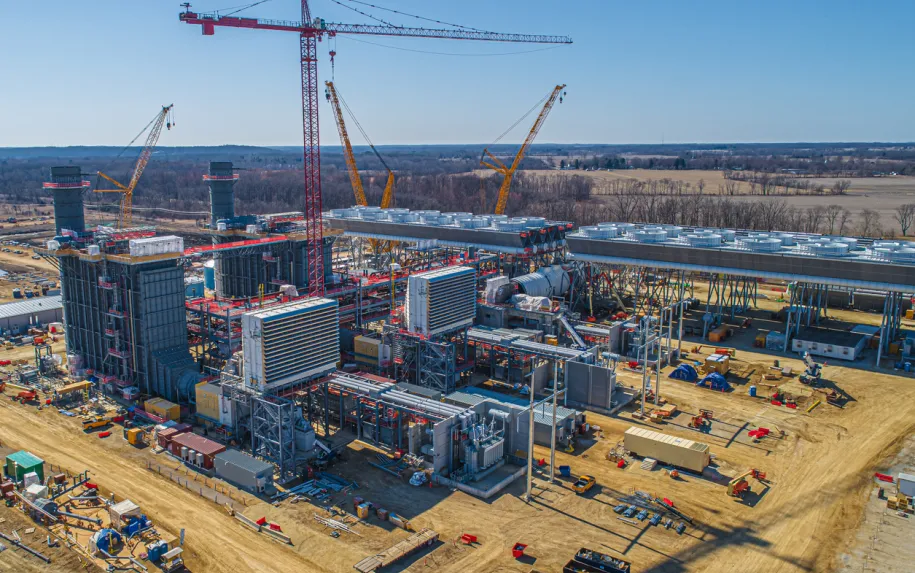
In the first half of the year, the United States nearly doubled the gas-fired capacity it is developing to directly power data centers, but uncertainty persists about how and when this capacity gets built, according to a new analysis from Global Energy Monitor¹.
The Global Oil and Gas Plant Tracker² now counts 189 gigawatts (GW) of gas-fired capacity in the U.S. across the announced, pre-construction, and construction phases, which is intended to meet the exponential increase in electricity demand brought by the booming data center expansion.
Since GEM’s January data release, gas power capacity in development in the U.S. has increased 50% (+127 GW), growing from 252 to 378 GW, now accounting for one-third of the global total. If all these plants are built, the U.S.’ existing gas fleet would grow by roughly two-thirds, at an estimated cost of over US$647 billion in capital costs³.
New gas power proposals in Texas surge faster than anywhere else in the world
Texas accounts for nearly one-third of the U.S. project pipeline with 122 GW of gas-fired power capacity in development, a 51 per cent (41.4 GW) increase in the last six months and more than any other country in the world. Nearly two-thirds of the in development capacity in Texas (77 GW), is planned to directly power data centers.
U.S. passes China as top builder of gas power
Projects under construction in the U.S. rose 76% in the first half of the year, reaching 52 GW, of which 16.9 GW is for projects intended to directly power data centers. The U.S. is now building twice as much gas-fired capacity as China (24 GW) and has nearly three times its gas-fired power capacity in development (Figure 4).
Data centers are turning to engines to skip the turbine queue
The boom in gas-fired capacity to power data centers still faces headwinds however. Gas turbines are the most critical and expensive component in building a gas-fired power plant. Faced with rising turbine demand, the leading three turbine manufacturers are now reporting rising order backlogs and multi-year lead times.
As surging demand for turbines outpaces current global supply, developers racing to power data centers are increasingly turning to reciprocating engines and smaller aeroderivative units, which can be manufactured and installed far faster in a bid to skip the turbine supply constraints entirely.
According to GEM data, engine capacity in development more than doubled in six months, from 31 GW to 67 GW. For projects in development specifically tied to data centers, engine capacity more than tripled in the last six months, reaching 45 GW, or nearly one-quarter of in development gas power projects for data centers.
Typically deployed during periods of high demand, gas turbines and engines are less efficient than combined-cycle plants and carry higher emissions per unit of electricity generated. According to GEM data, engines and gas turbines make up nearly half of the generating technology for data center tied gas power proposals, compared with just 17% of projects not tied to data centers in development globally.
True scale of gas power buildout remains uncertain
While the growth in gas power proposals is being driven largely by data centers, more than three-quarters of the global pipeline is still in early-stage development. In the first six months of the year, roughly 45 GW of announced and pre-construction capacity had its planned start year delayed.
Two-thirds of gas-fired capacity in development globally, and more than half of projects tied to data centers, do not have a named turbine/engine manufacturer. Nearly one-quarter of projects earmarked for data centers do not have a named start year.
Turbine supply constraints, financing uncertainty, local data center moratoriums, and mounting public opposition leave the true scale of the gas power buildout uncertain.
Jenny Martos, project manager for the Global Oil and Gas Plant Tracker at Global Energy Monitor, said,
This frenzy of gas proposals is running headlong into the hurdles of an already tight gas market. It is nearly impossible nowadays to guess what is a pie in the sky proposal, and what has a real chance of getting built. The projects that eventually clear those hurdles are paying top dollar for turbines, locking in emissions, and pushing up electricity prices.”
Notes
¹ Power plant built primarily to serve data centers as its main load, behind-the-meter or dedicated
² Less than 4% of projects in development are exclusively oil-fired (39 GW), with more than half concentrated in Iraq. Less than 6% of operating projects are oil-fired only. Since oil is a very small percentage of the global oil and gas power capacity fuel mix, and since most projects are dual fuel projects that primarily run on gas, oil- and gas-fired capacity will be referred to as “gas-fired”.
³ Estimate is based on CCGT capital costs ($2000/kW) from GridLab report and OCGT capital cost ($1375/kW) based on average published in Lazard's 2026 LCOE+ Report.
Media contact
For questions about the report, contact Jenny Martos.