
Key points
- Despite signs of a plateau in global coal demand and a historic decline in new mine commissioning in 2025, proposed coal mining capacity expanded by 11% to 2,521 Mtpa, when compared to 2024. This increase was driven almost entirely by India, whose proposed capacity nearly doubled from 329 Mtpa to 638 Mtpa. In contrast, China’s proposed capacity remained relatively flat, while the rest of the world’s proposed capacity edged down slightly.
- Coal mine development became even more concentrated in 2025, with just five countries — China, India, Australia, Russia, and South Africa — accounting for nearly 92% of proposed capacity (2,314 of 2,521 Mtpa), up from 89% in 2024. Development activity was once again dominated by China, which has 1,321 Mtpa in development, more than all other countries combined. In all, these trends highlight that coal’s global persistence is increasingly driven by a limited number of countries rather than broad-based global demand.
- Planned coal development in 2025 rose most sharply in India, where proposed coal mining capacity nearly doubled year-over-year, from 329 to 658 Mtpa. If built, the projects would commit India — a country with no formal coal phaseout timeline — to years of coal expansion, and would put a 1.5°C-aligned transition away from fossil fuels farther out of reach.
- The downturn in global coal mining capacity additions continued in 2025, falling to a new decade low. Approximately 113 Mtpa entered into operation — a nearly 40% decline from the previous year (185 Mtpa), which had already marked the lowest level in a decade.
- About 15% of China's proposed coal mine capacity is linked to, or dedicated to supplying, coal-to-chemicals projects. If built, this amount would be equivalent to roughly 194 Mtpa of coal production capacity — more than the size of Australia's entire proposed pipeline (187 Mtpa).
- Norway completed its domestic coal phaseout with the permanent closure of its last operational coal mine, Store Norske’s Mine 7. Prior to this, the last country to gain coal mining-free status was Spain in 2024.
- Based on reported closure years, about 12% (1,145 Mt) of current operating capacity is projected to retire by 2035. The world's two largest coal producers, China and India, report very limited operating capacity scheduled to retire before 2035, highlighting the slow pace of planned mine closures.
- Only 236 of the world’s 2,448 underground coal mines are located in top-producing countries with active regulations requiring routine methane emissions monitoring and public disclosure of data. Despite accounting for over a third of all operating coal mining capacity worldwide, no surface mines are required to monitor and report methane emissions.
Executive summary
The global coal market is showing clear signs of slowing, yet coal mine expansion plans continue to grow. Data from Global Energy Monitor's Global Coal Mine Tracker (GCMT) show that new coal mining capacity entering operation fell to a new decade low in 2025. This development mirrored broader global trends: Global coal demand grew by less than 0.5% in 2025 and is expected to plateau through 2030, according to the International Energy Agency (IEA). In addition, increasingly competitive wind and solar power overtook coal in global electricity generation for the first time in 2025, driving down coal-fired electricity generation by 0.6%, according to Ember.
Despite these slowdown signals, the global coal mine pipeline expanded by nearly 11% over the past year to 2,521 million tonnes per annum (Mtpa) across 834 proposed projects, according to the GCMT. Nearly all of the increase was driven by India, while China's proposed capacity remained relatively flat but still exceeded that of the rest of the world combined. Together, just five countries (China, India, Australia, Russia, and South Africa) account for nearly 92% of the global project pipeline.
The imbalance between new development and planned retirements also remains striking. By 2035, only about 1,145 Mtpa of currently operating coal mining capacity is scheduled to retire — less than half the amount of proposals. At the same time, roughly three-quarters of proposed capacity consists of new ("greenfield") mines, with expansion focused primarily on creating new production rather than extending existing operations.
The push for new coal mines despite flattening demand suggests that the global coal mine pipeline is increasingly being driven by factors beyond market demand, as governments support new coal production as a hedge against geopolitical risks and, in some countries, as feedstock for industries such as coal-to-chemicals.
Yet these strategies reflect an energy security playbook developed when few viable energy alternatives existed. As low-cost clean energy continues to displace coal, the economic rationale for expanding coal mining becomes progressively weaker. Rather than locking in decades of additional coal production, governments have an opportunity to cancel projects that remain in the development pipeline before they advance to construction.
Global data summary
Global coal markets continued to slow in 2025, even as plans for new coal mines continued to expand. According to the International Energy Agency (IEA), global coal demand growth slowed to less than 0.5% in 2025 and is expected to plateau through 2030, while coal-fired electricity generation fell by 0.6% in 2025, according to Ember. Despite these trends, the global pipeline of proposed coal mining capacity continued to grow, expanding from 2,270 Mtpa reported in 2024 to at least 2,521 Mtpa in 2025.
Proposed coal mine development also became increasingly concentrated geographically. China, India, Australia, Russia, and South Africa accounted for nearly 92% of proposed coal mining capacity in 2025, with India responsible for nearly all of the annual increase. At the same time, planned retirements remain far outpaced by proposed additions, with less than half as much operating capacity scheduled to retire by 2035 as is currently proposed for development.
Together, these trends point to a coal sector increasingly disconnected from underlying market signals; while demand growth and new mine commissioning are slowing, a small number of countries continue to sustain a large pipeline of future mine development.
China and Australia drive down global coal mining capacity additions to a new decade low
For a second consecutive year, coal mining capacity additions hit a new decade low. In 2025, the total capacity of new coal mining projects transitioning from late stages of development into commercial operation was roughly 113 Mtpa — a nearly 40% decline from the year prior.¹
Coal mining capacity additions naturally fluctuate from year to year as projects face varying permitting timelines, financing setbacks, and multi-year construction schedules. Even so, the overall trend has been downward since 2019. The unusually high level of newly commissioned capacity in 2018 was driven largely by China, where many previously suspended coal mines entered formal operation following changes in government policy. Since then, annual capacity additions have remained below the 2015–2025 historical average of 285 Mtpa, with 2024 and 2025 recording the lowest totals of the decade.
The decline in 2025 was largely driven by China and Australia, where capacity additions fell by 44% and 96%, respectively. In China, this decline is partly due to solar and wind energy accounting for an increasing share of electricity generation, as well as China’s National Energy Administration (NEA) strengthening safety inspections, tightening approvals for capacity expansions, and implementing measures to curb production beyond approved limits.
Meanwhile, shrinking demand from several of Australia's top thermal coal export markets (Japan; South Korea, which recently pledged to phase out thermal coal use by 2040; and Taiwan) are impacting the pipeline of its mine projects. And with new “greenfield” coal mines (which account for approximately 44% of Australia’s coal production) recently banned in New South Wales, Australia’s capacity additions will likely remain lower in future years.
Together with slowing coal demand growth, the developments in 2025 and back-to-back lows suggest that the pace of new coal mine commissioning has moderated in recent years, even as a substantial pipeline of proposed projects remains.
A concentrated group of countries dominates the already massive and expanding coal mining pipeline
While new coal mining capacity entering operation in 2025 continued to shrink, the pipeline of future coal mines continued to move in the opposite direction. GEM now tracks 2,521 Mtpa of proposed coal mining capacity across 834 projects — an increase of nearly 11% from last year's total. Much of this increase is attributable to India, where the continued emphasis on expanding domestic coal production has driven a sharp increase in proposed coal mine capacity.
The growth was accompanied by an increase in geographic concentration. China, India, Australia, Russia, and South Africa accounted for nearly 92% of proposed coal mining capacity (2,314 Mtpa of 2,521 Mtpa) by 2025 year end, up from 89% in 2024.
As in past years, China alone accounted for more than half of the world’s total proposed coal mining capacity (1,321 Mtpa). China’s planned capacity remained relatively flat from 2024 to 2025, which suggests that the country’s tighter capacity management may be having some effect within the coal sector, alongside the country’s continued expansion of wind and solar power. Similarly to last year, China's proposed projects were again concentrated in the five provinces and autonomous regions of Inner Mongolia, Shaanxi, Xinjiang, Guizhou, and Shanxi, with Inner Mongolia accounting for a third of China's total proposed coal mine development.
Although China’s coal mine development shows signs of flattening, it remains massive and, if built, would commit China to years of coal expansion well into its 15th Five-Year Plan period (2026–2030), during which the government says the country’s coal consumption will peak.
India is exceeded only by China in proposed coal mining capacity, with 638 Mtpa under development. While the proposed capacity is half that of China, it is nearly double the 329 Mtpa proposed by India in 2024. This massive spike can be attributed to Jharkhand and Odisha, India's leading coal-producing states, where proposed mine projects have doubled. This comes as India's Ministry of Coal has set an aggressive coal production target of nearly 1.15 billion tonnes of raw coal production for the 2025–2026 fiscal year, which it says is needed to meet growing energy demands from heatwaves, economic growth, and other energy security concerns. The government plans to achieve this by operationalizing over 20 new coal mines with an aggregate capacity of over 80 Mtpa.
Australia continued to rank third globally for total proposed coal mining capacity, behind only China and India. Its proposed capacity grew modestly, mostly for metallurgical coal export such as the Corvus Metallurgical Coal Project.
Aligning with its impending role as negotiations lead at COP31, Australia has taken significant strides that signal a shift away from new coal development, including the April 2026 release of the Coal Industry 2026–2050 policy by the New South Wales (NSW) government, Australia’s second largest coal-producing state. The NSW policy document provides a framework for more responsible coal practices, including bans on applications for new “greenfield” coal mines, and a preference for open-cut mine extensions over emissions-intensive underground mines.
In Russia, proposed capacity held steady in 2025, hovering just shy of 100 Mtpa. This plateau is likely a result of deepening stress in Russia’s coal sector, which is due in large part to ripple effects of the country’s ongoing invasion of Ukraine, which began in 2022. Multiple issues, including labor shortages, logistical bottlenecks, Western sanctions that restrict Russian coal imports, and weakening global coal demand amid the energy transition have together lowered investment appetite and effectively frozen Russia’s project pipeline.
South Africa, which continued to rank fifth globally for total proposed coal mining capacity, also remained relatively stable with a total 72 Mtpa of coal mining capacity under development. While the coal market remains a cornerstone of South Africa’s economy, the recent government shift in energy policy — including a US$127 billion investment plan to transition away from coal-fired power and toward a greener energy mix — could continue to limit capacity expansion.
Elsewhere in the African continent, coal proposals were again concentrated in Mozambique, which accounted for nearly three-fourths (26 Mtpa) of new coal development in the region. Botswana and Tanzania also contributed to a lesser extent (5 Mtpa each), with Botswana’s proposed capacity declining by nearly half in 2025 as a result of the approved 4.5 Mtpa expansion of its Morupule Colliery (Motheo Project) entering operation.
Coal mining development across North America remained limited in 2025. Activity was concentrated in Canada, which continues to maintain a modest but steady pipeline of proposals. Nearly 60% of this proposed capacity is located in British Columbia, and it consists almost entirely of metallurgical coal projects intended to supply export markets.
In response to the U.S. government’s policy shifts aimed at revitalizing coal, more than ten coal mine projects, including controversial expansions of the Bull Mountains Mine No. 1 and Blue Creek Mine No. 1, were expeditiously approved in 2025, allowing the recovery of an additional 245 million short tons (222 Mt) of federal and non-federal coal. Outside of this early 2025 wave of fast-tracked projects, the U.S.’s pipeline of coal mining projects remained relatively stable, with around 9 Mtpa of capacity proposed. The fact that few new plans have materialized across the collective U.S. coal industry reflects market realities that cheaper, cleaner alternatives are increasingly displacing coal.
Over half of proposed coal mine capacity has yet to receive approval
The global coal mine pipeline spans a range of development stages, meaning projects differ substantially in their likelihood of reaching operation. More than half of all proposed capacity (1,297 Mtpa) remains in the pre-permit stage, while another 443 Mtpa has received approval but has not yet begun construction. Together, these pre-construction projects account for nearly 70% of the global development pipeline. China and India continue to lead across all development stages.
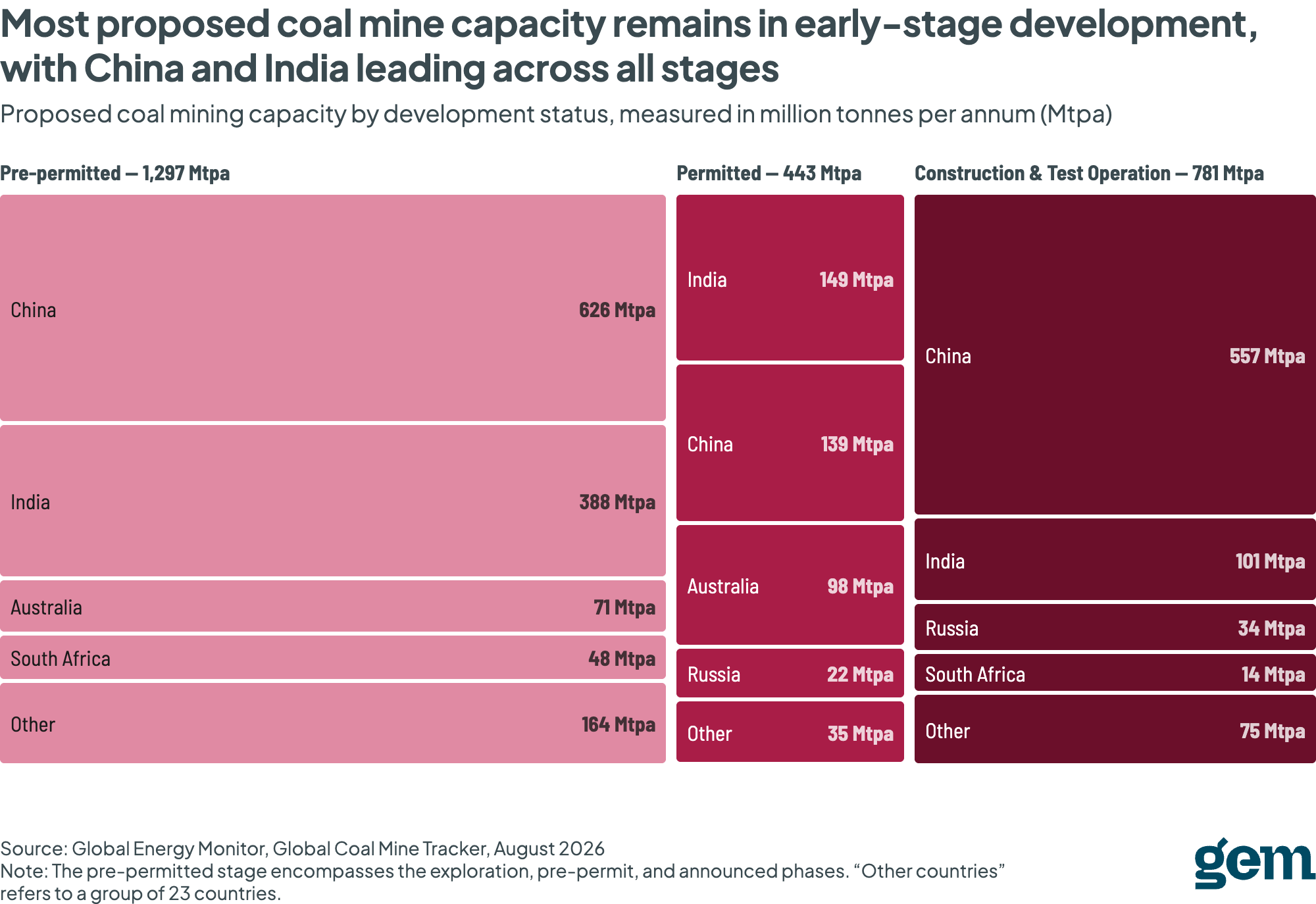
By comparison, roughly one-third (781 Mtpa) has already entered construction or trial operation, and of this capacity, 71% (557 Mtpa) is concentrated in China, and 13% (101 Mtpa) is located in India. While projects at these later stages are more likely to break ground, whether they do so in the near term also depends on various factors, such as the type and scale of the proposed projects. Underground mines typically take several years, in some cases up to a decade, to develop, whereas surface mines can often be built and brought into operation considerably faster.
This distinction matters for how quickly each country's pipeline is likely to materialize. Of China's 557 Mtpa of late-stage capacity, roughly 81% (450 Mtpa) consists of underground mines, which generally have longer construction timelines. For example, Baiyanghe Coal Mine (1.2 Mtpa) began construction in 2020 but remained under construction as of GEM's latest data release in 2026. By contrast, India's late-stage pipeline is much smaller, but around 90% of its 101 Mtpa consists of surface mines. As a result, while China has a substantially larger volume of late-stage capacity, its pipeline is weighted toward projects with longer construction periods, whereas India's smaller pipeline is dominated by surface mines that can typically be brought into operation more quickly.
Although projects that have entered construction are generally more difficult to halt, the majority of proposed coal mining capacity has not yet reached that stage. Many projects still require permits, financing, and final investment decisions before construction can begin, leaving a significant opportunity for governments, investors, and financial institutions to prevent additional capacity from advancing.
With global coal demand expected to plateau and renewable energy continuing to erode coal's share of electricity generation, advancing additional coal mining capacity risks creating long-lived assets that may become increasingly uneconomic over time. This could expose governments, companies, and investors to stranded assets, weaker project economics, and heightened market volatility resulting from excess production capacity. Decisions made while projects remain in the pre-construction phase will therefore play an important role in determining whether the coal mining sector continues to expand despite weakening demand.
“Greenfield” projects dominate over “brownfield”
Greenfield projects involve developing new mining sites and typically require higher upfront capital, whereas brownfield projects leverage existing infrastructure and geological information to expand or extend active operations. GEM data show that new (“greenfield”) coal mines accounted for roughly three-quarters of the total proposed capacity worldwide, with a remaining 20% from expansion projects, 5% from coal resource consolidation and restructuring,² and 2% from extension projects. The dominance of greenfield projects highlights that many countries are planning to expand coal production through entirely new mines despite signs of slowing global coal demand.
Among the top six countries with the most proposed capacity, new greenfield mines accounted for more than three-quarters of the total proposed capacity in Canada (87%), China (82%), India (80%), and South Africa (76%). In contrast, the majority (70%) of Russia’s proposed coal mines were expansion projects, likely reflecting the lower cost of expanding existing operations relative to developing new mines amid the country's prolonged economic challenges following its invasion of Ukraine.
Nearly half of Australia's proposed capacity consisted of mine expansions and extensions. Australia also held the largest extension capacity (25 Mtpa) of all six countries, which accounts for more than half of the total extension capacity globally. This emphasis on expanding existing operations is likely to continue following New South Wales' recent ban on standalone greenfield coal mines, which limits future development largely to mine expansions and extensions.
Coal mine integration and restructuring projects account for approximately 130 Mtpa of proposed capacity, all of which is located in China. Guizhou accounts for roughly 40% of this pipeline, followed by Shanxi (30%) and Shaanxi (24%). Many of these projects trace their origins to Shanxi's 2009 mine consolidation reforms, which closed or merged thousands of small mines into larger, state-controlled operations to improve efficiency, safety, and environmental performance. As China has continued modernizing its coal sector over the past decade, however, many of the restructuring projects that remain in the proposal pipeline are becoming increasingly unlikely to move forward.
Thermal coal remains king
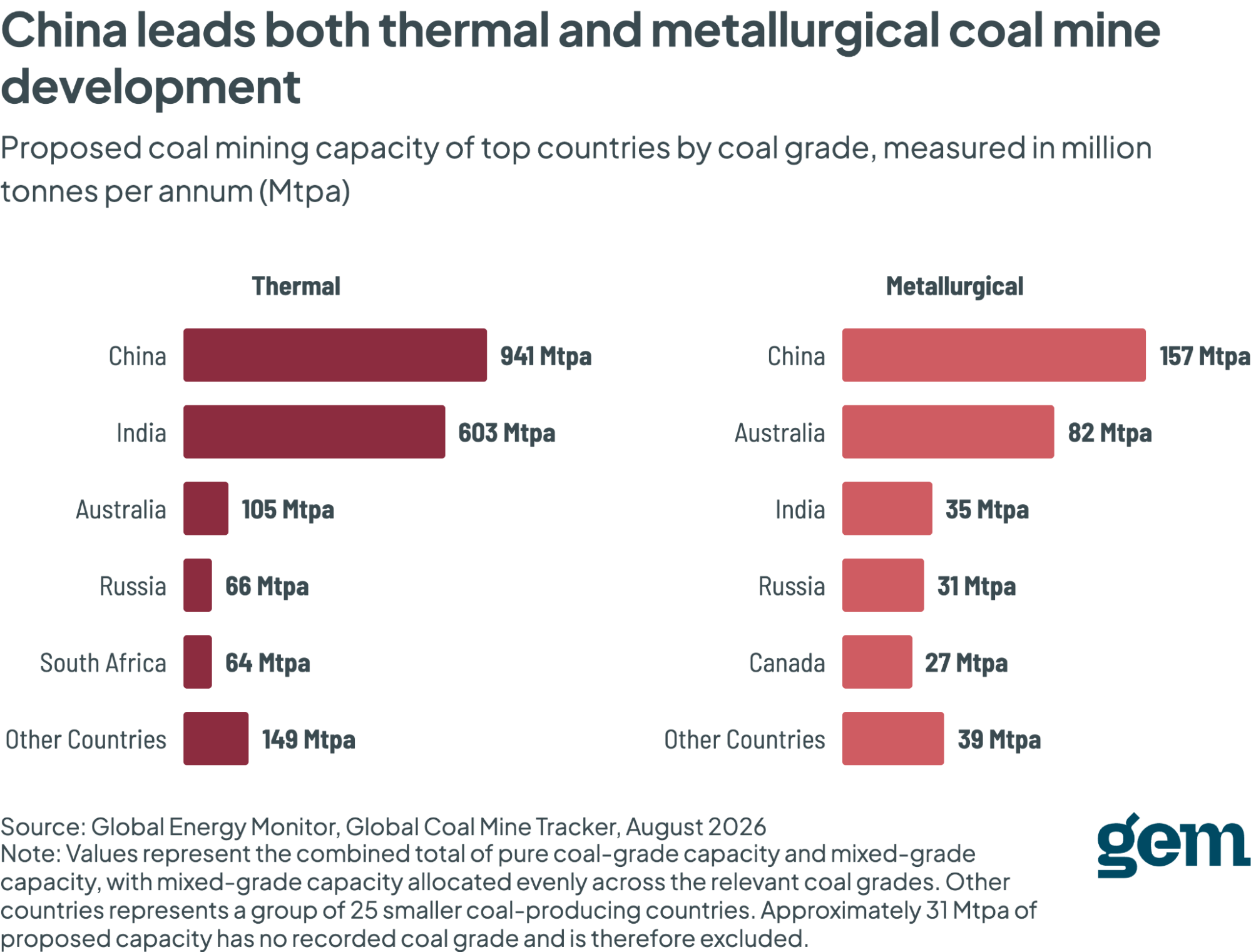
When split out according to coal grade, proposals that produce thermal coal for power generation still dominate global expansion plans, with at least 1,927 Mtpa in the pipeline — including thermal coal projects and an even split of mixed-grade projects — representing about 76% of the global pipeline. The continued dominance of thermal coal proposals stands in contrast to the recent 2025 slowdown in coal-fired electricity generation.
The remaining proposals are for industrial uses of coal. Proposals that produce metallurgical coal, consumed mainly by the steelmaking industry, total 370 Mtpa, including dedicated metallurgical coal projects and an even allocation of capacity from mixed-grade projects. Together, they represent about 15% of the global proposed pipeline. Approximately 194 Mtpa of proposed capacity has been identified as primarily destined for the coal-to-chemicals industry, including dedicated chemical coal projects and an even allocation of capacity from mixed-grade projects. This represents less than 8% of the total global proposed pipeline.³
Thermal coal proposals were overwhelmingly concentrated in Asia, led by China and India. Assuming a 50-50 allocation for mixed-grade projects, China accounted for roughly 941 Mtpa of proposed thermal coal capacity — about half of the global thermal pipeline and more than two-thirds of its own proposed coal mine capacity.
India's coal project pipeline is almost entirely thermal, with about 603 Mtpa of thermal coal capacity, accounting for nearly a third of the world’s total thermal pipeline, and 94% of its domestic proposed capacity.
Australia ranked a distant third with approximately 105 Mtpa of proposed thermal coal capacity, accounting for about 5% of the global thermal pipeline and just over half of its domestic proposed capacity. Altogether, these top three countries account for about 86% of the world's total thermal pipeline.
China, Australia, and India also led the global metallurgical coal pipeline. China accounted for approximately 157 Mtpa (42% of the global total), followed by Australia with 82 Mtpa (22%) and India with 39 Mtpa (10%). Despite China leading globally for planned metallurgical coal, metallurgical coal represented just 12% of its domestic proposed capacity, compared with 44% in Australia and 6% in India.
Chemical coal, which is used primarily in the coal-to-chemicals sector, is currently tracked by GEM only for Chinese coal mines.⁴ Although the market scale of the coal-to-chemicals industry remains small compared to the power, steel, and cement sectors, the volume of coal used as feedstock in the industry nationwide has increased by 87.1% over the past decade and continues to grow steadily, making it the only industrial sector in China where coal consumption is rising rather than declining.
Mothballed capacity: U.S. leads inactive coal mine capacity
In 2025, GEM identified 1,863 Mtpa of operating mine capacity as inactive or “mothballed,” with nearly three-quarters concentrated in just one country: the United States.⁵ The U.S. accounts for 1,399 Mtpa of mothballed capacity across about 168 coal mines, nearly three times its reported 2025 production of 484 million tonnes (533 million short tons). The country has, in effect, idled far more coal capacity than it still runs, a reflection of the long structural decline of American coal as gas and renewables displace it from the power sector. Most of these mothballed mines are concentrated in Appalachia, where West Virginia, Pennsylvania, Kentucky, and Virginia together hold about 87% (roughly 1,210 Mtpa) of the mothballed capacity.
China ranked second to the U.S., with 184 Mtpa of mothballed capacity across about 190 coal mines. Over 90% of this mothballed capacity is concentrated in just three provinces and regions: Inner Mongolia (92 Mtpa), Shanxi (55 Mtpa), and Guizhou (21 Mtpa). Production suspensions in China occur for a variety of reasons, including mining safety accidents, prolonged inactivity, and licensing or permitting issues. The Liushenyu coal mine, for instance, had its production suspended following a serious gas explosion in May 2026 that resulted in 82 deaths and more than 120 injuries. Two other common causes are mines sitting idle for six months or longer, and incomplete licences or permits, either of which would force a mine to suspend operations.
South Africa ranked third, with about 68 Mtpa of capacity marked as mothballed. Many of these mines have been inactive for several years due to issues such as reserve depletion, financial underperformance, temporary suspension ahead of permanent closure, and license renewals or regulatory issues. At the same time, coal’s role in South Africa’s power sector has gradually declined as renewable energy has expanded as a share of the electricity mix. Coal accounted for about 90% of the country's electricity generation in 2016, falling to approximately 81% in 2025, which may contribute to the accumulation of mothballed capacity.
Mine retirements: One-eighth of operating capacity is scheduled to close by 2035
Over the next decade (2026–2035), approximately 1,145 Mtpa of currently operating coal mine capacity is scheduled to close or retire, based on reported mine closure years. This represents about 12% of currently active coal production capacity and is equivalent to about 45% of proposed capacity in the global project pipeline.
The pace of scheduled retirements is modest and heavily front-loaded. About 743 Mtpa, or roughly two-thirds of total scheduled retirements, is expected to close by 2030, with the steepest increases around 2028 and 2030. After that, the cumulative curve generally flattens.
Indonesia alone accounts for 760 Mtpa, or about two-thirds of all scheduled global retirements, followed distantly by Australia at 216 Mtpa. However, Indonesia's figure should be interpreted with caution. Given the country’s position as one of the world’s top coal producers and a fast-growing exporter with substantial operating capacity, these reported closure years are more likely to represent mines reaching their stated end-of-life or license expiry dates than a firm indication of a nationwide coal phaseout.
In contrast, the European countries on the list — including Germany, the Czech Republic, Romania, and Greece — are more likely to reflect genuine policy-driven coal phaseouts. Norway, for instance, completed its coal phaseout when the final Norwegian-operated coal mine, Store Norske’s Mine 7 on the Svalbard archipelago, permanently shut down in July 2025, officially ending Norway's century-long coal mining tradition.
Meanwhile, the world's two largest coal-producing countries, China and India, report very limited data on their operating capacity scheduled to retire before 2035, underscoring the limited pace of planned mine closures in the countries that dominate global coal production.
China: Coal-to-chemicals risks slowing the decline in coal demand
In 2025, China’s coal consumption increased by just 0.1% year-over-year, suggesting almost no growth overall. But, by sector, the structure of coal consumption is changing. Coal use in traditionally major coal-consuming sectors such as power, metallurgy, and building materials declined, while coal use in the chemical sector continued to grow. According to industry data, China’s chemical sector consumed 430 million tons of coal in 2025, representing a 10.2% year-over-year increase. This growth complicates China’s efforts to reduce overall coal consumption.
According to GEM data, about 15% of China’s proposed coal mine capacity consists of mines that are linked to, or serve as dedicated suppliers for, coal-to-chemicals projects, assuming that mines classified as both “thermal and chemical coal” are split evenly between the two end uses. If all of these associated coal mine projects are built and commissioned, they will correspond to about 194 Mtpa of potential coal supply, equal to about 45% of China’s 2025 chemical sector coal consumption. This indicates the scale of potential additional coal supply that could support further coal-to-chemicals expansion. These projects are mainly concentrated in coal-rich northern and northwestern regions, with Xinjiang having the largest share (47%). Xinjiang has abundant coal resources, but it is far from eastern consumption markets and faces high transport costs. For local governments and companies, converting coal locally through coal-to-chemicals is more attractive than transporting coal over long distances.
In recent years, Chinese policies have provided growing support for the development of coal-to-chemicals. A 2022 policy excluded eligible feedstock energy use from total energy consumption controls, easing constraints on coal-to-chemicals projects. Subsequent policies in 2024 and the 15th Five-Year Plan released in June 2026 called for the orderly development of coal feedstock utilization, stronger coal-to-liquids and coal-to-gas capacity and technology reserves, and the development of coal-based fuels, specialty materials, and new materials. Together, these policies support a shift in coal use from direct fuel use toward chemical feedstocks, substitute fuels, and coal-based materials.
These projects are often justified within an energy security framework, on the grounds that coal-based fuels, chemical feedstocks, and materials can substitute for some imported oil, natural gas, and petrochemical products. But from the perspective of controlling coal consumption, this rationale also creates a pathway for continued coal expansion by shifting demand from power generation to chemical feedstocks and coal-based materials. The energy security narrative could therefore justify new coal-intensive projects, allowing coal to expand again in the form of chemical feedstocks and coal-based materials after declining in the power sector. Coal-to-chemicals could therefore act as a buffer against declining coal demand, creating a new source of consumption growth.
This brings multiple risks. First, coal-to-chemicals expansion could offset reductions in coal use in sectors such as power, metallurgy, and building materials, delaying the decline in coal consumption after the expected peak during the 2026–2030 period. Second, coal-to-chemicals projects are capital intensive and have long operating lifetimes. Once built, they will lock in stable coal consumption and carbon emissions for many years, making it harder for China to achieve its carbon peaking and carbon neutrality goals. Third, the economics of coal-to-chemicals depend heavily on oil and gas prices, coal prices, and product cycles. During periods of low oil prices, its competitiveness may weaken significantly, creating a new transition burden. Fourth, many projects are concentrated in coal-rich, but water-stressed regions, such as Xinjiang, Inner Mongolia, and northern Shaanxi, and project expansion could further increase local water resource pressures.
If China wants to truly reduce coal consumption, it will need to restrict the expansion of coal-to-chemicals projects, especially new coal-to-liquids and coal-to-gas projects that are highly coal intensive and emissions intensive. Otherwise, the positive progress made by declining coal consumption in the power sector could be partially offset by new demand from industrial feedstock, substitute fuel, and materials uses, slowing the decline of China’s coal consumption.
India accelerates coal gasification to strengthen energy security
Like China, India is increasingly promoting coal as an industrial feedstock rather than solely as a power fuel. Drawing on its vast coal reserves, the government is laying out plans for expanded coal gasification to reduce dependence on imports such as LNG, urea, ammonia, and methanol. In 2021, it launched the National Coal Gasification Mission, setting an ambitious target to gasify 100 million tonnes of coal per annum by 2030.
The initiative has gained additional momentum amid heightened geopolitical uncertainty. Disruptions to energy shipments through the Strait of Hormuz during the 2026 Iran conflict have highlighted India's vulnerability to volatile fossil fuel prices from imported LNG, LPG, and fertilizer feedstocks. In response, in May 2026, the Indian government approved a US$3.9 billion (₹37,500 crore) scheme to incentivize new surface coal and lignite gasification projects for syngas production, targeting the gasification of about 75 Mt of coal and lignite.
Despite strong policy support, significant technological, financial, and infrastructure challenges remain. Indian coal typically has a high ash content, making it more challenging and costly to gasify than lower-ash coal. Although an indigenous technology successfully produced high-purity methanol from high-ash Indian coal at a coal-to-methanol pilot plant in 2022, scaling the process up to commercial volumes remains difficult. Large-scale coal gasification projects also require substantial capital investment and typically take five to eight years to build.
As a result, while government support is accelerating investment, achieving the 2030 gasification target will remain challenging. Even so, continued policy support demonstrates how concerns framed around energy security are creating new proposed avenues for coal demand, such as global coal-to-chemicals development that could drive higher coal consumption in this sector.
Cleaning up before building out: Methane mitigation could address energy security concerns without expanding coal capacity
As governments pursue new coal mine development in the name of energy security, an overlooked alternative lies in recovering methane from existing and abandoned coal mines. According to the IEA, 4,481 kilotonnes (kt) of methane can be recovered and utilized from coal mines annually at negative net cost. The U.S. Environmental Protection Agency estimates this is equivalent to nearly 6.6 billion cubic meters of gas — approximately 6% of the gas supply disrupted by the Strait of Hormuz, highlighting the value of methane recovery as an additional domestic gas resource.
Despite its importance, coal mine methane remains poorly monitored worldwide. Major gaps exist in the types of mines that are monitored, the countries that require reporting, the level of detail disclosed, and international monitoring efforts.
First, no countries or regions worldwide require direct monitoring of methane emissions from surface mines. Though long assumed to be low-emitting by international agencies compared to underground operations, new evidence from satellites and plane flights has shown that individual surface mines can be “super emitters” depending on geologic conditions. In Australia’s Bowen Basin, for example, just one operation — the Hail Creek surface mine — emitted approximately 122 kt of methane, equal to 14% of Australia’s total coal mine methane emissions reported to the United Nations (845 kt).
Second, public reporting of underground coal mine emissions remains limited and uneven. Of the major countries in terms of global coal production, only Australia, the United States, and Poland mandate regular monitoring of underground coal mines at the individual mine scale, as well as disclosure to the public. The United States also recently delayed its reporting requirements, and so data are only currently available for underground mines up to 2023.⁶ (If the current U.S. proposal to permanently remove Greenhouse Gas Reporting Program obligations after reporting year 2024 is finalized, this exit would leave mandates by only Australia and Poland.) Only 236 out of the world’s 2,448 underground coal mines are located in these three countries which mandate monitoring and disclosure.
Third, methane monitoring and public disclosure are often inconsistent, making independent verification difficult. For example, while China does require some annual monitoring of underground coal vent shafts and drainage stations, provincial governments vary in terms of how much information they disclose publicly. While some provinces include categories of mine “gassiness” and emissions factors per tonne of coal, none disclose mine-scale annual emissions estimates, or the mine-scale production data which would make calculating these figures possible. As such, it is difficult to independently verify whether mine operators are taking appropriate measures to manage methane emissions.
Finally, while the International Methane Emissions Observatory has enhanced its efforts to use satellites to monitor emissions from metallurgical coal mines, thermal coal mines (which represent the majority of proposed capacity expansions) have no analogous international effort in place.
Beyond monitoring challenges, requirements surrounding coal mine methane mitigation remain patchwork. In India, where proposed capacity expansions grew fastest in 2025, operators are allowed to vent methane drained during mine construction directly into the atmosphere unabated. In contrast, both China and Australia’s New South Wales have recently implemented legislation requiring and/or incentivizing utilization of coal mine methane.⁷ While European Union countries are not among the top pursuing capacity expansions, the EU's landmark 2024 methane regulations establishes dedicated requirements for coal mine methane: It requires mine-scale monitoring, reporting, and verification of emissions, bans venting and flaring from EU abandoned and closed mines, encourages utilization by prohibiting venting at drainage stations, and establishes methane intensity standards for emissions from ventilation stations at thermal coal mines. However, metallurgic coal mines, which remain among the highest emitting, do not yet have intensity standards in the EU.
Taken together, these gaps leave much of the coal sector’s methane emissions poorly quantified and weakly regulated. As governments seek to strengthen energy security, improving coal mine methane management offers an opportunity to increase available energy supplies from existing operations rather than expanding coal production.
Media contact
For questions about the report, contact Dorothy Mei.