

Open data is no longer just a tool for understanding the energy transition. It is becoming essential infrastructure for delivering it.
This was my biggest takeaway from spending the past week at COP31 in Antalya, Türkiye.
For the first time since 2009, COP31 closed without an overarching agreement, with disagreements over fossil fuel language and climate finance for developing countries still unresolved. It’s hard not to be disappointed by the lack of meaningful progress. Nearly 11 years after the landmark Paris Agreement and three years after the historic commitment in Dubai to transition away from fossil fuels, the international community continues to struggle to translate collective ambition into concrete action.
Meanwhile, the International Energy Agency's newly released World Energy Outlook 2026, while recognizing the significant growth of renewables, raises questions about whether conventional energy modelling is failing to capture the full pace and scale of the solar revolution, particularly the rapid deployment of distributed solar across emerging economies.
As I shared during my keynote at the Asia Climate Solutions Pavilion at COP31, Global Energy Monitor's (GEM) is tracking more than 29,000 utility-scale solar, wind, and hydropower projects in development globally. Our data tell a different story about the remarkable progress of the transition already underway — specifically:
- Proposed clean energy projects in the pipeline represent over 80% of the additional capacity needed to achieve the global renewables tripling target by 2030.
- Global utility-scale solar capacity has reached nearly 1.3 TW, with a record 221 GW coming online in 2025 alone.
- Distributed solar accounts for more than half of operating solar capacity in 17 of the 31 countries GEM tracks.
The challenge is increasingly not one of ambition or technological feasibility, but of implementation — overcoming the policy, financing, grid, and institutional barriers that stand between projects being announced, and those same projects becoming operational.
Navigating the messy middle
Despite the shortcomings of the climate negotiations, I came away from COP31 cautiously optimistic.
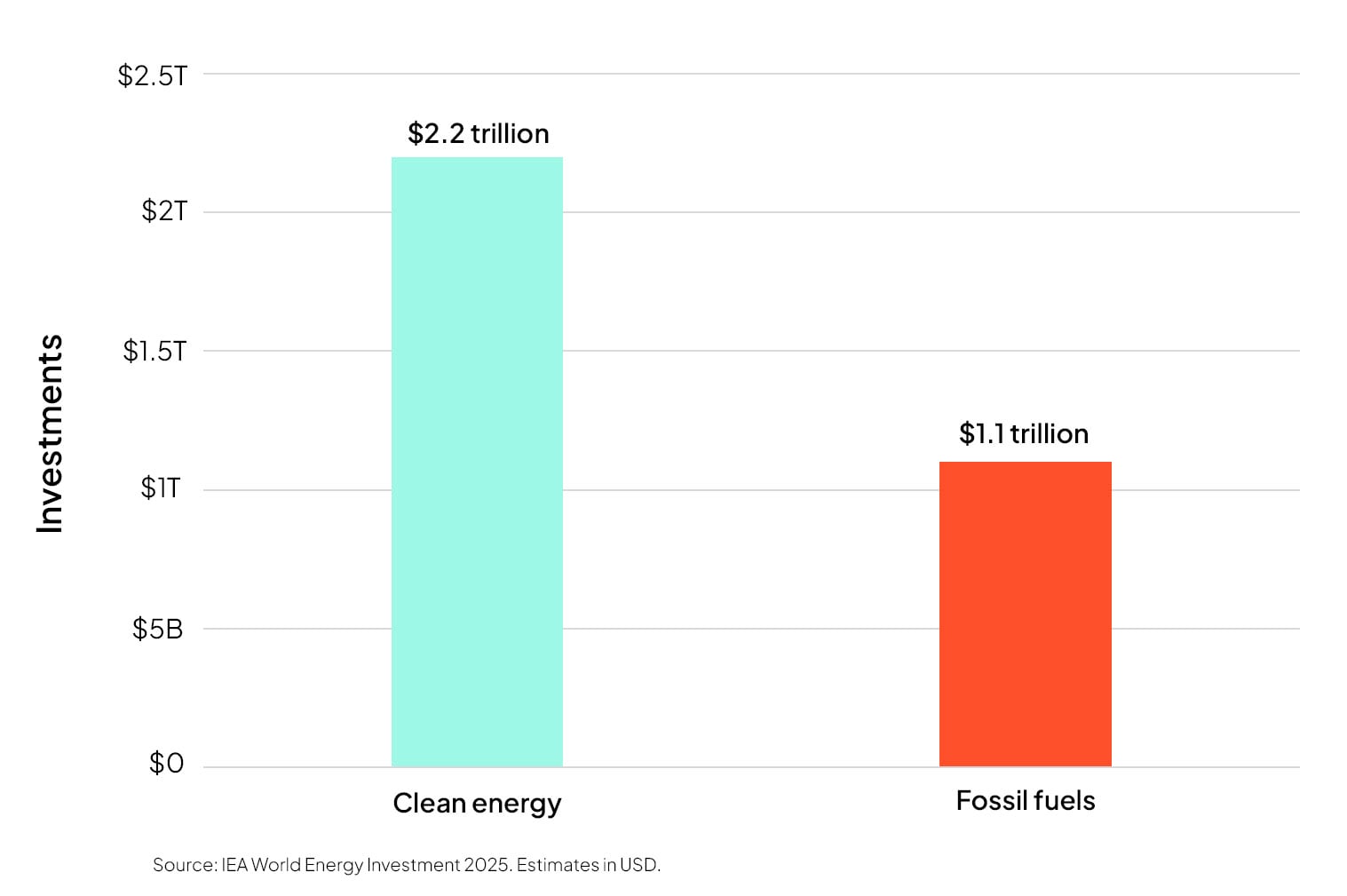
We are in what I often refer to as the messy middle of the energy transition. In 2025, global clean energy investment reached $2.2 trillion, twice the amount invested in fossil fuels, as detailed in Figure A below. The IEA predicts a similar trend in 2026. Yet significant investment in fossil fuel infrastructure continues, and the transition remains uneven across countries and sectors.
Figure A: World energy investments, 2025
Against this backdrop, the Strait of Hormuz crisis may ultimately prove to be one of the most meaningful geopolitical turning points in the global response to climate change.
While the immediate economic and human consequences are deeply concerning, the crisis has exposed the structural vulnerabilities associated with dependence on imported fossil fuels. It is forcing governments to fundamentally reassess how they meet their energy needs.
What struck me most at COP31 was the extent to which the energy transition dialogue is shifting toward energy security, affordability, and economic competitiveness.
Increasingly, the case for clean energy is being made not solely on environmental grounds, but on its ability to reduce exposure to volatile international commodity markets, strengthen national energy security, and provide affordable energy to households and businesses.
Pakistan's extraordinary bottom-up solar revolution is a compelling example. Households and businesses are adopting solar not primarily because of international climate commitments, but because of economics and the need for reliable, affordable electricity.
When climate objectives align with national economic interests and the everyday needs of citizens, the drivers of the energy transition become considerably more powerful.
The growing importance of open data
Three interconnected trends stood out to me at COP31:
1. From targets and pledges toward implementation, verification, and accountability. The global climate community is increasingly focused on what countries and companies are actually delivering. Independent, evidence-based assessments are essential to understanding whether commitments are translating into real-world outcomes.
2. Growing demand for granular, interoperable, asset-level data. As the international community prepares for the second Global Stocktake, there is increasing recognition of the need to connect national commitments with what is happening on the ground. Specifically, what energy infrastructure is being built, operated, financed, and retired.
This same data is critical to developing credible and independently verifiable national energy plans that meet countries' economic, energy security, affordability, and climate objectives.
3. Information and data integrity are becoming major governance priorities, particularly with the rise of AI. AI presents an extraordinary opportunity to democratize access to energy intelligence. But its effectiveness and credibility will ultimately depend on the quality and integrity of the underlying data.
In an increasingly fragmented information ecosystem, independent, openly accessible data grounded in transparent methodologies and verifiable sources has never been more important.
Holding the center on facts
At GEM, we see both an opportunity and a responsibility to help build the global energy data infrastructure required for this next phase of the transition.
Over the past year, more than 15,000 distinct organizations across 197 countries downloaded GEM's data. From governments and financial institutions to researchers, civil society, the media, and increasingly AI platforms, decision-makers across the world are relying on independent energy data to navigate a rapidly changing landscape.
Regardless of where one sits on the political spectrum, there is a shared interest in building energy systems that are secure, affordable, reliable, and sustainable. Achieving this requires a shared understanding of the facts.
The energy transition will not be determined by the climate negotiations alone. It will be shaped by millions of decisions made by governments, businesses, investors, communities, and households around the world. Ensuring that those decisions are grounded in credible, transparent, and accessible information is one of the most consequential contributions we can make.

Open data is no longer just a tool for understanding the energy transition. It is essential infrastructure for delivering it.

Executive Director
Header photo: Final moments of COP31 (Photo: © UN Climate Change - Kiara Worth) (CC BY-NC-SA 4.0)