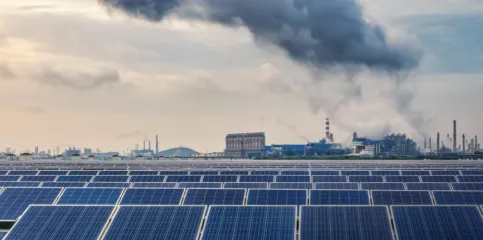
China’s coal power generation rebounded by 3.4% year-on-year in H1 2026, even as coal power plants were used less intensively and wind and solar curtailment rose by nearly 50%. The rapid expansion of coal power capacity has deepened oversupply in the power system, reflected in both falling coal power plant utilisation and growing volumes of wasted clean electricity. Curtailed wind and solar alone exceeded the entire increase in power demand during the period.
Published today, the Centre for Research on Energy and Clean Air (CREA) and Global Energy Monitor (GEM)’s H1 2026 China coal power review finds that new coal power plants entering operation reached the highest first-half year level in a decade as China added 10 times more capacity than it retired. The nation commissioned 30 GW of new coal power in H1 2026, up 43% from last year, while retiring only 2.7 GW. Another 25.4 GW started construction. China has a total of 274 GW in the pipeline, equivalent to 22% of its existing operating coal fleet.
Estimated wind and solar curtailment, including both reported and unreported curtailment, reached 360 TWh in H1 2026, up 49% year-on-year. Had this electricity been absorbed, the additional power supply could have met all demand growth and allowed coal power generation to fall. This shows that clean energy is able to meet China’s electricity demand growth without relying on increases in coal-fired power, once barriers are removed.
The rebound was not evidence of a broad return to coal following LNG (liquefied natural gas) shipping disruptions in the Strait of Hormuz—China’s combined domestic coal production and imports fell by 1.4% year-on-year in H1 2026, rather than expanding in response to the external energy shock. Growth in clean energy supply and electrification helped offset the fall in oil supply and limit increases in fossil fuel consumption.
The central government’s April 2026 policy called for stricter control of both coal power capacity and generation, but continued capacity growth highlights the long legacy of the 2022-2023 approval boom. Developers proposed 70 GW of new coal power projects and revived another 20 GW in H1 2026, a 25% year-on-year increase, indicating stronger investment appetite. At the same time, only 8.6 GW received permits, a sharp decline from recent years, suggesting tighter scrutiny of new projects.
Long-term contracts continue to reserve a substantial share of limited electricity demand for coal power, limiting space for clean power. Although minimum contract requirements have been reduced from the levels applied in 2023-2025, coal generators in 2026 are still expected to sign annual contracts covering 60 to 70% of the previous year’s delivered electricity. With limited growth and clean energy expected to meet all the incremental electricity demand in the next five years, these mandatory coal contract volumes risk turning a risk-management instrument into a barrier to renewable integration.
‘China’s coal buildout is a warning about overcapacity, not a blueprint for energy security. Coal capacity is still growing because of legacy approvals and policy protections, even as plants run fewer hours and large volumes of clean electricity go unused. The answer is to reward genuine reliability, not to protect coal in both the capacity and energy markets, which pushes out the clean power generation that is the only viable path to genuine energy sovereignty,’ said Qi Qin, China analyst at CREA.
‘China's power sector is receiving mixed signals. Policymakers are calling for tighter control of coal, yet record numbers of new coal plants continue to enter operation, supported by market mechanisms that guarantee coal both capacity payments and significant electricity sales. Until these incentives are aligned, coal's transition from baseload generation to a flexible backup role will remain challenging,’ said Christine Shearer, research analyst at Global Energy Monitor.
Policy recommendations include:
- Set explicit peak years for power-sector emissions and coal consumption.
- End net growth in coal power capacity during the 15th Five-Year Plan period.
- Phase out coal power-specific minimum requirements for medium- and long-term contracts.
- Separate payments for reliability from protection of coal energy sales and make capacity payments technology-neutral instead of favouring coal.
- End “retire-and-rebuild” coal power schemes.
Contacts
Qi Qin, China Analyst, CREA
China team, CREA
[email protected]
Christine Shearer, Research Analyst, GEM
[email protected]
About CREA
The Centre for Research on Energy and Clean Air (CREA) is an independent research organisation focused on revealing the trends, causes, and health impacts, as well as the solutions to air pollution. We use scientific data, research and evidence to support the efforts of governments, companies and campaigning organisations worldwide in their efforts to move towards clean energy and clean air.
About GEM
Global Energy Monitor (GEM) develops and shares information on energy projects in support of the worldwide movement for clean energy. By studying the evolving international energy landscape, and creating databases, reports, and interactive tools that enhance understanding, GEM seeks to build an open guide to the world’s energy system.